












Battery chargers vary a great deal in intelligence, the types of batteries they can charge, how they maintain batteries, and how long they take to charge. We recommend charging batteries at about 10% of their amp hour capacity. For example, an 80Ah deep cycle battery should charge at a rate of about 8A.
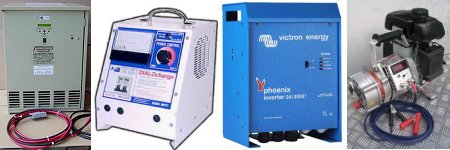
Battery chargers – all shapes and sizes
Different types of batteries require different charging regimes. SLA (sealed lead acid), AGM (absorbent glass matt) and gel batteries traditionally charge at a lower voltage than flooded lead acid batteries. This varies depending on the manufacturer and you should always check what charging voltage is required before you buy deep cycle batteries and a battery charger.
Types of battery chargers
A simple charger works by providing a constant DC power to the battery. A simple charger will not alter its output based on time or the charge on the battery. These type of battery chargers are usually cheap, but there is a trade-off in quality. Typically, a simple charger takes a lot longer to charge a battery, and a battery left in a simple charger for too long will suffer damage from over-charging.
Timer based chargers operate much like a simple charger, but (as the name would suggest) they operate on a timer. The timing regime has a configuration for a particular battery.
However, if batteries of lower capacity charge they would be then risk overcharging. Furthermore, if batteries of higher capacity charge they would be only partly charge. Timer based chargers also have the following drawback: charging batteries that didn’t fully discharge, even if those batteries were the correct capacity for the particular timed charger, would result in over-charging.
Battery charger output
Battery charger output current depends upon the battery’s state. An intelligent charger may monitor the battery’s voltage, temperature and/or time under charge to determine the optimum charge current at that instant. Charging terminates when a combination of the voltage, temperature and/or time indicates that the battery has a full charge. In a sense, the batteries tell the charger when they are full.
Some chargers use Pulse technology or pulse width modulation in which a pulse is fed to the battery. This DC pulse has a strictly controlled rise time, shape, pulse width, frequency and amplitude. This technology works with any size, voltage, capacity or chemistry of batteries, including automotive and valve-regulated batteries. Most good quality battery chargers and charge controllers.