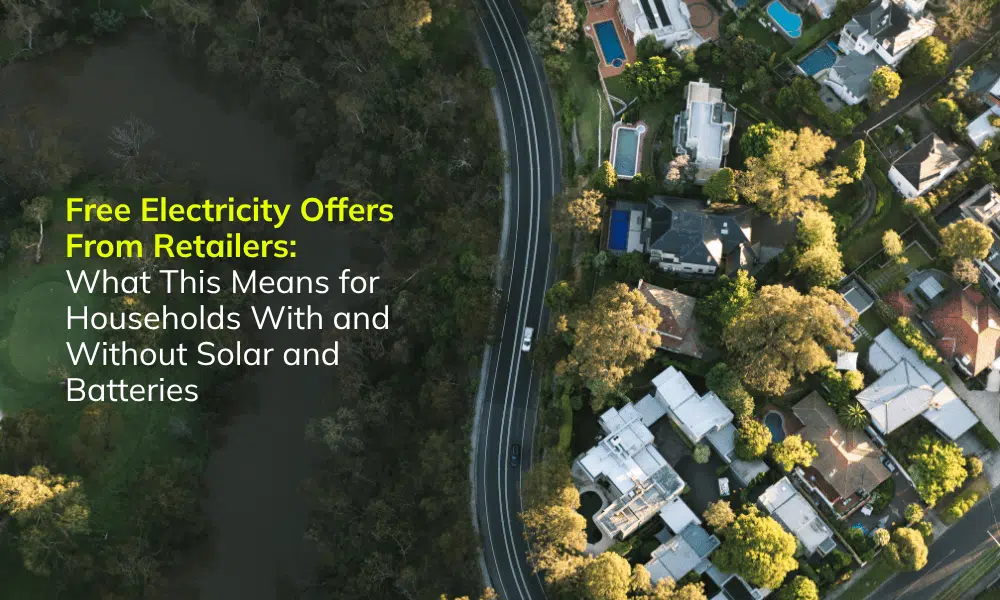






Over 40% of all Australian residential roofs feature solar. You’d be hard-pressed to find a street that didn’t have at least one house with the technology. My street reflects the average Victorian uptake of 30%, and the neighbours who don’t have solar want no bar of it. What began as a simple “I’ll get around to it one day” has now been solidified as “it’s a waste of money”. With the federal government legislating 3 hours of free electricity from 1 July in SA, NSW, and SE QLD, and from October 2026 in VIC under state legislation, it’s little wonder why solar is beginning to lose its lustre.
In this article, we’ll unpack:
- the 3 hours of free solar,
- whether solar is still worth it,
- and what this could mean for your household.
Why is part of Australia set to receive free electricity?
Australians love solar, and the steady uptake has seen the benefits flipped on its head. According to the Clean Energy Regulator’s May report1, Queensland is leading the charge in installation volume. The data below shows small-scale installations since 2001.
| State | Total Installed* |
| SA | 454,932 |
| QLD | 1,185,863 |
| WA | 569,043 |
| ACT | 66,662 |
| NSW | 1,157,194 |
| VIC | 877,676 |
| NT | 25,492 |
| TAS | 65,808 |
| Total | 4,402,670 |
The sheer volume of electricity generated by solar that enters the grid each and every day has not only drastically reduced Australia’s reliance on fossil fuels but also resulted in unexpected consequences.
The trouble with too much solar
When rooftop solar generates more electricity than homes and businesses are using, the excess power is exported to the grid. If too much electricity is exported at once, voltage can rise, and wholesale electricity prices can fall to zero or even become negative. Grid operators must then take action to maintain stability, such as charging batteries, reducing output from large-scale generators, or curtailing solar generation.
This is primarily why feed-in tariffs have reduced to near zero across Australia. The grid simply does not need the electricity during the day when most people are not home to use it.
South Australia, New South Wales, South East Queensland, and Victoria all have high levels of rooftop solar and are part of the National Electricity Market (NEM). The three hours of free electricity that will soon be available in these regions reflect the growing challenge of managing excess daytime solar generation, which can drive wholesale electricity prices to very low or even negative levels. By encouraging customers to use more electricity during these periods, retailers can help absorb surplus renewable energy and reduce the need for solar curtailment. Western Australia and the Northern Territory operate separate electricity networks and markets, so they do not experience the same conditions that make these offers possible.
What free electricity means for solar
The introduction of three-hour free electricity windows does not mean rooftop solar is no longer worthwhile. In fact, households that can shift their energy use to the middle of the day may be able to extract even more value from their solar system. While free electricity periods are designed to encourage consumers to use excess renewable energy that would otherwise be curtailed, solar owners already benefit from generating their own electricity during these same hours. As rooftop solar continues to drive down daytime wholesale electricity prices across the National Electricity Market, the ability to self-consume solar energy remains one of the most effective ways to reduce power bills.
New retail plans: the fine print matters
Consumers should also remember that a free electricity window is only one part of an energy plan. Retailers still need to recover their costs, which means higher usage charges, supply charges, or less competitive rates outside the free period may offset some of the advertised savings. For this reason, households should compare the total cost of an energy plan rather than focusing solely on the free electricity offer. Homes with solar, and especially those with battery storage, are likely to remain in a strong position because they can either use their own generation during the day or take advantage of the free period to charge a battery for use during the evening peak.
Batteries are already playing a growing role in shifting excess daytime solar into higher-demand periods, helping households maximise the value of low-cost renewable energy.
Key considerations for households:
- Compare the entire electricity plan, not just the free electricity window.
- Shift energy-intensive activities such as EV charging, pool pumps, dishwashers, and washing machines into the free period where possible.
- Solar owners may already receive more than three hours of effectively free electricity on sunny days through self-consumption.
- A home battery can be charged during the free window or from rooftop solar. This provides lower-cost electricity during the evening peak.
- Households without solar may benefit most from the free electricity offer. This is particularly true if they can move a large portion of their usage into the middle of the day.
- As solar penetration continues to increase, battery storage is expected to become increasingly valuable for both bill savings and grid stability.
Next steps: What should homeowners do when three-hour free electricity plans are available?
The arrival of three-hour free electricity plans is another sign that Australia’s energy market is changing. Rather than asking whether solar is still worth it, homeowners should be asking how they can maximise the value of both their solar system and their electricity plan.
For households without solar, a free electricity window may offer an opportunity to reduce energy costs. The free window will encourage running appliances, charging electric vehicles, and heating water during the middle of the day. However, it is important to look beyond the marketing and compare the total cost of the plan. This includes usage rates outside the free period, daily supply charges, and feed-in tariffs.
What to do if you have solar
For solar owners, the equation is slightly different. A rooftop solar system can already provide many hours of low-cost or effectively free electricity each day, particularly during spring and summer. The introduction of free electricity windows does not diminish the value of solar. Instead, it creates additional opportunities to reduce grid reliance and optimise energy consumption.
Homeowners should consider:
- Comparing the full cost of any free electricity plan before switching.
- Shifting discretionary loads such as EV charging, pool pumps, dishwashers, and washing machines into the free period.
- Increasing daytime self-consumption to maximise the value of solar generation.
- Considering battery storage to capture excess solar energy or charge during the free electricity window.
- Reviewing feed-in tariffs and export limits, which may become increasingly important as solar penetration grows.
For many Australians, the most effective long-term strategy may be a combination of solar, battery storage, and smart energy management. While free electricity offers can help reduce bills, generating and storing your own energy still provides the greatest control over future electricity costs. As retailers adapt to a grid increasingly powered by renewable energy, homeowners who can use, store, and manage their electricity intelligently will be best placed to benefit.
- “Small-scale installation postcode data”, Clean Energy Regulator, 19 May 2026 ↩︎