A heat pump heats water by pulling warmth out of the air, the way a fridge works in reverse. It uses about a quarter to a third of the electricity of an old electric storage tank, and no gas at all. With federal discounts in every state and extra rebates in Victoria, NSW and the ACT, it’s now the most common choice when an old hot water system needs replacing.
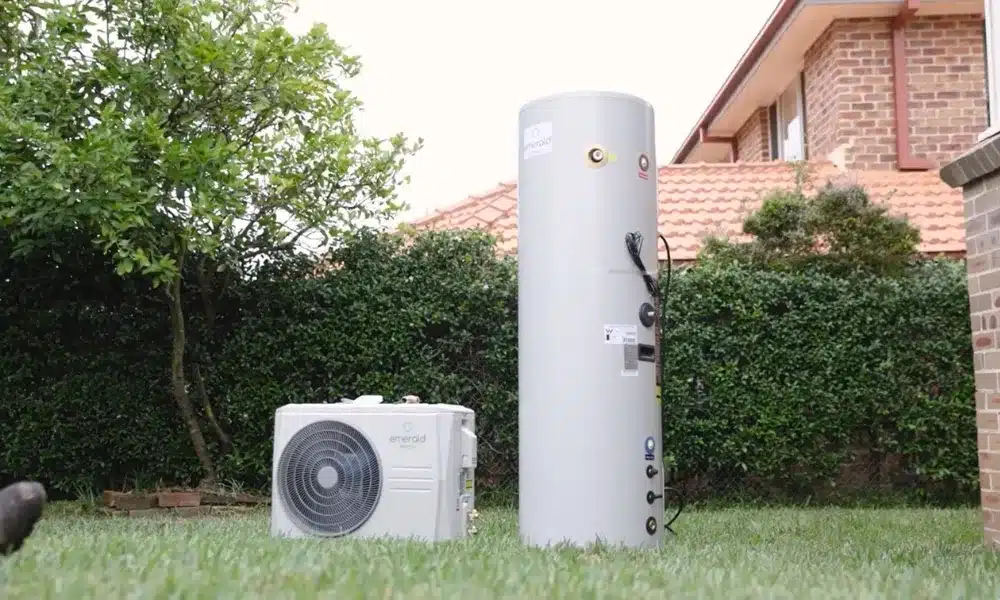
This guide covers what heat pumps cost before and after rebates, how much they save, which rebates apply in your state, and how 20 of the most popular models in Australia compare.
Heat pumps at a glance (2026)
|
What |
Typical figure |
|---|---|
|
Installed price before rebates |
About $2,500 to $8,500, depending on brand and size |
|
Federal discount (STCs) |
About $500 to $800 off at point of sale |
|
Extra state rebates |
Up to $2,030 in Victoria, $640 in NSW; loans in NSW and the ACT |
|
Running cost, 3 to 5 people |
About $230 to $350 a year |
|
Old electric storage tank |
About $900 a year |
|
Gas storage tank |
About $700 a year |
|
Typical lifespan |
12 to 15 years |
How a heat pump hot water system works
A fan draws outside air over a coil filled with refrigerant. The refrigerant absorbs heat from the air, even on cool days, and a compressor squeezes it to raise its temperature further. That heat passes into the water in the tank, the refrigerant cools down, and the cycle repeats.
Because the heat pump moves heat rather than making it, it delivers several units of heat for every unit of electricity it uses. That ratio is called the coefficient of performance (COP). A COP of 4 means 1 kWh of electricity puts about 4 kWh of heat into your water. An electric element has a COP of 1.
Integrated or split?
|
|
Integrated (all-in-one) |
Split system |
|---|---|---|
|
Layout |
Heat pump sits on top of the tank |
Heat pump unit outside, tank separate (often indoors) |
|
Install |
Simpler and cheaper, usually a straight swap for an old tank |
More plumbing, so it costs more to install |
|
Noise |
Usually 43 to 52 dB at 1 m |
Often quieter, from about 37 dB |
|
Best for |
Most replacements with outdoor space |
Tight spaces, noise-sensitive spots, cold climates |
Refrigerant types
- CO2 (R744): Used by Sanden, Reclaim Energy’s CO2 range and Daikin. Natural, very efficient, and keeps working in hard frosts (Daikin quotes down to -26°C). It costs the most.
- R290 (propane): The most common refrigerant in newer integrated units, including Emerald, Haier, Dux, Apricus, Chromagen, Midea and iStore. Natural and low-impact, and generally rated to around -7°C.
- R134a and R513a: Older synthetic refrigerants, still used in some Rinnai, Stiebel Eltron and Rheem models. They work well, but brands are moving to R290 and CO2.
Do heat pumps work in cold weather?
Yes, but efficiency drops as the air gets colder, and a backup element may switch on during frosts. In Canberra, Tasmania, alpine areas and the colder parts of regional Victoria and NSW, a CO2 system or a model with a low published minimum operating temperature is the safer choice. Elsewhere, a standard R290 unit is fine.
How much does a heat pump hot water system cost?
Most households pay $3,000 to $5,000 installed before rebates for a good integrated unit, and $5,500 to $8,500 for a premium CO2 split system. Rebates then take $500 to $2,830 off, depending on your state.
Average installed price by state (before rebates)
|
State |
Typical installed price before rebates |
|---|---|
|
Victoria |
$3,876 to $5,970 |
|
New South Wales |
$4,082 to $6,386 |
|
Queensland |
$3,508 to $5,649 |
|
South Australia |
$3,830 to $6,165 |
|
Western Australia |
$2,951 to $5,452 |
|
Tasmania |
$3,367 to $5,555 |
|
ACT |
$3,876 to $6,365 |
|
Northern Territory |
$3,500 to $5,569 |
These are independent modelled averages, not quotes. Metro jobs usually come in cheaper than regional ones because more installers compete. Your price depends on the model, access to the site, and whether new wiring, a new tank position or extra plumbing is needed.
What pushes the price up
- Split systems: more plumbing and two units to mount.
- Moving the tank, or putting a heat pump where a gas unit used to be, which may need a new power circuit.
- Switchboard upgrades, if your board can’t take another circuit.
- Larger tanks (315 L and up) and CO2 models.
Running costs and savings
|
System |
Typical yearly running cost (3 to 5 people) |
|---|---|
|
Heat pump |
About $230 to $350 |
|
Gas storage |
About $700 |
|
Electric storage |
About $900 |
Worked example: replacing an old electric tank in Sydney
- Integrated 270 L heat pump installed: about $3,500
- Federal STCs: about $600 off
- NSW Energy Savings Scheme: up to $640 off
- You pay: about $2,260
- Savings: about $600 a year, so it pays for itself in roughly 4 years
If you have solar, set the heat pump to run between about 10am and 3pm. It then heats the tank with your own solar power instead of grid electricity, which can cut its running cost to almost nothing. Some heat pumps have a built-in timer or app for this.
Need help with the upfront cost? NSW homeowners can borrow up to $15,000 interest-free through Home Energy Saver, and ACT homeowners can get a 3% loan through the Sustainable Household Scheme. See our guide to solar and energy upgrade loans.
Heat pump rebates by state (2026)
Every Australian household gets the federal STC discount, and four states and territories add their own help on top. Most discounts are taken off your quote by the installer, so you don’t have to claim them yourself.
Federal: Small-scale Technology Certificates (STCs)
Eligible heat pumps earn Small-scale Technology Certificates (STCs), which your installer takes off the price at the point of sale. For a 2026 install this is usually $500 to $800. Colder climate zones, such as Melbourne, Canberra and Hobart, earn more certificates than Sydney, Brisbane, Adelaide or Perth.
The discount drops on 1 January 2027. The same heat pump will earn about one fifth fewer certificates from that date, and the discount keeps shrinking each January until the scheme ends in 2030.
State and territory rebates
|
State |
What’s available |
Typical value |
|---|---|---|
|
Victoria |
Solar Victoria hot water rebate: 50% of the price up to $1,000, or up to $1,400 for an eligible locally made product. Victorian Energy Upgrades (VEU) discount on top. |
Up to $2,830 with STCs |
|
New South Wales |
Energy Savings Scheme discount: up to $640 replacing electric, up to $330 replacing gas. Home Energy Saver zero-interest loans up to $15,000. |
Up to about $1,440 with STCs |
|
ACT |
Sustainable Household Scheme loan at 3%, $2,000 to $20,000 over up to 10 years. Home Energy Support Program for concession card holders. |
Up to about $3,300 with STCs |
|
South Australia |
Retailer Energy Productivity Scheme (REPS) discounts, offered by some retailers |
Varies |
|
Queensland |
Federal STCs only |
Up to about $800 |
|
Western Australia |
Federal STCs only |
Up to about $800 |
|
Tasmania |
Federal STCs only (the Energy Saver Loan Scheme closed in September 2025) |
Up to about $800 |
|
Northern Territory |
Federal STCs only |
Up to about $800 |
Victoria: who qualifies
- Combined household taxable income under $150,000 (down from $210,000 since 1 July 2026)
- Property valued under $3 million
- Existing hot water system at least 3 years old
- Installed by a Solar Victoria authorised hot water retailer, who lodges the application with your quote
- VEU discounts need a minimum $200 contribution: up to $630 replacing electric, up to $560 replacing gas
From 1 March 2027, a gas hot water system that fails in an existing Victorian home must be replaced with an electric one, with limited exemptions. See our Victoria rebates and incentives guide.
New South Wales
The Energy Savings Scheme discount is applied by accredited providers and shown on your quote. Federal STCs come off the same installation. Read the full NSW heat pump incentive guide, or see every NSW incentive on our NSW page.
For all hot water rebates, including solar hot water, see hot water rebates.
Top 20 heat pump hot water systems compared (2026)
Installed prices are before federal STCs and state rebates. Tap a column heading to sort.
| Model | Tank | Type | Refrigerant | COP | Noise | Warranty tank / heat pump |
Installed price before rebates |
Suits |
|---|
How to read this table. COP is how many units of heat the system makes per unit of electricity, so higher is cheaper to run. Noise is measured at 1 metre where the maker says so. Prices are modelled installed ranges for a standard replacement, before rebates, and are not quotes. Federal STCs usually take $500 to $800 off, and Victoria, NSW and the ACT add more.
VIC locally made marks systems on Solar Victoria's locally made list, which can earn the higher $1,400 hot water rebate. Check the exact model on your quote against the current list. Brand rows show the range across that brand's sizes.
Sources: manufacturer data sheets and independent price modelling, checked October 2026. Specs and prices change, so confirm with your installer before you buy.
Compare real prices for your home, with your rebates already applied.
Get up to 3 free heat pump quotesQuick picks
- Coldest climates and quietest: Sanden Eco Plus or Reclaim Energy CO2. Both are split CO2 systems at about 37 dB, but they cost around twice as much as an integrated unit.
- Longest warranty: Sanden (15-year tank) and Daikin (10 years on the whole system, parts and labour).
- Best value on efficiency: Emerald All-In-One Pro. It has a published COP of 4.8 to 5.2 for about $2,750 to $3,750 installed.
- Quiet all-in-one: Haier 200 L and 250 L monoblocks, at 43 dB.
- Australian made: Rheem and Dux, both of which can qualify for Victoria’s higher $1,400 rebate tier.
- Big households: Rinnai AR 340L, the largest integrated tank in the table, or the Haier 330L.
COP and noise are the makers’ published figures and aren’t always measured the same way. Emerald, for example, quotes 39 to 40 dB at 3 metres on its website and 49 dB at 1 metre on its data sheet. Compare noise at the same distance.
How to choose the right heat pump
Tank size
|
Household |
Tank size |
|---|---|
|
1 to 2 people |
160 to 220 L |
|
3 to 4 people |
250 to 280 L |
|
5 or more people |
300 to 340 L |
Heat pumps recover more slowly than gas, so if you’re between sizes, go up one. A tank that’s too small leans on its backup element, which wipes out much of the saving.
Climate
Check the minimum operating temperature on the data sheet. Most R290 units are rated to about -7°C. For Canberra, Tasmania, alpine areas or the colder parts of regional Victoria and NSW, choose a CO2 system or a model rated lower.
Noise and placement
- Keep the unit away from bedroom windows and neighbours’ fences, since it may run at night or early morning.
- Leave the clearance the manual asks for, usually 0.5 to 1 m, so the fan can draw air freely.
- Check your council’s rules on noise near boundaries.
Warranty
The compressor is the part most likely to need repair, so look at the heat pump warranty as well as the tank warranty. Five years or more on the heat pump is a good benchmark. Ask your installer how long their own workmanship warranty is.
Installation
A heat pump must be installed by a licensed plumber, and an electrician may be needed if it needs a new circuit. Switching from gas usually means capping the gas line and adding a power point. Get at least three quotes, and make sure each one shows the STCs and any state discount already taken off.
Looking after it
- Check the anode every 3 to 5 years and replace it if needed, especially in hard-water areas.
- Keep leaves and debris away from the fan and coil.
- Have the relief valve checked during routine plumbing visits.
Frequently asked questions
How much does a heat pump hot water system cost in Australia?
Most cost $3,000 to $5,000 installed before rebates, and premium CO2 split systems $5,500 to $8,500. The federal STC discount takes about $500 to $800 off, and state rebates can take more off in Victoria, NSW and the ACT.
Is a heat pump cheaper to run than gas?
Usually, yes. A typical household spends about $230 to $350 a year running a heat pump, compared with about $700 for gas storage. Running it on daytime solar can cut that further.
What rebates can I get for a heat pump?
Every state gets federal STCs. Victoria adds the Solar Victoria hot water rebate (up to $1,000, or $1,400 for locally made products) and a VEU discount. NSW adds an Energy Savings Scheme discount of up to $640. The ACT offers a 3% loan of up to $20,000.
Will the federal discount get smaller?
Yes. From 1 January 2027, a heat pump earns about one fifth fewer STCs than in 2026, and the discount falls again each January until the scheme ends in 2030.
Are heat pumps noisy?
Most integrated units run at about 43 to 52 dB at 1 metre, similar to a quiet dishwasher. Split CO2 systems are quieter, at about 37 to 40 dB.
Do heat pumps work in winter?
Yes. They work less efficiently in cold air and may use a backup element during frosts. CO2 models keep working well below freezing, which suits Canberra, Tasmania and alpine areas.
How long does a heat pump last?
About 12 to 15 years with regular anode checks and servicing.
Can I replace my gas hot water with a heat pump?
Yes, you can replace your gas hot water system with a heat pump. A plumber caps the gas line and installs the heat pump, and an electrician may add a power circuit. In Victoria, from 1 March 2027, a failed gas hot water system in an existing home must be replaced with an electric one, with limited exemptions.