





100% independent & trusted brand since 2005
Compare against the biggest energy retailers
Fast & easy process - Let us do the hard work for you!
Energy Matters Compare Energy
Managing your household budget is a constant challenge in today’s world, where everything is getting more expensive. One often overlooked area where significant savings can be found is your electricity bill. However, navigating the complex world of electricity providers and plans can be daunting. This is where a reliable energy comparison service like Energy Matters’ “Compare Energy” tool comes in handy.
Your comparison powerhouse
Energy Matters Compare Energy is a free and user-friendly tool that compares your area’s electricity plans. Here’s how it simplifies the process:
- Enter your details: Provide your postcode and basic information about your property type (house, apartment, etc.).
- Tailored results: Energy Matters Compare Energy utilises this information to identify plans available from leading retailers in your region.
- Compare with confidence: The tool presents a clear comparison table highlighting key details like:
- Retailer name: Identify established and reliable energy providers.
- Plan type: Understand different plan options like fixed or variable rates.
- Rate per kWh: Compare the price you pay for electricity.
- Contract length: Consider the commitment period for each plan.
- Estimated annual cost: Understand potential annual savings based on your usage.
- Switch with ease: Once you find the best plan, Energy Matters Compare Energy can connect you with the chosen retailer for a seamless switch.

Your one-stop shop for plan comparison
Energy Matters Compare Energy is a user-friendly platform that simplifies your electricity plan comparison journey. Here’s how it empowers you:
- Effortless comparison: Simply enter your postcode and estimated annual electricity usage. Energy Matters Compare Energy will scour plans from prominent retailers in your area, saving you time and effort.
- Customisable search: You can refine your search based on your preferences for rate structure, contract length, green energy options, and desired features.
- Clear and concise results: The comparison tool presents plans in a user-friendly format, allowing you to compare key details like rates, fees, contract terms, and green energy percentages side-by-side.
How it Works
Compare, Switch & Save
Compare
Enter your postcode and a few other details and we’ll pinpoint competitive deals in your area. Compare against your current energy bill and optimise future ones.
Switch
Pick the plan that suits you best and leave the rest to us. We’ll take care of all transfers, without you having to pick up the phone.
Save
Generate cost-savings on future bills through an energy health check that embraces exclusive offers from leading retailers.
Switch to a better deal Now!
Our dedicated experts are working hard in the background to deliver thorough energy health checks to ensure clients get competitive deals on gas and electricity rates. We’ll compare the latest plans in your area, and present you with all the options available to your home or business – ALL BY EMAIL OR VIA SMS
Benefits of using Energy Matters' Compare Energy Tool
Energy Matters’ “Compare Energy” tool simplifies comparing electricity rates (or compare energy rates, best energy deals). Here’s how it benefits you:
- Saves time and effort: Researching and comparing plans from different providers can be time-consuming. The “Compare Energy” tool gathers data from a wide range of providers in your area and presents it clearly and concisely.
- Finds tailored solutions: The tool considers your specific needs, including your postcode, estimated energy usage, and preferred plan features (like fixed vs. variable rates). This ensures you’re presented with the most relevant plans for your situation.
- Unbiased results: Energy Matters is an independent service, so you can be confident that the results you receive are unbiased and not influenced by any specific provider.
- Seamless switching: Once you’ve identified the best plan for your needs (through energy plan comparison, compare energy plan, compare energy companies), Energy Matters can even handle the switching process for you, making it a hassle-free experience.
Beyond price: Factors to consider when comparing
While electricity rates are crucial, other factors play a role in choosing the best plan:
- Contract length: Consider fixed-term contracts that offer price stability versus flexible month-to-month plans with variable rates.
- Discounts and rebates: Look for plans with signup bonuses, referral rewards, or appliance rebates.
- Green energy options: Choose a plan that supports renewable energy sources like solar or wind power.
- Exit fees: Understand potential fees for switching to a different plan before the contract ends.
Additional tips for saving on electricity
Comparing plans is a great first step, but here are some additional tips to further reduce your electricity consumption and costs:
- Energy efficiency: Embrace energy efficiency by investing in energy-efficient appliances. Minor upgrades, like LED lightbulbs, can make a significant impact.
- Monitor usage: Track your electricity consumption through online tools or smart meters to identify areas for reduction.
- Reduce standby power: Turn off electronics when unused, as they consume energy in standby mode.
- Unplug unused chargers: Even unplugged phone chargers can draw phantom power.
- Harness natural light: Take advantage of natural light daily to reduce reliance on artificial lighting.
A zero-fuss approach to comparing energy plans
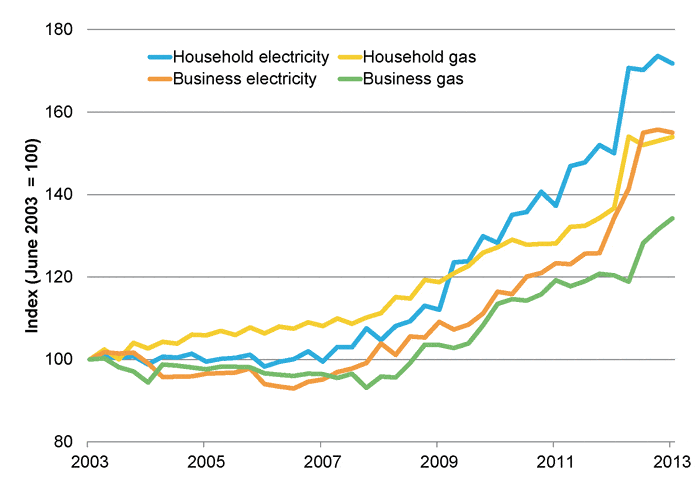
Electricity and gas prices are on the rise. Over the decade from 2000 to 2013, these prices had risen from 72% and 34% respectively . These figures are only expected to increase.
Energy Matters have launched “Energy Health Check” – a cutting-edge energy comparator tool that allows you to check the most competitive retail offers available in your area. All that’s needed is for you to enter your postcode and a few little details about your property, and we’ll use our innovative software to compare all current plans.
We collect this data from our wide-range of trusted retailers, enabling you to make an informed decision about changing your plan.
Why compare electricity plans?
Competition in the electricity market is fierce, with numerous retailers vying for your business. This translates to various plans with varying rates, features, and benefits. Comparing electricity plans allows you to:
- Save money: Identify plans with the most competitive rates for your specific usage.
- Find the right fit: Choose a plan that aligns with your consumption patterns, whether you’re a high-energy user or a conservation-minded household.
- Access special features: Explore plans with perks like reward programs, discounts on green energy sources, or fixed rates for budget predictability.
Understanding electricity bills before you compare
Before diving into comparisons, it’s essential to understand the components of your electricity bill. This includes:
- Energy consumption: Measured in kilowatt-hours (kWh), this reflects your overall electricity usage. Understanding your consumption helps estimate potential savings under different plans.
- Electricity rate: This is the price you pay per kWh. It’s a crucial factor in plan comparison. Some plans offer fixed rates, while others have variable rates that fluctuate with market conditions.
- Daily supply charge: This fixed fee covers maintaining the electricity grid.
- Other charges: Additional charges like meter reading fees or environmental levies might exist.
How to correctly compare plans
If your current objective is to reduce the cost of your gas and electricity bills, we encourage you to conduct an energy health check now. This assessment determines the options available to your property and needs, specifically within your postcode.
In return, you’ll be given a comprehensive list of offers, the best at the top of the list, helping you picking the right path for your home or business. Because your electricity bill is generated with a number of factors in mind, we take account for several details when assessing your opportunities.
Note: In order to make sure you get the most accurate health check, we recommend having a recent electricity or gas bill on hand whilst using the tool
All you have to do is enter your actual energy usage and review alternative plans to see how much you can save by switching providers. Once you’ve pinpointed the right option for you, we take care of the rest – we’ll deal with everything from A to B, including the transfer, paperwork, set up and communication with your former provider.
How electricity plans work
Receiving a bill in the mail can be a confusing process to wade through. There are lots of details to consider and a plethora of data to wrap your head around – so how do you know you’re even getting a good deal?
Half the challenge is understanding how these plans work, allowing you to assess each option open to you and the fine print that comes with them. All electricity bills are typically split up into two specific charges:
- Daily supply charge: You can’t control this cost. It’s the fee your retailer charges your property on a daily basis, no matter how much energy you use. This price is typically fixed.
- Usage charge: This part you can control and is the cost that you pay for the electricity you use. This is measured per unit and is listed on your bill as cents per kilowatt-hour (c/kWh).
From there, you’ll need to consider the kind of plan you’ve signed up for and the meter you have installed on your property. Your system may range from single rate, time of use and feed-in tariffs – all of which come with their own pros and cons. During your energy health check with our team, we’ll explain which option you can best utilise for your needs and circumstances.
Get an energy health check without picking up the phone
We understand dealing with salespeople can be a frustrating process, so we’ve eliminated this unnecessary step in our customer journey.
When you opt for a health check of your current plan with Energy Matters, we’ll conduct all necessary comparisons and research digitally. From start to finish, you can compare, review and switch your plan over without speaking to sales teams or technicians.
Across Australia, our clients are already reaping the benefits
Take control and save with Energy Matters Compare Energy
Comparing electricity plans empowers you to make informed decisions about energy consumption and costs. By leveraging Energy Matters Compare Energy, you can quickly identify the best plan for your needs and save money on your electricity bills.
Remember, even minor adjustments in your electricity usage habits, coupled with the right plan, can lead to significant savings over time. So, take control of your energy future and start comparing today!
Are you ready to make the switch?
Start your Energy Health Check now
The Energy Matters platform is powered by CIMET. We do not compare all brands in the market, or all products offered by all brands. At times certain brands or products may not be available or offered to you. If you proceed with an energy plan through Energy Matters, both Energy Matters and CIMET may each receive a referral fee.
Privacy Policy | Terms and Conditions | CIMET’s Privacy Policy | CIMET’s Terms and Conditions
Your energy plan should suit your household, your habits, and your budget. But a good deal today might become expensive later.
Rates change, introductory offers end, and the way you use electricity evolves. Installing solar, adding a battery, or buying an electric vehicle can also change which plan offers the best value.
Regularly comparing electricity and gas plans helps you understand what you pay and whether a better offer exists. You might save by switching retailers, changing plans with your existing provider, or choosing tariffs that better match your routine.
This guide explains how to shop around, estimate potential savings, and look beyond attention-grabbing offers. Because free electricity hours and generous solar feed-in tariffs only help when the whole plan stacks up.
Energy plan comparison at a glance
- Compare the total estimated yearly cost, including supply charges, usage rates, fees, and solar credits.
- Check every applicable tariff and its time window, especially when considering free electricity hours or solar offers.
- Review your plan regularly and whenever your rates, household, or energy equipment changes.
Why regularly comparing energy plans matters
Staying with one retailer does not automatically mean you are receiving its cheapest available offer. Your existing provider might offer a better plan, while another retailer could better suit your household.
Shopping around gives you an opportunity to:
- Find lower electricity or gas usage rates.
- Reduce daily supply charges.
- Replace an expired discount or introductory benefit.
- Choose pricing that suits when you use electricity.
- Reassess solar export payments and battery arrangements.
- Compare payment options, customer service, and contract conditions.
Even when switching offers little benefit, checking helps you understand your costs and make informed decisions.
As a practical habit, review your plan every six to twelve months. Check sooner after a price-change notice, an unexpectedly high bill, or a significant household change.
Moving home, working from home, installing a heat pump, or adding an EV are good reasons to reassess. Your previous energy habits might no longer reflect how your household operates.
How much could you save by switching energy plans?
Savings depend on your current plan, location, energy usage, and the offers available to you. Some households could save hundreds annually. Others may find smaller savings or discover their existing plan remains competitive.
The Victorian Government reports that Victorian Energy Compare users across 2025 could save $170 on average by switching to a better offer. This is a Victorian comparison result, not a guaranteed saving or a national average.
The most useful estimate comes from applying competing plans to your own energy usage.




A simple example of potential savings
Consider a household buying 4,000 kWh of electricity annually on a single-rate plan.
Cost component | Existing plan | Alternative plan |
Electricity usage rate | 35c/kWh | 30c/kWh |
Annual usage cost | $1,400 | $1,200 |
Daily supply charge | $1.20 | $1.00 |
Annual supply cost | $438 | $365 |
Total annual cost | $1,838 | $1,565 |
In this example, the alternative plan saves $273 annually without reducing electricity consumption.
These are illustrative rates, not current retailer offers. The calculation assumes a 365-day year and GST-inclusive prices. It excludes solar credits, discounts, demand charges, and other fees.
A low usage rate does not always produce the lowest bill. For households buying little grid electricity, the daily supply charge can make a substantial difference.
How to compare electricity and gas plans
1. Gather your bills and usage information
Start with a recent bill. Ideally, review twelve months of usage to capture seasonal changes in heating, cooling, and solar generation.
Useful information includes:
- Your address, postcode, retailer, and plan name.
- Electricity consumption in kilowatt-hours, or kWh.
- Gas consumption in megajoules, or MJ.
- Your daily supply charge and applicable usage rates.
- Peak, off-peak, shoulder, and controlled load usage, where applicable.
- Solar exports and feed-in tariff credits.
- Demand charges, discounts, fees, and benefit expiry dates.
Your electricity bill also contains your National Metering Identifier, or NMI. Government comparison services can use this identifier to access meter data through their authorised process.
Detailed smart meter data helps reveal when you buy electricity. That timing matters when comparing time-of-use tariffs and free electricity periods.
2. Compare offers available at your address
Plans vary by location, electricity network, meter configuration, and eligibility. A friend’s great deal might not be available at your property.
Start with an independent government comparison service, then confirm shortlisted offers directly with the retailer.
Location | Where to start |
New South Wales, ACT, South Australia, Tasmania, and Queensland | Energy Made Easy: https://www.energymadeeasy.gov.au/ |
Victoria | Victorian Energy Compare: https://compare.energy.vic.gov.au/ |
Western Australia | Check retailer eligibility and consumer guidance through the Economic Regulation Authority: https://www.erawa.com.au/ |
Northern Territory | Check available retailers and local guidance through Power and Water: https://www.powerwater.com.au/ |
Retailer choice varies across Australia. Regional Queensland has more limited options than south-east Queensland. Most WA households connected to the main south-west network cannot choose their electricity retailer, although gas retailer choice is available.
Embedded networks, including some apartments and retirement communities, can involve additional restrictions. Confirm your options before assuming you can switch.
Commercial comparison websites can also help, but check which retailers and plans they include. Some receive commissions and compare only a selection of offers.
3. Compare the whole cost
Look beyond the advertised discount, lowest rate, or sign-up credit. Estimate what each plan would cost using the same household consumption and comparison period.
A useful starting calculation is:
Estimated annual cost = supply charges + usage charges + demand charges + applicable fees − eligible discounts and credits − solar export credits.
Compare GST-inclusive prices consistently. Separate ongoing savings from one-off incentives, and check whether an introductory benefit expires.
Do not assume a percentage below the reference price means the same percentage off your existing bill. Reference prices use benchmark consumption, which may differ from your household’s actual usage.
4. Ask your current retailer for a better offer
Before switching, ask: “What is your lowest-cost available plan for my household’s actual usage?”
Check any better-offer message on your bill, then compare that offer against other retailers. A better deal from your current provider may still cost more than an alternative elsewhere.
Request the complete rates, conditions, and estimated cost in writing.
5. Confirm the details and arrange the switch
Before signing up, check the plan summary, contract, fees, price-change provisions, and cooling-off rights. Confirm meter requirements and any charges associated with changing your meter or tariff.
Ask the new retailer to confirm the exact plan, transfer date, and how it will arrange the changeover. For a standard retailer switch, your electricity distributor remains the same, and switching itself does not interrupt your supply.
Check your final bill from the previous retailer and the opening bill from your new provider. Confirm rates, solar credits, concessions, and account details match what you agreed.
Understand every electricity rate before choosing a plan
An electricity tariff describes how your electricity charges are calculated. The best structure depends on how much grid electricity you buy and when you buy it.
Charge or tariff | What it means | What to compare |
Daily supply charge | A fixed daily charge for your electricity connection | The daily price and annual total, even when grid usage is low |
Single rate | One usage rate throughout the day | The rate alongside supply charges and other conditions |
Peak | A rate applying during specified periods, commonly when demand is higher | The price, exact hours, days, and seasonal variations |
Off-peak | A rate applying during specified lower-priced periods | Whether your household actually uses electricity during those hours |
Shoulder | A separate rate between other designated pricing periods | Both the rate and the hours covered |
Controlled load | Separate pricing for eligible appliances on a dedicated circuit | Appliance eligibility, availability periods, rates, and additional supply charges |
Demand charge | An extra charge linked to your measured power demand | Measurement windows, calculation method, seasonal rules, and rates |
Peak and off-peak times are not universal. Check each plan’s schedule, including weekends, public holidays, seasons, and daylight saving treatment.
Off-peak pricing also differs from controlled load. An appliance does not qualify for controlled load simply because you run it overnight.
Why your usage split matters
Imagine two plans with the same supply charge and no other charges:
- Plan A charges 30c/kWh throughout the day.
- Plan B charges 50c/kWh during peak periods and 20c/kWh during off-peak periods.
If you buy 6 kWh during peak periods and 4 kWh off-peak, Plan A costs $3 in daily usage charges. Plan B costs $3.80.
If you buy 2 kWh during peak periods and 8 kWh off-peak, Plan B costs $2.60.
The same plans produce different winners because the household’s timing changes. These illustrative calculations exclude other charges and credits.
Watch for demand charges
Demand measures power in kilowatts, or kW. Energy consumption measures electricity used over time in kilowatt-hours, or kWh.
A demand charge can increase when several powerful appliances run together during the relevant measurement window. Depending on the calculation, a short spike can influence charges beyond that moment.
Check how the retailer measures demand, which hours count, and how long the measured demand affects your bill. A low advertised usage rate may offer poor value once demand charges are included.

Are free electricity hours worth it?
Plans offering free electricity periods can benefit households that shift significant grid consumption into those hours. They may suit scheduled EV charging, eligible battery charging, heat pump operation, or household appliances.
However, free usage hours do not mean a free electricity bill. Supply charges remain, and other charges or limits may apply.
Before signing up, ask:
- What are the exact free hours, and which days qualify?
- Is the usage rate genuinely zero, or does the offer provide a bill credit?
- Are there usage caps, fair-use rules, or exclusions?
- What are the peak, shoulder, and off-peak rates outside the free period?
- Does controlled load qualify?
- Are there demand charges or additional fees?
- Is a smart meter required?
- Are battery and EV charging eligible, and under what conditions?
- Can you realistically move enough electricity use into the free window?
Compare the total bill using your expected schedule. Do not assume every appliance can operate whenever you choose.
A free-hours example
Suppose a household buys 10 kWh daily. A flat-rate plan charging 30c/kWh costs $3 in daily usage charges.
A competing plan offers free hours but charges 45c/kWh for all other usage.
If the household buys 2 kWh during free hours, its remaining 8 kWh costs $3.60. The free-hours plan costs more.
If it buys 5 kWh during free hours, its remaining 5 kWh costs $2.25. The free-hours plan costs less.
These examples assume identical supply charges and exclude other charges, credits, and consumption changes. Actual plans may have several paid rates.
Consider your solar and battery setup
Without a battery, solar households may already cover much of their daytime consumption with rooftop generation. Their grid purchases during a daytime free period could therefore be modest.
A compatible battery may allow eligible grid charging during free hours and discharge during expensive periods. However, savings depend on charging limits, usable capacity, efficiency losses, settings, and plan conditions.
EV charging also depends on whether the vehicle is home during the free window. A generous lunchtime offer might have limited value when your car spends weekdays elsewhere.
Consider your solar and battery setup
A solar feed-in tariff pays you for eligible electricity exported to the grid. A higher rate can help, but it does not automatically deliver the lowest total bill.
A solar-focused plan may have higher import rates, higher supply charges, or limits on its advertised export payment.
Compare:
- Feed-in rates and the exports eligible for each rate.
- Daily or billing-period export caps.
- Different payments by time of day.
- The rate after any higher-paying export allowance is exhausted.
- System-size limits and eligibility conditions.
- Electricity import rates and supply charges.
- Any export charges passed through under the plan.
- Battery export rules or virtual power plant requirements.
A higher feed-in tariff can still cost more
Suppose a competing plan pays an extra 4c/kWh for 3,000 kWh of eligible annual solar exports. That increases credits by $120.
But an extra 5c/kWh on 4,000 kWh of annual grid imports adds $200. The household pays $80 more overall, assuming all other charges remain identical.
Use exported electricity in your calculation, rather than total solar generation. Electricity consumed at home or stored in your battery does not automatically earn export credits.
If you receive a legacy government feed-in tariff, confirm whether changing plans, retailers, or equipment could affect your entitlement.
Choosing energy plans for homes with batteries or EVs
A battery or EV can change both your electricity volume and its timing. Reassess your plan after installation using actual meter data where possible.
For batteries, compare import costs, export payments, charging windows, and virtual power plant conditions. Check compatibility, retailer control, event participation, and how participation could affect your backup reserve.
For EVs, compare eligible charging rates against the cost of powering the rest of your home. Cheap overnight charging might not outweigh expensive evening household consumption.
Wholesale-linked plans also deserve careful assessment. Prices can vary substantially, so check fees, automation requirements, export pricing, and your exposure to price spikes.
Choose a plan that suits your household’s ability to manage usage, not just its equipment.
Do not forget your gas plan
Compare gas separately, even when the same retailer supplies both fuels. A combined offer may be convenient without providing the lowest combined cost.
Check the daily supply charge, usage rates, consumption blocks, fees, and discount conditions. Gas consumption can vary substantially across seasons, particularly when you use gas heating.
If electrification has reduced your gas use, the supply charge may represent more of your remaining bill. Consider both immediate plan savings and your longer-term appliance choices.
Your energy comparison checklist
Before choosing a new plan, confirm:
- The offer is available at your address and suits your meter.
- The estimate uses your actual usage and a consistent comparison period.
- Every applicable rate and time window has been checked.
- Supply charges, demand charges, fees, and solar credits are included.
- Free-hour limits, export caps, and eligibility conditions are clear.
- Discounts and sign-up benefits are separated from ongoing savings.
- Price-change terms and benefit expiry dates are understood.
- Payment arrangements, concessions, and customer support suit your needs.
- Contract terms and cooling-off rights have been reviewed.
Save the plan summary and set a reminder to review the offer again.
Frequently asked questions
How often should I compare energy plans?
Review your plan every six to twelve months as a practical habit. Compare sooner when prices change, discounts expire, or your household changes. Solar, battery storage, EV charging, and electric appliances can all alter which plan suits you. You do not need to switch if your existing offer remains competitive.
Can I get a better deal without changing retailers?
Yes. Ask your current retailer about cheaper plans available for your actual usage. Check better-offer messages on your bill and request the full terms. Compare the proposed plan with other available offers before accepting. A cheaper plan with your current retailer can provide savings without changing providers.
Will switching retailers turn off my electricity?
An ordinary retailer switch does not interrupt your electricity supply. Your distributor continues operating the network while your retailer and billing arrangements change. Ask the new retailer to confirm timing. A separate meter replacement or electrical upgrade may require an arranged interruption, so clarify any additional work involved.
Are free electricity plans cheaper?
They can be, particularly when you shift substantial eligible consumption into the free window. However, higher paid rates, supply charges, demand charges, and usage limits can outweigh those savings. Compare the total estimated cost using realistic consumption patterns, including the electricity you buy outside the free period.
Should I choose the highest solar feed-in tariff?
Compare the whole plan before deciding. Higher export payments may come with higher import rates, supply charges, or export caps. Calculate eligible solar credits alongside the cost of buying electricity. A plan with a lower feed-in tariff can still produce a smaller total bill for your household.
Can renters switch energy retailers?
Renters who hold their own energy account can generally choose from retailers available at their address. Embedded networks, shared supply arrangements, and some tenancy conditions can complicate that choice. Check your account and property arrangements first. Switching retailers is different from changing equipment or making alterations to the property.
Are energy savings guaranteed?
No. Savings depend on the offers available and how your household uses energy. Comparison estimates also rely on accurate information and assumptions about future consumption. Weather, tariff changes, and new appliances can affect the outcome. Treat advertised savings as a starting point, then calculate costs for your circumstances.
Find an energy plan that works for you
Your best energy plan should suit the way you live, generate electricity, and use the grid.
Start with your bill, compare the complete costs, and ask questions before committing. Small differences in rates and conditions can add up across a year.
Use an independent government comparison service to explore your options, then contact your preferred retailer to confirm and arrange the plan.