
On this page

Nearly one in three Victorian homes now has solar. If you’re thinking about joining them, the numbers have changed: there’s no longer a minimum feed-in tariff, batteries are cheaper with the federal rebate, and Solar Victoria’s income cap dropped on 1 July 2026. Here’s what you can claim today, what it costs, and how to get up to three quotes from local installers.
Victorian rebates at a glance
| Scheme | What you get | Who can get it | Status |
|---|---|---|---|
| Solar Victoria solar panel rebate | Up to $1,400 off, plus an optional interest-free loan up to $1,400 | Owner-occupiers, household income under $150,000, home under $3m | Open. Moves into VEU from 1 July 2027 |
| Solar Victoria hot water rebate | Up to $1,400 (locally made) or $1,000 (other products) | Same as solar rebate | Open |
| Federal STCs (solar) | About $1,480 off a 6.6kW system in Melbourne | All buyers, applied by the installer | Open. Falls each 1 January until 2030 |
| Cheaper Home Batteries Program | About $272 per kWh for the first 14kWh (May–Dec 2026) | Anyone with solar, battery must be VPP-capable | Open. Drops every 6 months |
| Victorian Energy Upgrades (VEU) | Discounts on heat pumps, reverse cycle AC, ceiling insulation, windows | Most households, through an accredited provider | Open |
| Midday Power Saver | Free power 11am–2pm every day | Smart meter, retailer with 1,000+ customers | Live since 1 October 2026 |
| Minimum feed-in tariff | No longer set | Not applicable | Ended 30 June 2025 |
| Solar Victoria battery loans | Not applicable | Not applicable | Closed |
Free estimate · Updated October 2026
What will solar, batteries and electrification cost your home?
Enter your postcode and pick the systems you're after. We'll size them for your household and apply current federal STC discounts and the main state rebates.
How much does solar cost in Victoria?
A typical 6.6kW to 10kW solar system in Melbourne costs about $4,000 to $8,300 once the federal discount comes off. Where you land in that range depends on the size of the system, the panels and inverter you choose, and how easy your roof is to work on.
System size | Typical installed price | After the STC discount |
|---|---|---|
6.6kW | $5,500–$7,200 | $4,000–$5,700 |
10kW | $8,000–$10,500 | $5,800–$8,300 |
Indicative Melbourne prices, September 2026. Source: WhySolar.
You don’t apply for the STC discount yourself. Your installer takes it off the quote. On a 6.6kW system in Melbourne it’s worth about $1,480. It gets smaller every January until the scheme ends in 2030, so the same system costs a little more each year you wait.
If you own your home and your household earns under $150,000, Solar Victoria’s rebate can take up to $1,400 more off. You can also borrow the same amount again, interest-free.The average system installed in Victoria over the past year was 9.3kW, so many households now pay closer to the 10kW price than the 6.6kW one.
Example:
- Typical installed price (midpoint): $6,350
- Federal STC discount: -$1,482
- Solar Victoria rebate (if eligible): -$1,400
- You pay: $3,468
Every roof is different, and the quickest way to know what solar will cost on yours is to compare a few quotes.
Is solar still worth it in Victoria?
Yes, but the way it saves you money has changed. Solar used to pay its way partly through the feed-in tariff. Now most of the value comes from the power you use yourself.
Under the Victorian Default Offer, grid electricity costs about 26c to 32c per kWh, depending on where you live. Most retailers pay around 1c per kWh for the solar you export. So every unit of solar you use at home is worth roughly 25 times more than one you send back to the grid.
Grid rates are the Victorian Default Offer 2026–27 flat usage charges, including GST. Feed-in rates are as at 29 October 2026.
“I got 3 very competitive quotes and the installer I went with removed the old solar system and professionally installed a brand new one that has been working very well for a number of months now. Very happy with the service and so glad I decided to give solar a second chance.”
Margaret
“The process from start to finish was easy and quick! I completed the solar quote quiz and was contacted by 2 local installers within a week. I had solar and a battery installed within a month and I’ve been saving ever since! cannot recommend these guys highly enough!”
Robert Long
“I called Energy Matters to get a quote on the Friday, and by Monday I had 3 quotes from 3 installers in my area. One of the consultants even called me late on Saturday at my request. The installers we went with were professional, friendly and polite. Thanks Energy Matters for helping me find the best deal, and for your help understanding the rebates.”
Alisha
Solar Victoria Solar Homes program
Solar Victoria’s Solar Homes program takes up to $1,400 off the cost of solar panels. You can also take an interest-free loan for up to $1,400 on top of that. If you want the loan, tick it when you apply. You can’t add it later.
Who can get it
You can apply if:
- you own the home and live in it, or you’re building it
- the combined taxable income of everyone who owns the home is under $150,000 a year
- the property is worth less than $3 million
- the address hasn’t had a Solar Homes solar or battery rebate before
- no solar has been installed at the address in the last 10 years.
The income cap dropped on 1 July 2026. It used to be $210,000, so some households who qualified last year no longer do.
Renting out a property? Rental providers can apply too. If you own an apartment, look at Solar for Apartments.
How to claim it
You need to use a retailer on Solar Victoria’s authorised list and products from its approved lists. Once you’re approved, you get a QR code to give your installer, and the system must be installed within 120 days.
What changes in 2027
From 1 July 2027, support for solar panels moves from Solar Victoria into the Victorian Energy Upgrades program. If you’re eligible now, check the Solar Victoria website for current numbers before you book an install.
Home batteries and rebates in Victoria
Victoria doesn’t have its own battery rebate any more, and Solar Victoria’s battery loans have closed. The main discount now is the federal Cheaper Home Batteries Program, which started on 1 July 2025.
How much can you get
The discount depends on the size of the battery and when it’s installed. Since 1 May 2026 it’s worked out in tiers:
- the first 14kWh gets the full rate
- from 14 to 28kWh, you get 60% of the rate
- from 28 to 50kWh, you get 15% of the rate.
Until 31 December 2026, the full rate is abouVictoria doesn’t have its own battery rebate any more, and Solar Victoria’s battery loans have closed. The main discount now is the federal Cheaper Home Batteries Program, which started on 1 July 2025.t $272 per kWh after typical installer fees. That’s roughly $3,670 off a 13.5kWh battery, or $4,790 off a 20kWh one. The rate drops every six months. The next cut is on 1 January 2027, to about $228 per kWh.
These are CHOICE’s figures after typical installer fees of about 10%. Label them “approximate”.
After the discount, CHOICE puts a 10kWh battery at $7,000 to $11,000 installed, and a 20kWh battery at $14,000 to $19,000.
How much can you get
To get the discount:
- you need solar, either new or already on the roof
- the battery must be on the Clean Energy Council’s approved list
- an installer accredited with Solar Accreditation Australia must fit it
- the battery must be able to join a virtual power plant (VPP), though you don’t have to join one.
Each property can claim once.
Is a battery worth it in Victoria?
With most retailers paying around 1c for exported solar, a battery lets you keep that power for the evening instead of buying it back from the grid. A VPP can earn you extra credits on top. Before you sign up, read how often the retailer can draw on your battery and how much it pays.
Feed-in tariffs in Victoria
Victoria stopped setting a minimum feed-in tariff on 1 July 2025. Retailers now decide what they pay for the solar you send back to the grid. The last minimum, in 2024–25, was 3.3c per kWh.
What retailers pay now
Not much. In late October 2026, the median feed-in tariff across Victorian plans was 1c per kWh. A handful of plans pay more: up to about 12c all day, or higher rates only in the 6pm–9pm peak.
A high feed-in rate isn’t always the better deal. Check the usage and supply charges on the same plan, because you’ll still buy power from the grid at night.
Can my feed-in tariff go negative?
No. Retailers can pay as little as zero, but they can’t charge you for the solar you export.
What this means for your solar
The solar you use yourself is now worth far more than the solar you sell. Running appliances during the day, adding a battery or charging an EV at home will save you more than chasing a higher feed-in rate.
To compare plans, use the free government site Victorian Energy Compare.
Free electricity in Victoria: the Midday Power Saver
Since 1 October 2026, Victorian households can get free electricity from 11am to 2pm every day, weekends included. It’s called the Midday Power Saver.
How to get it
You need a smart meter, and you sign up through your electricity retailer. Retailers with 1,000 or more customers have to offer it. It’s optional. There’s a cooling-off period, and you can switch it off at any time with no exit fee.
What to watch for
Power outside the free window may cost a little more than on your current plan. There’s also a fair-use cap, so very high use in the window can still be charged. Your retailer has to tell you whether the offer suits you and estimate how it affects your bill. Ask for that before you switch.
How much could you save?
The Victorian Government estimates households could save $149 to $428 a year by moving between 5% and 30% of their power use into the free window. A household with an EV could save about $1,012 a year, including $674 from charging the car during those three hours.
Already have solar?
Midday is when your panels make the most power, so you’re probably already using free electricity at that time. The plan helps most if your home uses more than your panels make around midday, or if you charge an EV then. Compare it against your current plan, including your feed-in tariff, before you change.
Getting off gas in Victoria
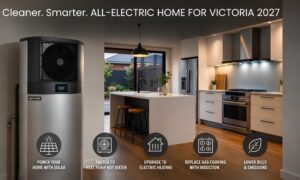
Victoria is moving homes off gas in stages, starting in 2027. You won’t be forced to rip out working appliances, but the rules change what you can install when something breaks.
New homes go all-electric
- 1 January 2027
All new homes and commercial buildings must be built without a gas connection.
Broken gas hot water must be replaced with electric
- 1 March 2027
If your gas hot water system fails and can’t be repaired, replace it with an electric option such as a heat pump. Rentals also need R5.0 ceiling insulation, efficient cooling and 4-star showerheads at the start of a new lease. Broken heating in a rental must be replaced with an efficient electric system.
Rentals need draughtproofing
- 1 July 2027
At the start of a new lease, rental properties need draughtproofing on external doors, windows and vents.
Efficient cooling in every rental
- 1 July 2030
All rental properties must have efficient electric cooling in the main living area, whether or not a new lease starts.
The new rules
- From 1 January 2027, new homes must be all-electric.
- From 1 March 2027, if your gas hot water system breaks and can’t be repaired, you’ll need to replace it with an electric one, such as a heat pump.
- Gas heating and cooktops: if you own and live in your home, you don’t have to replace them.
If you rent out a property
- From 1 March 2027: if the hot water or heating breaks and can’t be fixed, it must be replaced with a heat pump or an efficient reverse cycle air conditioner.
- At the start of a new lease from 1 March 2027: the property needs R5.0 ceiling insulation, efficient cooling in the living area and 4-star showerheads.
- At the start of a new lease from 1 July 2027: draughtproofing on doors, windows and vents.
- By 1 July 2030: every rental needs efficient cooling in the living area.
Discounts to help you switch
Discounts to help you switch
- Hot water:
- Solar Victoria offers up to $1,400 off a locally made heat pump or solar hot water system, or $1,000 off other eligible products. If you qualify for the solar panel rebate, you’ll most likely qualify for this one too.
- You may also get a Victorian Energy Upgrades (VEU) discount through an accredited provider.
- Heating and cooling:
- Replacing a gas room heater with a reverse cycle air conditioner can attract a VEU discount of $630 to $1,610.
- Swapping ducted gas heating for ducted reverse cycle can get up to $2,520, $4,200 or $5,530, depending on the size of the system.
- The Victorian Government says upgrading a gas room heater can save up to $460 a year, and a whole-home upgrade up to $1,140.
- Ceiling insulation: a VEU discount of up to $1,500 in metropolitan Melbourne, or $2,100 in regional Victoria, for homes with little or no insulation.
- Windows: VEU discounts are available for replacing single-glazed windows with double glazing through an accredited provider.
Victorians are already making the switch. In the June quarter of 2026, half of all heat pumps installed in Australia went into Victorian homes.
Where Victoria's electricity comes from
In 2025, renewables supplied 44.6% of Victoria’s electricity, ahead of the state’s 40% target for that year. Wind made up about 24% and solar about 16%. Solar includes both rooftop systems and the state’s 54 solar farms
Source: Victorian Government, 2025
Victoria’s targets are 65% renewable electricity by 2030 and 95% by 2035. It also aims to have at least 2.6GW of energy storage by 2030, and 6.3GW by 2035.
Homes are a big part of that shift. Close to a third of Victorian homes now have rooftop solar, up from 14% when the Solar Homes program began in 2018.
How to choose a solar installer in Victoria
How to choose a solar installer in Victoria
The installer matters as much as the panels. Before you sign, check these:
- Accreditation: the installer should be accredited with Solar Accreditation Australia. You need this to get the federal STC discount and the battery discount.
- Approved products: panels, inverters and batteries should be on the Clean Energy Council’s approved lists.
- Solar Victoria rebate: to claim it, the retailer must be on Solar Victoria’s authorised list.
- Warranties: ask for the product warranty, the panel performance warranty and the installer’s own workmanship warranty, in writing.
- What’s included: check whether the quote covers switchboard upgrades, monitoring and the paperwork for your grid connection and rebates.
- Battery-ready: if you might add a battery later, ask whether the inverter can take one.
Getting more than one quote is the easiest way to spot a price that’s too high, or a deal that looks too cheap to be true.
Get up to 3 free solar quotes in Victoria
Tell us a little about your home and what you’re after, and up to three installers in your area will get in touch with their best offer. It’s free, and there’s no obligation to go ahead.
Frequently asked questions
Is there still a solar rebate in Victoria?
Yes. Solar Victoria offers up to $1,400 off solar panels, plus an optional interest-free loan of up to $1,400, for owner-occupiers with a combined household income under $150,000 and a home worth under $3 million. From 1 July 2027 this support moves into the Victorian Energy Upgrades program.
How much do solar panels cost in Victoria?
A 6.6kW system in Melbourne typically costs about $4,000–$5,700 after the federal STC discount. Eligible households can take off up to $1,400 more with the Solar Victoria rebate.
Is there a battery rebate in Victoria?
There’s no state battery rebate now. The federal Cheaper Home Batteries Program takes about $272 per kWh off the first 14kWh until 31 December 2026, and less after that.
What is the feed-in tariff in Victoria?
There has been no minimum feed-in tariff since 1 July 2025. Retailers set their own rates. Most pay around 1c per kWh, and the best all-day rate is about 12c.
When is electricity free in Victoria?
From 1 October 2026, the Midday Power Saver gives free power from 11am to 2pm every day. You need a smart meter, and you sign up through your retailer.
Is gas being banned in Victoria?
New homes must be all-electric from 1 January 2027. From 1 March 2027, a gas hot water system that can’t be repaired must be replaced with an electric one. Owner-occupiers don’t have to replace gas heating or cooktops.
Is there a double glazing rebate in Victoria?
Yes. The Victorian Energy Upgrades program offers discounts on replacing single-glazed windows through an accredited provider.
Who is eligible for the Solar Victoria rebate?
Owner-occupiers with a combined taxable income under $150,000 and a property worth under $3 million, at an address with no previous Solar Homes rebate and no solar installed in the last 10 years.
VIC news and updates
Keep up to date with the latest renewable news and updates from Victoria.