




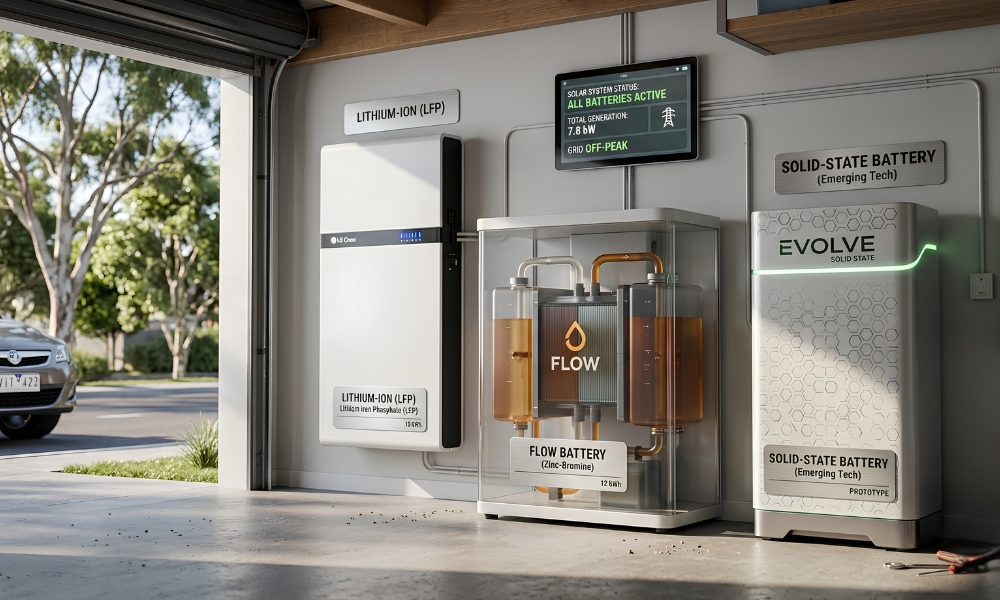
Australia’s home battery market is moving rapidly, with more than 72,000 home batteries installed during 2024 alone, according to the Australian Government’s Consumer Energy Resources Roadmap update. As battery adoption grows, such as home solar battery storage, understanding chemistry matters because the technology inside a battery affects cost, lifespan, efficiency, safety and performance.
This battery chemistry comparison guide for Australia examines three important technologies: lithium-ion, flow batteries and solid-state batteries. While lithium-ion currently dominates practical solar storage, flow and solid-state technologies could become increasingly relevant as storage requirements evolve.
If you’re considering solar battery storage, Energy Matters can help you compare your options and connect with trusted Australian installers.
Key takeaways
- Lithium-ion currently leads the battery chemistry comparison in the Australian market because it is mature, compact and widely available.
- LFP lithium-ion is particularly relevant to residential solar because of its established performance and thermal characteristics.
- Flow batteries could be valuable for long-duration applications where physical space is available.
- Solid-state batteries offer significant future potential, but mainstream availability in Australia remains limited.
- The best battery depends on the complete system, including capacity, power, warranty, safety, inverter compatibility, and installation conditions.
Why battery chemistry matters in Australia
A battery is more than a box that stores solar electricity. Its chemistry influences how much energy it can store, how quickly it can charge and discharge, how often it can cycle, how it handles heat, and how much space the system requires.
For Australian households, these factors matter most. Solar batteries may operate through hot summers, frequent daily cycling and varying household loads, so selecting a chemistry should involve more than comparing advertised capacity.
The wider electricity system is also increasing its reliance on storage. AEMO’s current 2026 Integrated System Plan identifies renewable generation supported by storage as a key part of Australia’s least-cost pathway towards a secure, lower-emissions electricity system.



Battery chemistry comparison in Australia: lithium-ion
Lithium-ion is currently the benchmark for many residential and commercial solar battery systems. ARENA identifies lithium-ion as the most common battery chemistry used for electricity storage, reflecting its established manufacturing base and widespread deployment.
Contact Energy Matters today for up to 3 FREE quotations from commercial solar firms we’ve pre-qualified and vetted for their track record of delivering Australia’s best business solar systems.
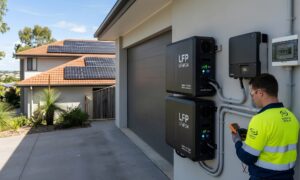
Modern home batteries commonly use lithium iron phosphate, or LFP, a lithium-ion chemistry valued for its thermal stability, long cycle life and suitability for stationary energy storage. Other lithium chemistries, including nickel-manganese-cobalt, or NMC, can provide higher energy density but have different thermal and material characteristics.
Advantages of lithium-ion
- High energy density: More storage can fit into a relatively compact enclosure.
- High efficiency: A large proportion of stored electricity can be recovered for household use.
- Mature supply chain: Products, installers and supporting equipment are widely available.
- Fast response: Suitable for solar shifting, backup and energy-management applications.
Limitations of lithium-ion
Lithium-ion batteries are sensitive to operating conditions, particularly excessive heat. Good thermal management, correct installation and appropriate battery placement therefore matter in Australia’s climate.
Battery degradation is another consideration. Cycling, temperature, and operating conditions gradually reduce available capacity, so examine warranty terms and expected performance alongside the purchase price.
Energy Matters’ solar battery storage guide provides additional background on battery technologies and storage considerations.
Use Energy Matters’ easy-to-use solar power and battery storage calculator to determine the size of your solar system with storage! Our solar calculator will generate performance information and potential savings.
We can send this information to 3 pre-vetted, trusted local installers in your area so they can provide obligation-free solar quotes and help you take the first step toward true energy independence!

Battery chemistry comparison in Australia: Flow batteries
Flow batteries operate differently from conventional lithium-ion batteries. Instead of storing energy primarily within solid electrode materials, they use liquid electrolytes stored in external tanks, with the electrolyte circulating through an electrochemical cell.
This design offers a key advantage for long-duration storage. Increasing storage duration generally means increasing electrolyte and tank capacity, rather than simply adding more conventional battery cells.
Where flow batteries can make sense
Flow technology may be attractive for:
- Large commercial or industrial solar installations.
- Renewable energy projects requiring extended discharge periods.
- Applications where long cycle life is more important than compact size.
- Sites with sufficient physical space for tanks and associated equipment.
Flow batteries can also potentially be deeply discharged repeatedly with relatively low degradation compared with some conventional battery technologies.
The trade-off is that flow systems are generally larger and less established in the residential Australian market. Their lower energy density makes them difficult to compete with compact lithium-ion batteries where roof space, garages or indoor installation areas are limited.
Battery chemistry comparison in Australia: solid-state batteries
Solid-state batteries replace the conventional liquid or gel electrolyte found in many lithium-ion designs with a solid electrolyte. This approach has attracted significant interest across the automotive and energy-storage industries.
Potential benefits include improved safety, higher energy density, and reduced reliance on some conventional battery materials. However, solid-state technology remains less commercially mature than lithium-ion for mainstream Australian residential solar applications.
Manufacturers still need to demonstrate manufacturing scale, cost, durability, and real-world performance across a broader range of stationary storage applications.
Are solid-state batteries ready for Australian homes?
For most homeowners shopping for a solar battery now, solid-state should be considered an emerging technology rather than the default purchasing option. Lithium-ion systems have the advantage of established products, installer familiarity, warranties and supply chains.
That does not make solid-state irrelevant. As manufacturing develops, solid-state batteries could eventually offer compelling combinations of safety, longevity, energy density and system design flexibility.
Lithium-ion vs flow vs solid state: Key battery chemistry comparison
| Feature | Lithium-ion | Flow battery | Solid state |
| Australian residential availability | High | Limited | Emerging |
| Energy density | High | Low to moderate | Potentially very high |
| Long-duration storage | Good | Excellent potential | Still developing |
| Cycle-life potential | High | Very high potential | Potentially high |
| Physical footprint | Compact | Larger | Potentially compact |
| Technology maturity | High | Moderate | Emerging |
| Best current application | Homes and businesses | Larger-scale storage | Future residential and commercial storage |
| Main consideration | Heat, degradation and cost | Size and upfront economics | Availability, cost and maturity |
What should Australian solar buyers look for in battery chemistry?
Chemistry is only one part of a battery purchasing decision. A well-designed system should match your electricity consumption, solar generation, inverter configuration and desired level of energy independence.
Consider these factors before signing a contract:
- Usable capacity: Check how much electricity you can actually access rather than relying solely on nominal capacity.
- Power output: A battery with plenty of kWh may still struggle with high-demand appliances if its kW output is limited.
- Efficiency: Higher round-trip efficiency generally means less energy is lost during charging and discharging.
- Warranty: Examine both the warranty period and capacity-retention conditions.
- Temperature performance: Australian heat makes thermal management particularly important.
- Backup capability: Confirm whether the system can provide blackout protection and which circuits it can support.
- VPP compatibility: A compatible battery may be able to participate in a Virtual Power Plant (VPP) and provide additional value.
- Installer and product compliance: Check that the proposed equipment meets applicable Australian requirements and suits your installation.
The Clean Energy Council maintains an approved battery products program and is transitioning its requirements towards the newer SA TS 5398 technical specification for home batteries.
For a broader purchasing framework, see Energy Matters’ solar battery storage buying guide.

Why storage technology matters beyond the home
Battery chemistry is also becoming important at grid scale. AEMO reported that grid-scale batteries represented approximately 1.4 GW of storage capacity in the NEM in 2024 and highlighted a major increase in battery capacity expected as Australia’s electricity system changes.
The 2026 ISP reinforces the importance of storage in Australia’s future electricity system, with different storage capacities, durations and technologies likely to serve different requirements.
This means Australia’s future energy-storage landscape is unlikely to depend on a single chemistry. Lithium-ion may remain dominant in many applications, while flow, solid-state and other technologies could fill specific niches.

Frequently asked questions for battery chemistry comparison in Australia
Is lithium-ion the best solar battery chemistry in Australia?
For most Australian residential solar installations today, lithium-ion is the most practical chemistry because it is mature, compact, efficient and widely available. LFP lithium-ion batteries are particularly common in modern stationary storage. However, the best option depends on capacity, power, backup requirements, budget and installation conditions.
Are flow batteries better than lithium-ion for solar?
Flow batteries can have advantages for long-duration storage and frequent cycling, particularly in larger installations. However, they generally require more physical space and are less common in residential solar. Lithium-ion remains more practical for most Australian homes because of its compact size, established supply chain and broad installer support.
Will solid-state batteries replace lithium-ion?
Solid-state batteries could become an important alternative, particularly if manufacturers achieve competitive costs, high production volumes and strong long-term durability. However, they are not yet a mainstream replacement for lithium-ion in Australian residential solar. Buyers should assess commercially available products rather than future technology promises.
How long do solar batteries last in Australia?
Battery lifespan varies by chemistry, product design, operating temperature, cycling and warranty conditions. Modern lithium-ion systems can provide many years of service, but capacity gradually declines. Reviewing the manufacturer’s warranty, cycle expectations and Australian operating conditions is more useful than relying on one generic lifespan figure.
What battery chemistry should I choose for my solar system?
For most homeowners installing a battery now, lithium-ion, particularly LFP, is the logical technology to investigate first. Flow batteries may suit larger, longer-duration projects, while solid-state is an emerging option. Compare chemistry alongside usable capacity, power, warranty, safety, compatibility and installed cost.
Secure your energy independence with Energy Matters
Choosing the right battery system changes how your household uses energy. By matching your daily energy usage to the right chemistry, you reduce grid dependence and shield your home from rising power tariffs.
Take control of your electricity bills now! Energy Matters can match your home or business with a SAA-accredited installer who will assess your energy use and recommend the right chemistry and system size for your situation. Complete our simple online form today to receive up to 3 free, no-obligation battery comparison solar quotes today!
Source and References
- Australian Renewable Energy Agency: Battery Storage
- AEMO: 2026 Integrated System Plan
- Clean Energy Council: Approved Batteries
- Australian Government: Consumer Energy Resources Roadmap update