


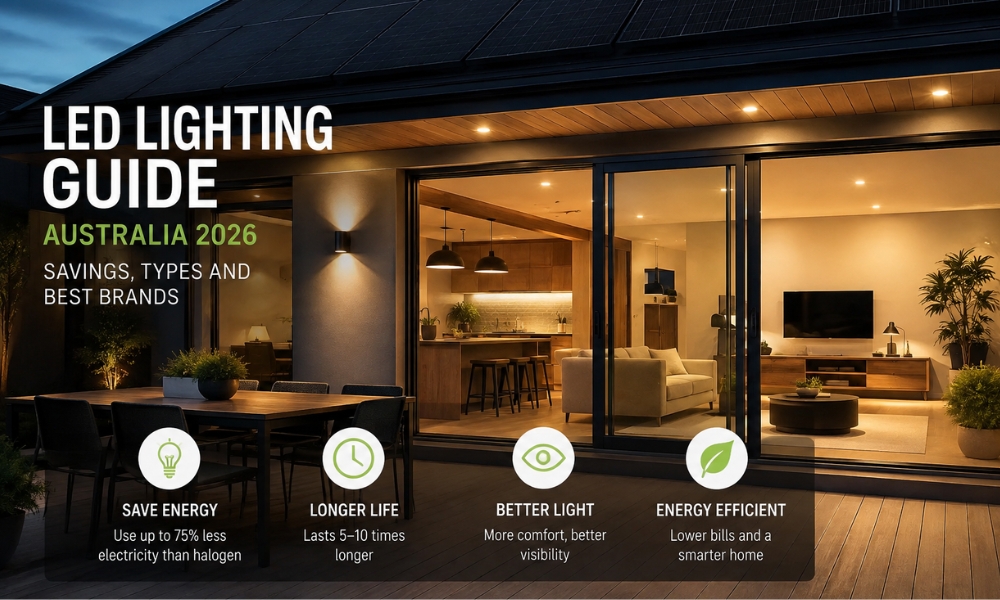
Australia’s average household spends around 10 to 15 per cent of its electricity bill on lighting, and much of that cost still comes from old halogen downlights left running long after sunset. This LED lighting guide for Australia, 2026 edition, exists to change that.
Whether you are replacing a single lamp or planning a full home upgrade, this LED lighting guide for Australia in 2026 helps you choose the right bulbs, downlights, and brands the first time. LEDs use around 75% less energy than halogen bulbs and last five to ten times longer, which means faster payback and fewer trips up the ladder.
In this guide, we cover LED types, real savings figures, the best LED bulbs Australian shoppers are choosing, and how to future-proof your home lighting before older inefficient bulbs are phased out entirely.
Quick summary
- LEDs use about 75% less energy than halogen bulbs and pay for themselves within a year.
- Warm white (2700K-3000K) suits living areas; cool white (4000K+) suits kitchens and garages.
- Look for CEC-endorsed or Energy Rating Label-compliant brands such as Philips, Brilliant, HPM and Domus.


Why energy-efficient lighting Australian homes need in 2026
Australia’s Minimum Energy Performance Standards are steadily phasing out inefficient halogen and incandescent lamps, following changes that began removing older tungsten and halogen products from shelves. The Clean Energy Regulator and Energy Rating scheme estimate the tighter LED rules will save consumers hundreds of millions of dollars while cutting emissions by around 1.5 million tonnes nationally.
For households, this makes now the practical time to plan an upgrade rather than wait for old bulbs to fail one by one. A well-planned LED lighting guide Australia 2026 checklist lets you switch room by room, prioritising the fittings that run the longest hours, such as kitchens, living areas and outdoor security lights.
Types of LED lighting for Australian homes
Not all LEDs suit every room, so it helps to understand the main categories before you buy. Here is a quick breakdown of the most common options for Australian households.
LED downlights Australian homes are switching to
- Fixed downlights: budget-friendly and ideal for standard ceiling recesses in living rooms and bedrooms.
- Dimmable downlights: pair with a compatible dimmer switch for adjustable mood lighting in dining and lounge areas.
- IC-rated downlights: safe for direct contact with roof insulation, a must for most modern Australian homes.
- Colour-selectable temperature (CCT) downlights: let you switch between warm and cool white on installation.
Best LED bulbs Australia shoppers choose for everyday fittings
- Bayonet (B22) and Edison screw (E27) globes for lamps and pendant fittings.
- LED strip lighting for under-cabinet, feature walls and outdoor decking.
- Sensor and smart LED bulbs for entryways, garages and security lighting.
- Weatherproof LED floodlights rated IP65 or higher for outdoor areas exposed to rain.
LED vs halogen savings: what the numbers show
The clearest reason to follow an LED lighting guide Australia 2026 upgrade plan is the savings. Government energy data shows replacing just 20 halogen downlights with LEDs can save Australian households up to $210 a year, with the switch typically paying for itself within 12 months.
Over a decade, households that replace ten halogen lamps with LEDs can save more than $2,000 and around three tonnes of greenhouse gas emissions, according to the Australian Government’s Energy Rating scheme. The table below summarises the key differences.
| Feature | Halogen | LED | LED advantage |
| Energy use (50W equiv.) | 50W | 6-8W | Up to 75% less energy |
| Average lifespan | 1,000-2,000 hrs | 15,000-25,000 hrs | 5-10x longer life |
| Annual cost (20 downlights) | ~$280 | ~$70 | Save up to $210/year |
| Heat output | High | Low | Safer, cooler rooms |
| Payback period | N/A | Under 12 months | Fast return on spend |
Best LED brands for Australian homes in 2026
Quality varies widely among LED products, so sticking to established brands that comply with the Energy Rating Label reduces the risk of flickering, colour shift, or early failure. These are among the most trusted names in the Australian market.
- Philips: broad range of screw and bayonet globes with reliable colour consistency and long warranties.
- Brilliant Lighting: widely stocked Australian brand known for affordable downlights and outdoor fittings.
- HPM: a long-standing Australian electrical brand with dimmable and IC-rated downlight ranges.
- Domus Lighting: popular with electricians for commercial-grade residential downlights and battens.
- Havit Lighting: Australian-designed decorative and architectural LED fittings, including outdoor and strip lighting.
- When comparing options, check for a genuine Energy Rating Label, a warranty of at least three years, and compatibility with any existing dimmer switches before you buy.
How to plan your LED lighting guide Australia 2026 upgrade
- Audit your home room by room and note bulb type, wattage and daily usage hours.
- Prioritise high-use areas first, such as kitchens, living rooms and outdoor security lighting.
- Check ceiling insulation contact and choose IC-rated downlights where required.
- Compare colour temperature and brightness (lumens, not watts) rather than price alone.
- Bundle your lighting upgrade with a broader home energy review, including solar and battery storage, for compounding savings.
Expert tips
- Match colour temperature to the room’s purpose: warm white (2700K-3000K) for bedrooms and living areas, and cool white (4000K and above) for kitchens, bathrooms and garages where task lighting matters more.
- If you’re renovating or building, ask your electrician for IC-rated, dimmable LED downlights from the outset. Retrofitting later costs more than specifying the right fitting during construction.
- Pair an LED upgrade with a solar system if you haven’t already. Lower lighting loads mean your existing panels stretch further across the rest of the household.

Frequently asked questions
Are LED downlights worth it for Australian homes?
Yes. LED downlights use up to 75% less energy than halogen equivalents and typically pay for themselves within a year through lower electricity bills, while lasting five to ten times longer with less maintenance.
What is the best LED colour temperature for living rooms?
Warm white, around 2700K to 3000K, suits most Australian living rooms and bedrooms. It mimics traditional incandescent lighting and creates a relaxed atmosphere, while cooler tones suit kitchens and workspaces.
How much can I save switching from halogen to LED?
Replacing 20 halogen downlights with LEDs can save Australian households around $210 a year on electricity, according to government energy data, with most upgrades recovering their cost within 12 months.
Do I need an electrician to install LED downlights?
Yes, a licensed electrician should install hardwired LED downlights to meet Australian wiring standards and IC-rating requirements, especially where fittings contact ceiling insulation.
Which LED brands are most reliable in Australia?
Philips, Brilliant Lighting, HPM, Domus Lighting and Havit are among the most established brands sold in Australia, offering Energy Rating Label compliance and multi-year warranties on most ranges.
Key takeaways
- LEDs use about 75% less energy than halogen bulbs and last 5 to 10 times longer.
- Replacing 20 halogen downlights can save Australian households up to $210 a year.
- Match colour temperature to each room: warm white for living areas, cool white for task areas.
- Choose IC-rated, dimmable downlights from trusted brands such as Philips, HPM, and Domus Lighting.
- Bundle your LED upgrade with a broader energy-efficiency or solar review for greater long-term savings.

Bring your home’s lighting into 2026
Switching to LED lighting is one of the simplest, fastest ways for Australian homeowners to cut electricity costs and reduce their carbon footprint. With energy-efficient lighting now more affordable and widely available than ever, there has never been a better time to act on the advice in this LED lighting guide for Australia in 2026.
Ready to take the next step? Energy Matters connects Australian homeowners with trusted, SAA-accredited suppliers for energy-efficient lighting, solar and battery storage, so you can start saving sooner. Get your free, no-obligation comparison today and see how much you could save.
Sources and Resources
- Energy.gov.au: Lighting
- Energy Rating: Switch and Save, Lighting regulation