Over 3.6 million Australian homes now have rooftop solar, yet thousands of households still pay inflated energy bills. Learning how to use Time-of-Use (TOU) tariffs to maximise your solar savings is the fastest way to lower your electricity expenses. By matching your daily power use with cheaper off-peak windows, you can turn your solar investment into a high-yielding asset. Connect with trusted solar providers today through Energy Matters to upgrade your home setup and start saving.
Ready to take control of your energy bills? Get free solar quotes from Energy Matters and discover a solar and battery solution designed around your household’s energy needs.

What is time-of-use and why does it matter for Australian homes?
A Time-of-Use tariff is an electricity pricing structure where the rate you pay changes depending on when you consume energy from the grid. Unlike flat-rate tariffs, TOU pricing reflects real-time market demand across the National Electricity Market (NEM).
Key terminology
- Peak hours: High-demand periods, usually in the late afternoon and evening, with the highest electricity rates.
- Off-peak hours: Low-demand windows, typically overnight and late morning, offering cheaper power rates.
- Shoulder hours: Transitional timeframes between peak and off-peak with moderate pricing.
- Solar feed-in tariff: The credit you receive from your electricity retailer for sending excess solar power back to the grid.
Why time-of-use tariffs matter in 2026
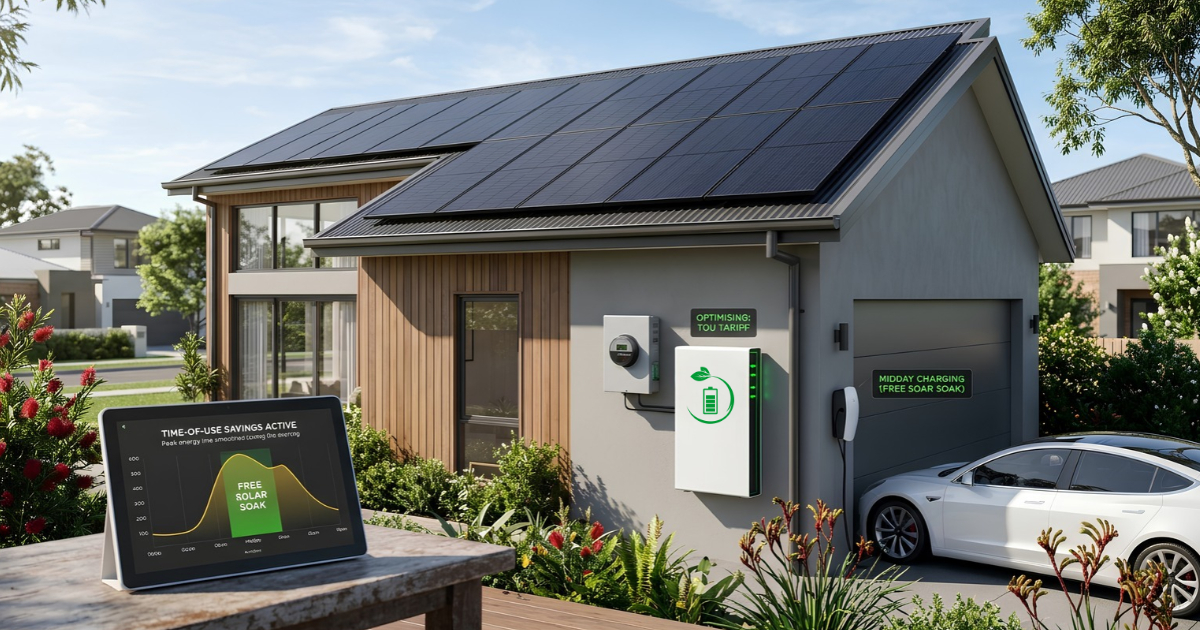
Electricity networks face massive midday power surges due to high solar generation. Energy retailers now use TOU pricing to encourage households to consume grid power during midday “solar soak” periods or save self-generated solar for expensive evening windows.
How time-of-use tariffs work in Australia
Understanding your network schedule is the first step to mastering Time-of-Use (TOU) tariffs and maximising your solar savings. Modern digital meters track energy use electronically every 15 to 30 minutes.
Step-by-step mechanism
- Generation: Your solar panels generate electricity during daylight hours.
- Direct self-consumption: Home appliances run directly on clean solar energy during daytime off-peak windows.
- Grid import: During peak evening hours, you import grid power at a higher rate if solar generation drops.
- Exporting: Surplus power is sent back to the grid for a retailer feed-in tariff credit.
Real-world examples
A household running pool pumps and dishwashers at 7:00 PM imports electricity during expensive peak rates. Shifting those appliances to 1:00 PM uses free rooftop solar, avoiding peak grid charges entirely.
Why the federal solar sharer offer changes the game
The Federal Solar Sharer offer, launched on 1 July 2026, presents an unprecedented opportunity for Australian households. This federal initiative provides three hours of free midday electricity to encourage domestic energy consumption when renewable supply peaks.
- Maximising the solar sharer offer: Schedule EV chargers, electric hot water systems, and clothes dryers between 11:00 AM and 2:00 PM.
- Combining free grid power with solar: Run home appliances on free grid power while charging your residential battery using rooftop solar.
- Boosting savings: Combining the solar sharer offer with self-consumption significantly reduces grid import costs.

Costs and savings of TOU tariffs with solar
Switching to TOU pricing requires no major upfront costs if your home already features a smart meter.
Upfront costs
If your home has an older basic disk meter, your retailer typically upgrades it to a smart meter for a minimal fee or no upfront cost.
Savings calculation
| Metric | Single Rate Plan | TOU Plan with Solar |
| Average Flat Rate | $0.32 per kWh | N/A |
| Peak Rate (Evening) | N/A | $0.48 per kWh |
| Off-Peak / Solar Soak | N/A | $0.00 to $0.15 per kWh |
| Typical Annual Energy Bill | $2,200 | $850 |
Payback period
Combining rooftop solar with TOU scheduling reduces standard system payback periods from 5-6 years down to under 4 years. Adding a battery system further reduces grid imports during peak periods.
State-by-state considerations and off-peak electricity times
Electricity network schedules vary across Australia. Knowing your specific off-peak electricity times helps you maximise efficiency.
Peak and off-peak hours by state
| State | Peak Hours | Off-Peak / Solar-Soak Hours | Shoulder Hours |
| New South Wales (Ausgrid/Endeavour) | 3:00 PM – 9:00 PM | 10:00 PM – 7:00 AM & 10:00 AM – 3:00 PM | 7:00 AM – 10:00 AM |
| Victoria (AusNet/CitiPower) | 3:00 PM – 9:00 PM | 9:00 PM – 3:00 PM | N/A (Standard TOU) |
| Queensland (Energex) | 4:00 PM – 9:00 PM | 9:00 PM – 4:00 PM | N/A |
| South Australia (SA Power Networks) | 6:00 PM – 10:00 PM | 10:00 AM – 3:00 PM (Sponge) | 10:00 PM – 6:00 AM |
| Western Australia (Synergy) | 3:00 PM – 9:00 PM | 9:00 AM – 3:00 PM (Super Off-Peak) | 9:00 PM – 9:00 AM |
Time-of-use plans vs. single-rate plans
Choosing between time-of-use plans and single-rate plans depends on your home’s daily energy usage patterns.
A solar feed-in tariff yields lower financial returns today than in previous years, with average retailer feed-in tariff rates ranging from 4c to 8c per kWh. As a result, using your own solar energy during TOU off-peak windows is more valuable than exporting surplus electricity.
What does a time-of-use tariff structure meter mean?
A common question among Australian homeowners is: What does a time-of-use tariff structure meter mean?
It simply means your property has a smart meter that can record electricity usage continuously. The meter logs your exact kilowatt-hour consumption in set time intervals, allowing your electricity provider to bill different rates based on when you use power.
How to maximise your solar savings with TOU: A step-by-step guide
Follow these actionable steps to learn how to use Time-of-Use (TOU) tariffs to maximise your solar savings efficiently:
- Check your current metering: Ensure your home features an active smart meter by checking your electricity bill or contacting your retailer.
- Audit daily power Habits: Identify major energy loads such as pool pumps, clothes dryers, dishwashers, and electric heating or cooling systems.
- Automate appliance timers: Set timers on water heaters and laundry appliances to run during off-peak or free solar-soak hours.
- Install home battery storage: Store cheap daytime solar energy to power your home during expensive evening peak hours. Explore home battery system options and learn about available savings through the federal solar battery rebate.
Use Energy Matters’ easy-to-use solar power and solar battery storage system calculator to determine the right size for your solar system with storage. Our solar calculator will generate performance information and potential savings.
We can send this information to 3 pre-vetted, trusted local installers in your area so they can provide obligation-free solar quotes and help you take the first step toward true energy independence!

- Evaluate advanced energy plans: Consider dynamic pricing plans such as Amber Electric or sign up to join a Virtual Power Plant to monetise stored battery power during grid spike events.
- Optimise electric vehicle charging: Charge your EV using dedicated EV chargers during off-peak hours or free midday windows.
Powering up your EV with solar
If you’re thinking of buying an EV, adding an EV charger to your solar system is a smart way to “fuel” your car with clean, renewable energy.
Common mistakes to avoid with TOU tariffs
- Running high-load appliances during evening peaks: Avoid running clothes dryers or dishwashers between 3:00 PM and 9:00 PM.
- Ignoring solar system sizing: Make sure your solar panel capacity is large enough to cover your household's daytime baseline energy needs.
- Failing to compare energy retailers regularly: Regularly assess plans to secure the best off-peak rates and feed-in tariffs. Use an online tool to compare energy options easily.
Summary table of key information
| Topic Feature | Overview & Actionable Advice |
| Primary goal | Learn how to use Time-of-Use (TOU) tariffs to maximise your solar savings |
| Best appliance window | 10:00 AM – 3:00 PM (Solar Soak / Off-Peak) |
| Worst appliance window | 3:00 PM – 9:00 PM (Peak Pricing) |
| Key battery benefit | Discharges stored solar energy during peak evening rates |
| Solar sharer window | Free 3-hour midday grid offer (Effective July 2026) |
Expert insight: What solar households should prioritise
Solar savings increasingly depend on when you use electricity, not simply how much solar a household generates.
- Tariffs: Compare peak, off-peak and solar-soak pricing before switching.
- Solar sharer: Use free daytime electricity strategically, but check charges outside the free window.
- Batteries: Store excess generation when later use is more valuable than exporting.
- EVs: Schedule charging to match solar generation or cheaper electricity.
- Feed-in tariffs: Compare export credits with the cost of buying electricity.
- Smart meters: Use interval data to identify the most expensive consumption periods.
This approach aligns with Australian Government guidance to shift electricity use into lower-cost periods and with IPART's time-of-day solar export benchmarks.

Frequently asked questions
What is a Time-of-Use (TOU) tariff?
A TOU tariff is a pricing structure where your electricity retailer charges different rates for power depending on the time of day. Rates are higher during peak demand hours and significantly lower during off-peak or shoulder windows.
How do I know if I have a smart meter installed?
Check your latest electricity bill for multi-rate interval breakdowns or look at your meter box. A smart meter has a digital display screen and no mechanical spinning dials.
Is a TOU tariff better than a single rate plan for solar owners?
Yes, TOU tariffs are generally far better for solar owners. They let you shift heavy appliance use to cheap or free off-peak daytime hours while avoiding costly grid imports during peak evening periods.
What is the Solar Sharer offer?
The Federal Solar Sharer offer is a national scheme providing three hours of free midday electricity. It encourages domestic energy use during periods of high renewable generation to balance the electricity grid.
How does a solar battery help with TOU tariffs?
A home battery stores surplus electricity generated by your solar panels during the day. It then powers your home during expensive evening peak tariff hours, effectively eliminating peak grid charges. Calculate your savings with a solar battery calculator.
Can I charge my EV on off-peak rates?
Yes, you can set electric vehicles to charge exclusively during off-peak hours or free midday solar-soak periods. This practice drastically reduces overall vehicle running costs.
Key takeaways
- Time-of-Use (TOU) tariffs offer reduced electricity rates during off-peak daytime and overnight hours.
- Self-consuming rooftop solar power delivers far greater financial returns than relying on low feed-in tariffs.
- The 2026 Federal Solar Sharer offer provides free midday power windows to maximise appliance efficiency.
- Home batteries allow you to store cheap daytime solar and avoid expensive evening peak electricity charges.
- Smart meters provide the detailed data needed to automate and optimise household energy usage effortlessly.
Optimise your solar system today
Mastering Time-of-Use (TOU) tariffs to maximise your solar savings gives you full control over your electricity expenses. By combining smart appliance scheduling, rooftop solar generation, and home battery storage, you can virtually eliminate reliance on the grid during peak times.
Ready to lower your power bills? Visit Energy Matters to compare top-rated solar systems, explore smart energy management solutions, and request up to 3 free, no-obligation solar battery quotes from qualified local installers today!
Sources and References
- Australian Renewable Energy Agency (ARENA): Insights & Publications
- Australian Energy Market Operator (AEMO): Electricity Sector Data & Reports
- Clean Energy Council (CEC): Clean Energy Council Resources
- Australian Government / Australian Energy Regulator (AER): Energy Made Easy Comparison Tool
- NSW: EnergyNSW Rebates & Schemes
- Victoria: Solar Victoria Programs
- Queensland: Home Energy Emergency Assistance Scheme
- South Australia: SA Government Office for Hydrogen and Renewable Energy
- Western Australia: Synergy WA Residential Tariffs