More than 15,000 NSW households have been approved for a zero-interest NSW Home Energy Saver loan in the five months since the program launched in June 2026. But the loan is only one piece of the puzzle. Used on its own, it simply spreads the full price of your solar, battery or heat pump over 10 years. Stacked with federal and state rebates first, it can cover what’s left of a much smaller bill.
Getting the order right matters. The NSW Government says rebates and discounts should come off your quote before the loan, so you borrow less and repay less.
This guide explains every incentive you can combine with the Home Energy Saver loan, the order to apply them in, and what the numbers look like for typical NSW homes. We also cover the eligibility changes from 10 November 2026, and the mistakes that can cost you thousands.
Quick summary
- The NSW Home Energy Saver loan offers up to $15,000 at zero interest over 10 years, and it stacks with federal and NSW rebates.
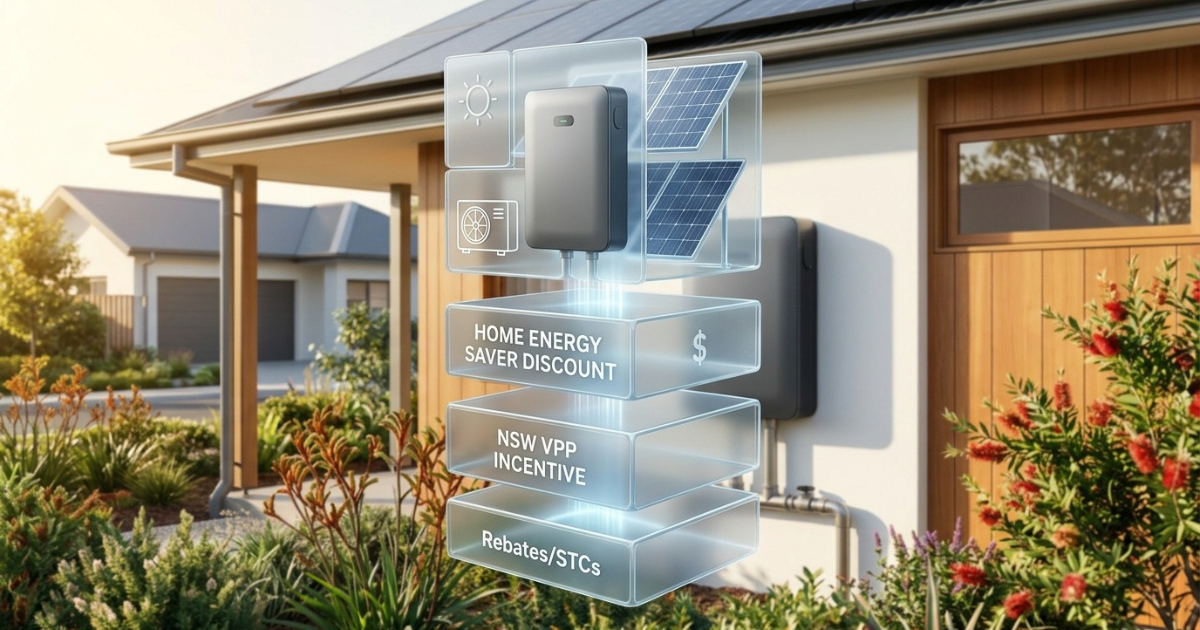
- Apply rebates first (federal solar and battery STCs, the NSW VPP incentive and any Home Energy Saver discount), then use the loan for the remaining balance.
- From 10 November 2026, the loan is limited to households with a combined taxable income of $150,000 or less.
What the NSW Home Energy Saver program offers
Home Energy Saver is a $557 million NSW Government program with two parts: zero-interest loans ($480 million) and upfront discounts ($77 million).
The zero-interest loan
- Amount: up to $15,000, repaid over up to 10 years.
- Cost: no interest and, through Brighte, no account, service or admin fees.
- Who delivers it: Brighte and Plenti. You apply through them or your installer, not the government directly.
- Who can apply: NSW homeowners and landlords. Social housing and short-stay properties are excluded.
- Income cap: combined taxable household income of up to $210,000, falling to $150,000 from 10 November 2026.
The upfront discount
A discount of up to $4,000 is planned for households with a combined taxable income of up to $80,000, or with an eligible concession card. It isn’t open yet, but you can register for updates on the NSW Government website.
What it covers
Eligible upgrades include rooftop solar, home batteries, heat pump and solar hot water, reverse-cycle air conditioning, insulation, switchboard upgrades, ceiling fans and draught-proofing. Check the full product list in the official loan guidelines before getting quotes.
Expert tip
Check your eligibility with the NSW Government’s Energy Savings Finder before you get quotes. Finance providers assess the combined taxable income of all property owners, so have your latest tax assessments ready.
Which rebates stack with the Home Energy Saver loan?
The loan is designed to sit on top of existing incentives, not replace them. Here are the main ones available to NSW households.
Federal solar rebate (STCs)
The Small-scale Renewable Energy Scheme gives an upfront discount on rooftop solar through small-scale technology certificates (STCs). It’s worth roughly $2,000 on a typical 6.6 kW system, and it reduces each January until the scheme ends in 2030. Your installer applies it to your quote.
Federal battery rebate (Cheaper Home Batteries Program)
The federal battery rebate also uses STCs. Since 1 May 2026, it’s worth about $252 per kWh of usable capacity on the first 14 kWh, based on an STC price of around $37. It drops to 60% of that rate for capacity between 14 and 28 kWh, and 15% between 28 and 50 kWh. That’s about $2,520 off a 10 kWh battery. The battery must be on the approved list and be VPP-capable, though you don’t have to join a VPP to get this rebate.
NSW VPP incentive (Peak Demand Reduction Scheme)
NSW pays a one-off incentive when you connect a battery to an approved virtual power plant (VPP). The amount scales with battery size, up to around $1,500 for larger batteries, and depends on certificate prices at the time.
NSW Energy Savings Scheme discounts
The NSW Energy Savings Scheme can reduce the price of heat pump hot water and other efficient appliances. Accredited providers apply the discount upfront, so it should already be in your quote.
Home Energy Saver discount
If your household is eligible, the planned discount of up to $4,000 also comes off before the loan.
Expert tip
Ask every installer for an itemised quote showing each rebate as a separate line. If the federal and state discounts aren’t listed, you can’t tell whether you’re borrowing more than you need to.
In what order should you apply incentives?
The rule is simple: every rebate and discount comes off first, and the loan covers what’s left. The NSW Government advises households using both a discount and a loan on the same upgrade to apply for the discount first. Loan provider Brighte also requires installers to apply any existing federal or NSW incentives before the loan.
In practice, the order looks like this:
- Federal STC discounts for solar and batteries, applied by your installer.
- NSW Energy Savings Scheme discounts for eligible appliances such as heat pumps.
- NSW VPP incentive if you’re connecting a battery to a VPP.
- Home Energy Saver discount if your household is eligible.
- Home Energy Saver loan for the remaining balance, up to $15,000.
Expert view
NSW Energy Minister Penny Sharpe says efficient upgrades deliver lasting savings, but “the upfront cost puts them out of reach for many families.” Stacking rebates before the loan shrinks that upfront cost as far as possible.
Expert tip
Rebate values change on fixed dates. Check when your installation will be signed off, because the federal battery rebate is set by the date of installation, not the date you sign the quote.

What stacking looks like for NSW homes
These examples use typical installed prices and current rebate estimates. Your quote will vary with your home, products and installer, and rebate values move with certificate prices.
Solar and a battery for a home with no solar
| Item | Amount |
| 6.6 kW solar and 10 kWh battery, installed | $20,000 |
| Federal solar rebate (STCs) | −$2,000 |
| Federal battery rebate | −$2,520 |
| NSW VPP incentive (example) | −$1,000 |
| Balance covered by the loan | $14,480 |
| Repayment over 10 years | about $121 a month |
Heat pump hot water replacing an electric storage system
| Item | Amount |
| Heat pump hot water system, installed | $4,500 |
| Federal STCs and NSW ESS discounts (example) | −$1,200 |
| Balance covered by the loan | $3,300 |
| Repayment over 10 years | about $28 a month |
A battery for a lower-income household with existing solar
| Item | Amount |
| 10 kWh battery, installed | $11,000 |
| Federal battery rebate | −$2,520 |
| NSW VPP incentive (example) | −$1,000 |
| Home Energy Saver discount (once open) | −$4,000 |
| Balance covered by the loan | $3,480 |
| Repayment over 10 years | about $29 a month |
Without stacking, the first household would need to borrow the full $15,000 and pay the remaining $5,000 upfront. Applying every rebate first keeps the whole project within the loan limit.
Expert tip
Compare the monthly repayment with your expected monthly bill savings. For many homes with solar and a battery, the savings match or exceed the repayment, so the upgrade can pay its way from the first bill.
Common mistakes when stacking rebates
- Borrowing before the rebates come off. If your loan is calculated on the full price, you repay money the rebates should have covered. Check the loan amount matches your quote after discounts.
- Choosing a battery that isn’t VPP-capable. It won’t qualify for the federal rebate, and you’ll miss out on the NSW VPP incentive.
- Oversizing your battery for the rebate. The federal rebate is reduced above 14 kWh, so a bigger battery adds cost faster than it adds rebate.
- Signing a VPP contract without reading it. The NSW incentive is a one-off payment, but the VPP terms can last for years. Compare exit fees and how much control the provider has over your battery.
- Missing the income deadline. Households earning between $150,000 and $210,000 lose loan eligibility from 10 November 2026.
- Using an unaccredited installer. Federal and NSW incentives require accredited installers and approved products. Check before you sign.
Expert tip
Get at least three quotes. Prices for the same system can vary by thousands of dollars, and a lower starting price means a smaller loan and lower repayments.
Ready to make your rebates go further?
Compare quotes from accredited NSW installers that apply every federal and state rebate upfront, and find out how much of your upgrade the Home Energy Saver loan could cover.
Frequently asked questions
Can I use the Home Energy Saver loan and the federal battery rebate together?
Yes. The Home Energy Saver loan is designed to stack with the federal Cheaper Home Batteries Program. Your installer applies the federal rebate as an upfront discount on your quote, and the zero-interest loan then covers the remaining balance, up to $15,000. Adding the NSW VPP incentive reduces the amount you need to borrow even further.
Who is eligible for the NSW Home Energy Saver loan?
NSW homeowners and landlords can apply if their combined household taxable income is within the cap. The cap is $210,000 until 10 November 2026, then $150,000. Social housing and short-stay properties are excluded. You apply through the participating finance providers, Brighte and Plenti, usually with help from your installer.
Can I get both the Home Energy Saver discount and the loan?
Yes. Eligible households can use both on the same upgrade. The discount of up to $4,000 is for households with a combined taxable income of up to $80,000 or an eligible concession card. The NSW Government advises applying for the discount first, then using the loan to cover the remaining cost.
Do I have to join a VPP to get the federal battery rebate?
No. Your battery must be VPP-capable to qualify for the federal Cheaper Home Batteries rebate, but joining a VPP is optional. You only need to join an approved VPP if you want the separate NSW VPP incentive, which is a one-off payment that scales with the size of your battery.
How much can I save by stacking rebates with the loan?
It depends on what you install. A typical 10 kWh battery attracts around $2,520 from the federal rebate, plus the NSW VPP incentive if you join a VPP. Solar adds roughly $2,000 in federal STCs on a 6.6 kW system. The loan then removes interest on whatever balance remains.
Key takeaways
- The NSW Home Energy Saver loan offers up to $15,000 at zero interest over 10 years for solar, batteries and efficient appliances.
- It stacks with federal solar and battery rebates, NSW Energy Savings Scheme discounts and the NSW VPP incentive.
- Always apply rebates and discounts first, then use the loan for the remaining balance.
- From 10 November 2026, the loan is limited to households with a combined taxable income of $150,000 or less.
- Get itemised quotes from accredited installers so you can see every rebate before you borrow.
Sources
- Home Energy Saver program (NSW Government)
- Energy savings for NSW households: loans and discounts (NSW Government)
- Home Energy Saver rebate listing (Australian Government, energy.gov.au)
- Peak Demand Reduction Scheme updates (NSW Government)
- Home Energy Saver loan details (Brighte)
- State tightens reins on home energy saver loans (Renew Economy)
- NSW battery incentives and solar battery rebates (Energy Matters)