





University of Pennsylvania scientists have devised a new method of harvesting energy from light that is much more efficient than conventional photoconduction and could lead to improved optoelectronic devices.
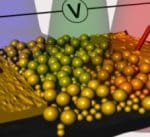
The work, published in the journal ACS Nano, is based on exploiting the light-enhancing characteristics of plasmonic nanostructures; i.e., materials fabricated from gold particles and light-sensitive molecules of porphyin.
Plasmons are a collective oscillation of electrons that become excited and produce an electrical current when exposed to optical radiation. The flow, or pattern, of this current is determined by the size and layout of the gold particles within the system as well as the electrical properties of the surrounding environment.
These materials enhance the scattering of light, giving rise to many technical applications, such as increased absorption of energy in solar cells. This could have big implications for improved solar power systems, according to Dawn Bonnell, Penn’s vice provost for research and Trustee Professor of Materials Science and Engineering in the School of Engineering and Applied Science.
“We’re excited to have found a process that is much more efficient than conventional photoconduction,” Bonnell said. “Using such an approach could make solar energy harvesting and optoelectronic devices much better.”
In a 2010 paper, Bonnell and Penn colleagues reported fabricating a promising plasmonic nanostructure which induced and projected an electrical current across molecules, but the team could not prove the transformation of optical radiation into an electrical current was due to the “hot electrons” produced by the excited plasmons. Other factors may have included that the porphyin molecule itself was excited or that the electric field could focus the incoming light.
By systematically changing the size of the gold nanoparticles, the size of the porphyin molecules and the spacing of those components within the system, the Penn team ruled out these possible factors until the only contributor to higher photocurrent were hot electrons harvested from plasmons.
“In our measurements, compared to conventional photoexcitation, we saw increases of three to 10 times in the efficiency of our process,” Bonnell said. “And we didn’t even optimize the system. In principle you can envision huge increases in efficiency.”
Bonnell foresees a day when devices incorporating plasmonic nanostructures as energy sources are common.
“You could imagine having a paint on your laptop that acted like a solar cell to power it using only sunlight. These materials could also improve communications devices, becoming part of efficient molecular circuits.”