The U.S. Navy has announced it will deploy Imergy Power Systems’ vanadium-based flow battery technology for a new Smart Microgrid project designed to optimise the storage and consumption of solar energy at military bases, college campuses and other institutions.
The system will be rolled out at the Navy’s Mobile Utilities Support Equipment (MUSE) Facility in Port Hueneme, California, and used to demonstrate the effectiveness of energy storage on regulating the often uneven flow of solar power into a power grid.
The project will incorporate releasing bursts of stored power at times of high demand to reduce consumer electricity bills; timed load shifting and management and the smoothing of troughs and peaks in solar energy generation. It will also involve an off-grid islanding application that will show how well an off-grid photovoltaic (PV) solar system with combined battery storage can provide energy for users deployed at remote or mission-critical facilities.
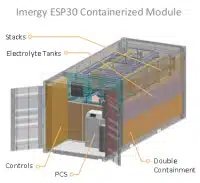
Three Imergy Energy Storage Power (ESP) 30 vanadium flow batteries will be incorporated into the system. Each has a capacity of up to 50 kilowatts and stores up to 200 kilowatt-hours. These batteries can be built for cost below $300 per kilowatt-hour storage, well below the industry benchmark of $500.
The company says this efficiency is possible due to its proprietary process for recycling the rare and expensive element vanadium used in its flow battery systems from secondary sources such as mining slag, oil field sludge and fly ash. This process lowers vanadium cost by 40 per cent relative to Imergy’s competitors.
“Other manufacturers of vanadium flow batteries build their devices with virgin vanadium extracted from mining. It must then be processed to a 99% plus level of purity. Imergy’s flow batteries from low-grade vanadium will also be capable of storing more energy per kilogram than conventional vanadium flow batteries by more than twice,” the company states.
In this type of battery, the chemical interaction of two liquids “flowing” next to each other produces electricity. The ESP30 is Imergy’s flagship storage solution, boasting an unlimited shelf life and the ability to operate in conditions above 55 degrees Celsius.
As the U.S. military transitions away from expensive and burdensome oil-based fuel supply – the Navy currently generates 12 per cent of its energy from renewable sources – transportable battery systems for solar and wind energy will play a larger part in operations at home and abroad, according to Imergy Power Systems CEO Bill Watkins.
“For military personnel, energy security can mean the difference between life and death. This Smart Grid project will pave the way for more secure energy solutions at mission critical military and other facilities.”