Australia has installed over 3.5 million rooftop home solar systems, leading a global clean energy transition. Yet a looming wave of decommissioned solar panels in Australia threatens a massive waste crisis. Understanding solar panel recycling options in Australia helps homeowners future-proof their sustainable investments.
Explore solar quotes to start making conscious energy choices.
Quick answer: What happens to old solar panels?
- Solar panels can be recycled. Specialist recycling processes can recover aluminium frames, glass, copper, silicon, and small quantities of silver.
- Australia faces a growing waste challenge. The Australian Government estimates that approximately one million tonnes of solar panel waste could accumulate by 2035.
- Homeowners have options. Professional removal, reuse, and specialist recycling can keep unwanted panels out of landfill.


What is solar panel recycling in Australia and why does it matter?
Solar panel recycling involves dismantling old, damaged or unwanted photovoltaic (PV) panels and recovering materials that can be reused in manufacturing or other industries.
Most modern solar panels contain valuable materials, including glass, aluminium, silicon, copper and silver. Recovering these resources reduces the need for virgin materials and helps prevent unnecessary waste.
Expert insight: Solar panels are not simply disposable products. Their environmental value extends beyond electricity generation, making responsible end-of-life management essential to a genuinely sustainable renewable energy industry.
Key terminology
Understanding a few industry terms makes solar panel disposal easier to navigate.
- End-of-life solar panels: Panels that have stopped operating effectively or are no longer suitable for their original purpose.
- Solar e-waste: Discarded solar equipment, including panels, inverters, wiring and associated electronic components.
- Solar panel recycling: The process of separating and recovering useful materials from retired panels.
- Product stewardship: An approach that shares responsibility for a product’s environmental impact across manufacturers, suppliers, retailers and consumers.
- Decommissioning: Safely removing a solar installation from a property or solar farm.
Why this matters right now in Australia
Australia has one of the world’s highest rates of rooftop solar adoption, with approximately one in three households having solar panels.
However, many early systems installed during the 2000s and 2010s are approaching the end of their expected working lives. Some panels are also being replaced earlier because homeowners want more efficient technology or larger systems to accommodate household batteries and electric vehicles.
How solar panel recycling in Australia works
Solar panels generally have an expected lifespan of around 25 to 30 years, although they can continue generating electricity beyond their original performance warranty.
When panels become unsuitable for continued use, they can be assessed for reuse or sent to specialist recycling facilities.
Expert insight: Extending the useful life of functioning panels should generally be considered before recycling. Reuse preserves the energy and resources already invested in manufacturing them.
How the recycling process works
The process typically involves several stages:
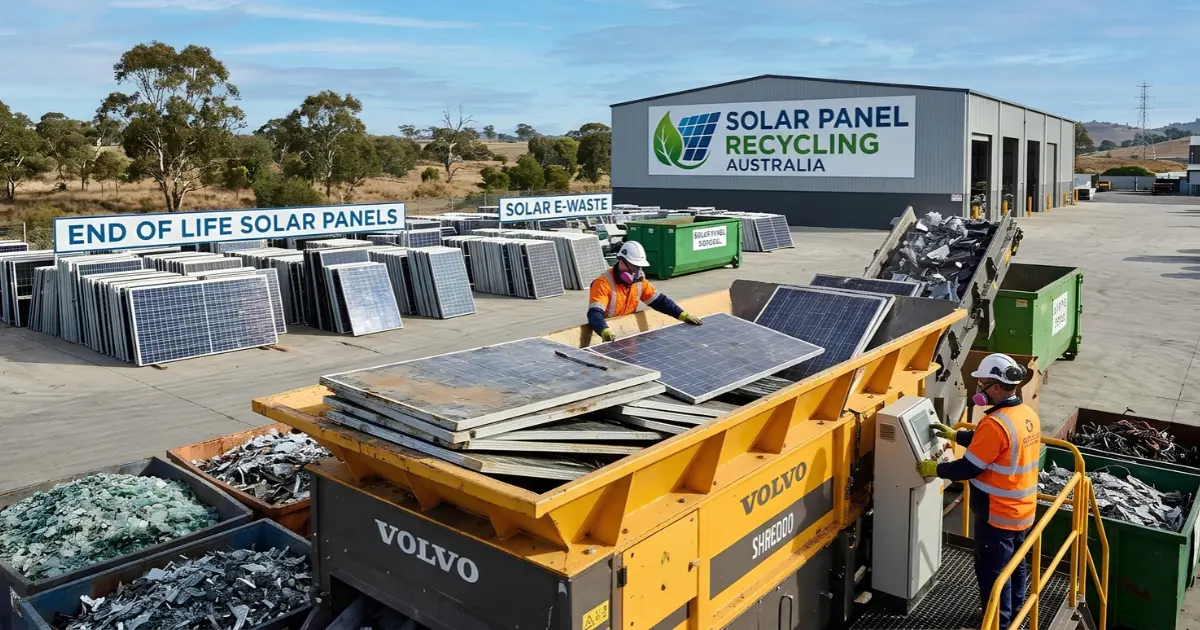
- Collection and transportation: Panels are professionally removed and transported to an authorised recycling facility.
- Inspection and sorting: Workers assess the panels to determine whether they can be repaired, reused or recycled.
- Frame removal: Aluminium frames and junction boxes are separated from the panel.
- Material separation: Specialist equipment separates glass, silicon cells, wiring and other components.
- Material recovery: Recovered materials are processed for reuse in manufacturing or other industrial applications.
The difficulty lies in separating the different layers. Solar panels are designed to withstand harsh outdoor conditions, so their glass, encapsulant, and photovoltaic cells are tightly bonded.
What materials can be recovered?
| Solar panel component | Potential recovery | Possible reuse |
| Aluminium frame | High recovery potential | New frames and metal products |
| Glass | High recovery potential | Glass and construction products |
| Silicon cells | Specialist processing required | Industrial and solar manufacturing |
| Copper wiring | Recovered through separation | Electrical products |
| Silver | Specialist extraction required | Electronics and solar manufacturing |
| Plastics and encapsulants | More difficult to recover | Specialist material recovery or treatment |
The Victorian Government reports that specialist recyclers can recover up to 90% of a solar panel’s materials, depending on the recycling process and the panel’s condition.
Australian examples and developments
Australia already has businesses recovering materials from decommissioned solar panels.
ARENA-supported research is also helping develop more efficient recycling processes. However, the industry still faces challenges with collection networks, transportation costs, and a consistent supply of waste panels.
In September 2026, The Guardian Australia reported that the Federal Government’s approximately $25 million national recycling pilot had been delayed amid procurement issues. The development highlighted the uncertainty facing Australian recyclers and investors.

What happens to your electricity bills when solar panels reach end of life?
Solar panel recycling does not directly reduce a household’s electricity bills. However, how homeowners manage an ageing solar system can affect replacement costs, energy production and long-term savings.
Expert insight: Replacing panels before they genuinely need replacing can create unnecessary expenses and additional waste. A professional system assessment can help determine whether maintenance, repairs or a complete upgrade makes the most financial sense.
Short-term impact
When solar panels deteriorate or become damaged, their electricity generation may decline. This can increase reliance on grid electricity, particularly during daylight hours when a household would otherwise use solar power. Homeowners may also face expenses associated with:
- Professional system inspections.
- Removing damaged or outdated panels.
- Transporting panels to recycling facilities.
- Purchasing and installing replacement equipment.
- Upgrading inverters or electrical components.
Long-term implications
Choosing a suitable replacement system can restore generation capacity and improve household energy efficiency.
Energy Matters recommends switching to energy-efficient appliances now to save money and live more sustainably.
However, homeowners should consider the complete lifecycle of their investment, including product warranties, expected performance, maintenance requirements and recycling arrangements.
Before upgrading, explore available solar panels and module options and consider whether your existing installation can accommodate a battery.
Use Energy Matters’ easy-to-use solar power and solar battery storage system calculator to determine the right size for your solar system with storage. Our solar calculator will generate performance information and potential savings.
We can send this information to 3 pre-vetted, trusted local installers in your area so they can provide obligation-free solar quotes and help you take the first step toward true energy independence!

Costs and savings of solar panel recycling in Australia
One of the biggest barriers to widespread solar panel recycling is the cost of collecting and transporting bulky panels.
Unlike aluminium and copper, which have established recycling markets, recovering some materials from photovoltaic modules requires specialised equipment and additional processing.
Expert insight: Recycling economics depend on more than the value of recovered materials. Collection distance, panel condition, processing capacity and transport arrangements all influence the final cost.
Upfront costs
Homeowners may encounter several expenses when disposing of old panels.
These include:
- Labour for professional removal.
- Transportation to a collection or recycling facility.
- Sorting and processing charges.
- Fees for handling damaged or unsuitable equipment.
Indicative costs and potential savings
| Item | Indicative cost or value | What homeowners should know |
| Panel collection and transport | Up to $38 per panel in an industry estimate | Depends on location and provider |
| Proposed recycling contribution | $10 to $20 per panel | Industry proposal, not a universal current charge |
| Aluminium recovery | Material value varies | Established recycling market |
| Glass recovery | Material value varies | Requires suitable processing |
| Silver and silicon recovery | Depends on technology | Specialist extraction is required |
| Reuse of working panels | Potentially avoids replacement costs | Subject to safety and performance testing |
Savings calculation and payback period
Unlike installing solar panels or batteries, recycling does not generally provide a direct financial payback for households.
Potential savings come from avoiding unnecessary replacement, recovering valuable materials, and reducing the environmental costs associated with landfill.
For example, a homeowner with 20 functioning panels should first compare the cost of retaining the existing system against the cost of replacing it. If the panels remain safe and productive, keeping them in service may deliver better financial and environmental value.
There is currently no reliable national household payback period for solar panel recycling.
State-by-state considerations for solar panel disposal
Solar panel disposal requirements vary across Australia. Homeowners should check their state environmental authority and local council requirements before arranging removal.
- Victoria (VIC): Victoria has one of Australia’s strongest e-waste disposal frameworks. Since 2019, e-waste, including photovoltaic panels, has been prohibited from landfill. Solar retailers and installers must ensure replaced systems are removed and managed through appropriate authorised facilities.
- New South Wales (NSW): NSW is progressing Australia’s first mandatory solar panel product stewardship scheme. In September 2026, the NSW Government announced proposed requirements for panel brand owners to take responsibility for end-of-life management. The EPA’s draft framework identifies a planned commencement in 2028, subject to implementation arrangements.
- Queensland (QLD): Queensland has supported solar recycling initiatives and industry development. Under changes taking effect in June 2025, solar panels are no longer classified as regulated waste requiring special transport or handling. This does not mean homeowners should put panels into ordinary household bins. Specialist recycling and local disposal guidance remain important.
- South Australia (SA): South Australian homeowners cannot place unwanted solar panels in kerbside bins. The state’s recycling guidance recommends asking installers to remove old panels and arrange appropriate recycling. Check with your council or a specialist recycler for available collection services.
- Western Australia (WA): Western Australia has committed $13 million through its Remade in WA program to establish solar panel collection and recycling pathways. Importantly, solar panels are excluded from the initial phase of WA’s e-waste landfill ban. Homeowners should therefore confirm the appropriate disposal pathway rather than assume the general e-waste restrictions automatically cover photovoltaic panels.
Solar panel reuse vs recycling vs landfill: Which is better?
Not every panel removed from a roof needs to become waste immediately. Consider reuse where panels remain safe and meet performance requirements.
| Option | Environmental impact | Financial considerations | Recommendation |
| Reuse | Extends product lifespan and avoids premature waste | May reduce replacement expenses | Best where panels are safe and functional |
| Repair | Can restore system performance | Often cheaper than full replacement | Suitable for repairable faults |
| Specialist recycling | Recovers valuable materials | May involve collection and processing fees | Preferred for unusable panels |
| Landfill | Loses recoverable resources and creates waste | May appear cheaper initially | Avoid where lawful alternatives exist |
| Uncontrolled dumping | Risks environmental contamination | Can result in penalties | Never recommended |
The distinction between reuse and recycling is important. A panel that still produces electricity may be more valuable as a working product than as a source of recovered glass and metals.
The Australian Government’s recycling initiative also recognises the importance of assessing panels and improving recovery pathways.
What Australian homeowners can do right now?
Households do not need to wait for a national recycling scheme to make responsible decisions about their solar installations.
Practical ways to reduce solar e-waste and ensure unwanted panels are handled appropriately.
Expert insight: Planning for end-of-life management when purchasing a solar system is easier than finding a recycler after panels have already been removed.
Actionable steps
- Inspect your existing system. Arrange a professional assessment if panels show visible damage or reduced performance.
- Consider repairs first. A faulty inverter or electrical connection does not necessarily mean the panels need replacing.
- Explore reuse options. Ask whether functioning panels can be tested and reused safely.
- Find an authorised recycler. Check local council services and guidance from the state environmental authority.
- Arrange professional removal. Solar systems contain electrical components that can remain hazardous even when disconnected from the grid.
- Keep disposal records. Request documentation showing where the panels were transported and how they were managed.
The Australian Government specifically advises homeowners not to remove solar system components themselves. Instead, contact a qualified installer or solar retailer to arrange safe removal.
Questions to ask your installer or retailer
Before purchasing a replacement system, ask:
- Does the company offer an end-of-life panel collection service?
- Which recycling facilities does it work with?
- Are recycling and transportation included in the installation price?
- Can the existing panels be tested and reused?
- Does the manufacturer have a product stewardship or recycling program?
- Will the installer provide documentation confirming responsible disposal?
These questions can help homeowners make informed purchasing decisions while encouraging better industry practices.
Common mistakes to avoid when disposing of solar panels
Even environmentally conscious homeowners can make mistakes when replacing an existing solar installation.
Expert insight: Responsible solar panel disposal starts before removal. Choosing the wrong contractor or disposal pathway can create unnecessary environmental and legal problems. Avoid these common mistakes:
- Putting panels in household rubbish: Solar panels should not be treated like ordinary household waste. Follow state rules and local disposal arrangements.
- Removing panels yourself: Solar installations contain electrical equipment and should be handled by qualified professionals.
- Assuming every damaged panel is unrecyclable: Specialist recyclers may still recover useful materials from damaged modules.
- Replacing functioning panels too early: Older panels may still provide useful electricity for years.
- Ignoring recycling fees: Always request an itemised quote covering removal, transport and processing.
- Choosing an installer without an end-of-life plan: Ask about recycling arrangements before signing an installation agreement.
- Confusing recycling with reuse: Working panels may be suitable for a second application after appropriate testing.
Homeowners should also remember that solar batteries require separate handling. Damaged or unwanted batteries must not be treated as ordinary e-waste because of their potential fire and safety risks. Check our page for our recommended solar battery products.
Frequently asked questions about solar panel recycling in Australia
Can solar panels be recycled in Australia?
Yes. Specialist Australian recycling facilities can recover materials including aluminium, glass, copper, silicon and silver from photovoltaic panels. However, recycling capacity and collection services vary by location. Not every material can currently be recovered economically, so investment in better processing technology and collection infrastructure is important.
How long do solar panels last before recycling?
Most residential solar panels are designed to operate for approximately 25 to 30 years. However, they can continue producing electricity beyond their performance warranty. Their actual lifespan depends on manufacturing quality, installation, weather exposure and maintenance. Homeowners should have panels professionally assessed before deciding to replace them.
What happens to solar panels that cannot be recycled?
Panels that cannot be fully recycled may undergo partial material recovery, with remaining materials sent for appropriate treatment or disposal. The exact process depends on the panel's condition and available facilities. Homeowners should use authorised waste management providers and avoid illegal dumping or unapproved disposal pathways.
Does solar panel recycling cost money in Australia?
It can. Homeowners may pay for professional removal, transportation and recycling, depending on their location and service provider. Some installers include removal arrangements in replacement quotes. A proposed national contribution of $10 to $20 per panel was discussed in 2026, but this is not a universal household recycling fee.
Can I sell or donate my old solar panels instead of recycling them?
Potentially, yes. Panels that remain safe and functional may be suitable for resale, donation or reuse in another application. However, they should undergo appropriate inspection and electrical testing before being transferred. Panels that are damaged, unsafe or no longer suitable for use should be directed to a specialist recycling facility.
Key takeaways: What homeowners should remember?
- Solar panels are recyclable: Specialist processes can recover aluminium, glass, copper, silicon and silver.
- Australia faces a growing waste challenge: Around one million tonnes of solar panel waste are forecast by 2035.
- Reuse should come first: Assess functioning panels for continued use before replacement.
- Disposal requirements differ: Victoria has a landfill ban covering solar panels, while other states are developing different recycling pathways.
- Plan ahead: Ask installers about collection, recycling fees and end-of-life management before purchasing a new system.
Building a more sustainable future for solar in Australia
Australia's solar success should not end with panels being removed from rooftops and sent to landfill. Solar panel recycling in Australia is an important part of building a genuinely circular renewable energy industry, recovering valuable resources and reducing unnecessary waste.
Although national recycling infrastructure is still developing, homeowners can make a difference by choosing durable equipment, maintaining existing systems and asking installers about responsible disposal.
At Energy Matters, we believe the future of clean energy depends on responsible decisions throughout a product's lifecycle.
Planning a solar upgrade? Explore your options with Energy Matters and request a free solar and battery quote from SAA-accredited installers. Make your next solar investment smarter and more sustainable.
Sources and References
- Australian Government: Solar panels and national recycling pilot
- ARENA: Efficient low-cost solar PV recycling technology
- ABC News: Australia's solar panel waste is mounting, January 2026
- The Guardian Australia: Solar panels going to landfill while recycling scheme is on hold, September 2026
- NSW EPA: Solar panel product stewardship scheme
- Victorian Government: Managing end-of-life solar PV
- Australian Government: Replacing and recycling your solar system