


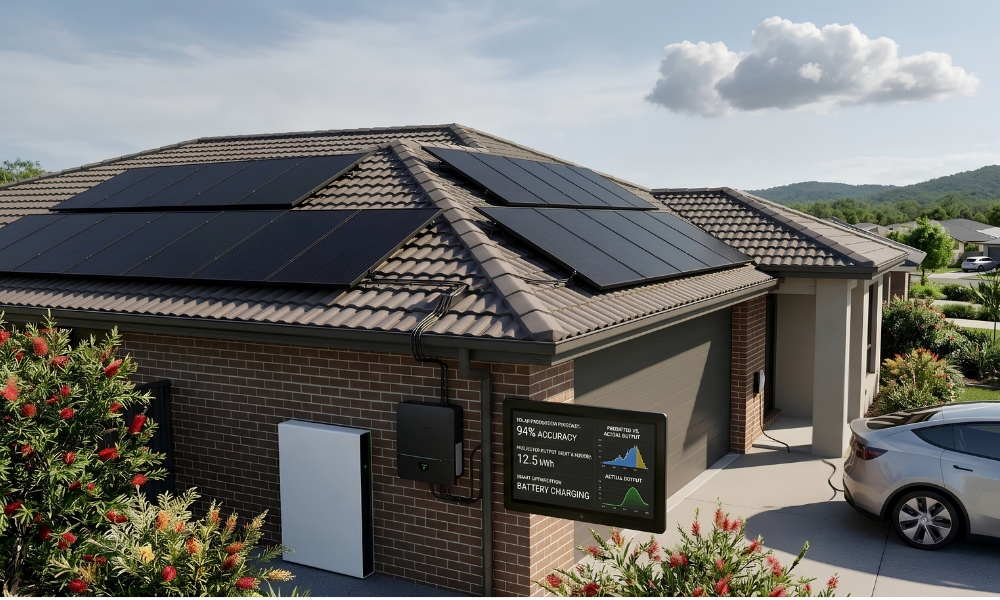
Australia leads the world in rooftop solar adoption, with more than 3.6 million homes generating clean power from the sun. However, unpredictable cloud cover and sudden weather shifts can make daily generation unpredictable for homeowners relying on home solar systems→. AI solar production forecasting Australia systems are changing this landscape by predicting solar output down to the minute. These smart energy management setups let households get the most value from every ray of sunlight.
Ready to compare? Get a solar quote for a smart solar system from SAA-accredited installers today.
Quick answer
- AI solar production forecasting uses weather data, satellite imagery and your system’s own history to predict how much power your panels will generate.
- Your battery, hot water, pool pump, and EV charger can use that forecast to run when it makes the most sense.
- Savings depend on your tariff, battery size and habits, so ask your installer which forecasting tools come with your system.



What is AI solar production forecasting in Australia, and why should Australian homeowners care?
AI solar forecasting uses artificial intelligence, weather information, and electricity-generation data to estimate a solar power system’s future output. It can help households plan energy use around expected sunshine instead of relying only on live monitoring or fixed operating schedules.
The key facts
- Forecasting estimates future generation. It does not increase the physical output of solar panels.
- AI learns from data. Depending on the product, it can identify patterns in weather, household consumption and historical system performance.
- Batteries make forecasts more actionable. Compatible systems can use predictions to schedule charging and discharging.
- Accuracy varies. Fast-moving clouds, storms, shading and equipment faults can affect actual generation.
- Not every solar system needs AI. A basic monitoring app may be enough for households that mainly want to see how much electricity they generate.
Why this matters right now in Australia
The Australian Energy Market Operator (AEMO) regularly manages record levels of rooftop solar generation feeding into the grid simultaneously. This high penetration often leads to negative feed-in tariffs during peak mid-day sun hours.
Smart solar forecasting lets Australian households shift from passive generation to active energy management. Instead of exporting cheap solar back to the grid for minimal returns, smart systems ensure your self-consumption stays high.
Reduce your home carbon footprint with solar. Explore residential solar options from Energy Matters→.
Expert insight: AEMO market data show rooftop solar supplied more than 100% of South Australia’s electricity demand for several hours on clear spring days. Without smart solar forecasting, home battery systems risk charging from the grid during high-cost periods instead of storing free solar power.

How AI solar forecasting works in Australia
AI solar forecasting combines several information sources to estimate how much electricity a system will produce over a particular period. Some products provide a simple daily estimate, while more sophisticated energy management platforms use forecasts to help automate household electricity decisions.
The technical explanation
A typical solar forecast AI system works through five stages.
- Collect data. The system gathers weather forecasts, sunlight estimates, historical solar output and, where available, inverter or smart meter readings.
- Analyse conditions. Its models assess cloud cover, temperature, expected sunlight and seasonal generation patterns.
- Predict solar output. The software estimates the electricity your panels are likely to generate at different times of day.
- Compare supply with demand. Compatible energy management systems combine the forecast with expected household consumption and battery charge levels.
- Recommend or automate actions. Depending on the system, it may suggest running appliances during sunny periods or schedule battery operation within configured limits.
For example, imagine your household typically generates plenty of solar electricity on a clear summer day. Your forecasting platform predicts heavy cloud cover tomorrow afternoon and estimates that generation will fall below normal.
If your system supports automated energy management, it could charge the home battery earlier in the day if there is sufficient solar energy. It might also recommend shifting flexible electricity use to a sunnier period.
Forecasts remain estimates, not guarantees. A sudden storm or unexpected cloud formation can change production, so effective systems update their predictions as new information becomes available.
Use Energy Matters’ easy-to-use solar power and solar battery storage system→ calculator to determine the right size for your solar system with storage. Our solar calculator will generate performance information and potential savings.
We can send this information to 3 pre-vetted, trusted local installers in your area so they can provide obligation-free solar quotes and help you take the first step toward true energy independence!

Australian examples and data
Australia’s forecasting expertise extends beyond household apps. ARENA supported the Solar Power Ensemble Forecaster project, which combined multiple forecasting approaches, including satellite imagery, sky cameras, statistical models and weather predictions, to improve short-term solar forecasting across sites in NSW, Queensland and Victoria. The project concluded in 2022.
That research illustrates an important principle behind smart solar forecasting. Combining several sources of information can produce a more useful prediction than relying on a single weather indicator.
For consumers, however, a product’s quality depends on how it’s implemented. An app labelled AI-powered may offer little more than a basic weather-based estimate, so it is worth checking what data it uses and what actions it can perform.
What does AI solar production forecasting mean for your electricity bills?
Short-term impact
In the short term, forecasting helps your system make smarter daily choices. On a sunny forecast, it frees up battery space for midday solar. On a cloudy run, it may top up from cheaper off-peak power before the evening peak.
- Smarter battery scheduling: Charge when power is cheap or free, discharge when it is dear.
- Better hot water timing: A solar hot water system→ or element can heat when the sun is strongest.
- Gains are real but not magic: They depend on your tariff, battery size and habits. The WA Government says households with solar and a battery could save up to $1,500 a year, which gives a sense of the opportunity.
- Sun-powered driving: Smart EV chargers→ can charge from surplus solar.
Powering up your EV with solar
If you’re thinking of buying an EV, adding an EV charger to your solar system is a smart way to “fuel” your car with clean, renewable energy.
Long-term implications
Over the longer term, better forecasts support virtual power plants (VPPs)→, where home batteries are grouped to help the grid. As AI solar production forecasting for Australian providers matures, platforms can commit your battery’s capacity more precisely, which may increase VPP rewards. VPP offers→ vary by provider.
Forecasting also protects your investment as feed-in tariffs trend down. When exports earn less, using your own solar is worth more. Pair smart forecasting with energy-efficiency upgrades→ to reduce the load your solar has to cover.
Energy Matters recommends switching to energy-efficient appliances→ now to save money and live more sustainably.
What Australian homeowners can do right now
Actionable steps
- Check your inverter app. Look for production forecasts or a smart battery mode.
- Keep your system online. Reliable Wi-Fi gives the model the data it needs.
- Move flexible loads to the sun. Run the dishwasher and pool pump when the forecast is strong.
- Choose smart add-ons. A solar hot water system and smart EV chargers can follow the forecast.
- Compare your plan. Time-of-use and dynamic tariffs reward good forecasting most, so request solar quotes→ that state the tariff assumed.
Questions to ask your installer or retailer
- Which app or platform provides the forecast, and does it charge an ongoing fee?
- What data does it use, such as weather, satellite imagery and my usage history?
- Does the battery adjust its charging automatically based on the forecast?
- Is the system compatible with VPPs and dynamic tariffs in my state?
- Which solar panels→ and inverter do you recommend, and how will you handle shading?
- Can you show a real customer example of forecast versus actual output?
Expert insight: Be wary of claims that forecasting alone will slash your bill. It works best as an optimiser for a system that is already well sized and on the right plan.
State-by-state considerations for AI solar prediction
AI solar prediction can benefit households across Australia, but local weather, electricity tariffs, network requirements and government incentives influence how useful a particular system will be.
| State | Key consideration | What homeowners should investigate |
| Victoria (VIC)→ | Variable weather, seasonal production and time-of-use tariffs | Forecast accuracy during cloudy conditions, battery controls and current Victorian energy programs. |
| New South Wales (NSW)→ | Strong rooftop solar uptake and changing electricity prices | Retailer tariffs, export limits and current NSW energy incentives. |
| Queensland (QLD)→ | High solar generation potential and local network constraints | Midday export conditions, battery scheduling and Queensland energy programs. |
| South Australia (SA)→ | High rooftop solar penetration and periods of abundant daytime generation | Export management, battery optimisation and South Australian energy policies. |
| Western Australia (WA)→ | Different market arrangements between the South West Interconnected System and regional networks | Synergy or Horizon Power tariffs, network compatibility and the WA Residential Battery Scheme. |
Expert predictions for 2027 and beyond
AI solar production forecasting: Australia is moving from a nice-to-have to an expected feature. Several trends point the same way.
- More solar: AEMO’s Step Change scenario sees 47 per cent of suitable NEM homes with rooftop solar by 2035, up from 36 per cent today.
- Bigger volumes: rooftop installations are on track to pass 300,000 in 2026, with batteries installed faster than solar.
- Two-way EVs: Australia approved the first vehicle-to-grid→-capable chargers in the first half of 2026.
- Better data: house-level and solar farm self-forecasting should improve accuracy.
Frequently asked questions
What is AI solar production forecasting?
AI solar production forecasting uses machine learning to predict how much electricity your solar panels will generate over the next minutes, hours and days. It combines weather forecasts, satellite cloud data and your system’s past performance. Batteries, hot water and EV chargers can then run at the best time.
How accurate is AI solar forecasting?
Accuracy depends on your location, the weather and how much data your system has collected. Short-term forecasts covering the next few hours are usually more reliable than day-ahead predictions, and results improve as the model learns your roof. No forecast is perfect.
Do I need a battery to benefit from smart solar forecasting?
No, but a battery benefits most. Without storage, you can still use forecasts to schedule flexible loads, such as your dishwasher, pool pump, hot water, and EV charger, for sunny periods. With a battery, it can also decide when to charge or discharge.
Can I add AI solar prediction to an existing system?
Often, yes. Many inverter apps, home energy management systems, and retailer or virtual power plant platforms add forecasting to existing solar systems. Compatibility depends on your inverter, meter and internet connection, so ask a SAA-accredited installer what your setup supports before you pay for extras.
Will AI solar forecasting lower my electricity bills?
It can, but results vary. Forecasting helps you use more of your own solar and avoid buying expensive grid power, particularly on time-of-use or dynamic tariffs. Savings depend on your plan, system size, battery and habits, so treat any promised dollar figure with caution and ask for the assumptions behind it.
Key takeaways
- AI forecasting predicts your solar output using weather data, satellite imagery and your system’s own history.
- Forecasts let batteries, hot water, and EV chargers run when it makes the most sense, so you use more of your solar at home.
- Savings depend on your tariff, battery size and habits, so avoid promises of fixed dollar savings.
- Ask installers which app provides the forecast, what data it uses and whether there are ongoing fees.
- State schemes differ, so check current VPP and battery rebates in VIC, NSW, QLD, SA and WA before signing.
Get started with smarter solar energy: Find the right solar and battery solution for your home
AI solar production forecasting Australia households can use today turns a rooftop system from a passive generator into a planner. By predicting your output, smart systems help your battery, hot water, and EV charger run when you need them, which can mean lower bills and less wasted sunshine. Results depend on your tariff, system and habits, so ask your installer the right questions and compare options before you buy.
Energy Matters helps Australians explore solar and battery options with their energy needs in mind. Compare your options today and get a free solar + battery quote, plus more, from suitable accredited installers to take the next step toward a smarter, more efficient home.
Sources and References
- Australian Energy Market Operator (AEMO): Australian Solar Energy Forecasting System
- Australian Renewable Energy Agency (ARENA): Solar Power Ensemble Forecaster
- Clean Energy Council: Rooftop solar and storage report, January to June 2026
- Clean Energy Regulator: Record solar and battery growth, August 2026
- ABC News: Household battery storage surges as plunging solar tariffs improve the economics, March 2025
- The Guardian Australia: Home batteries are cheaper than ever, here’s what to consider before installing one, February 2025
- Western Australian Government: WA Residential Battery Scheme