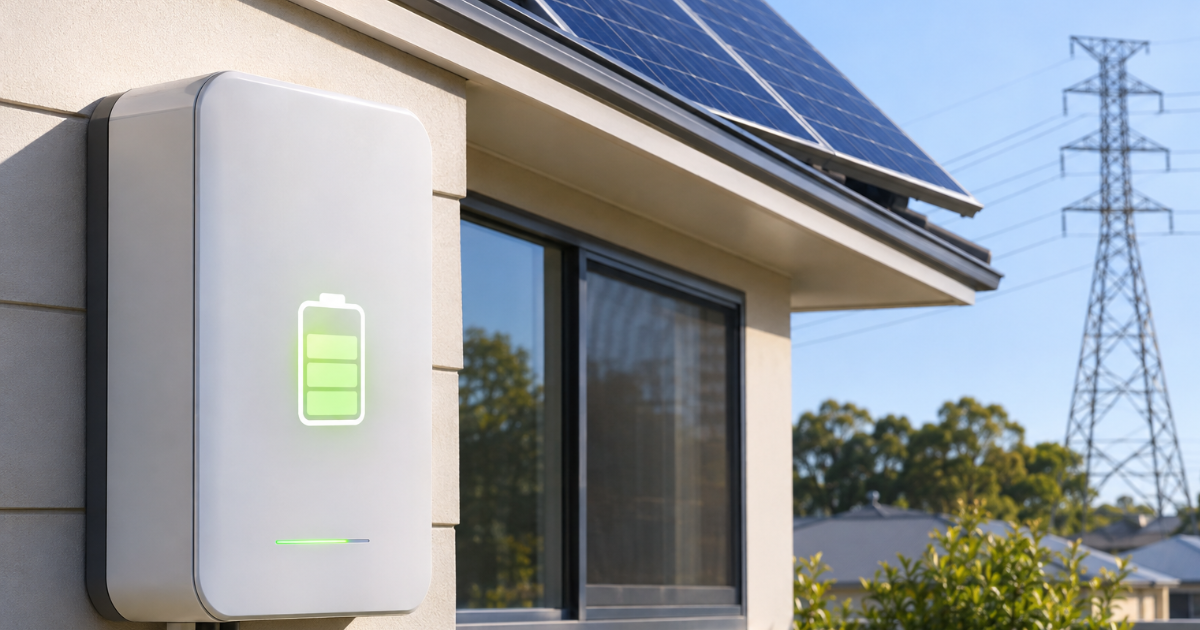
Australians installed more than 1 GWh of home batteries in October 2026 alone. At the same time, South Australia, Queensland, Victoria, Western Australia and now NSW all have an emergency backstop that lets networks turn down or pause rooftop solar during rare grid emergencies.
So what happens to your battery when that switch gets flipped? The honest answer is that it depends. Two homes with similar batteries can behave very differently during the same event, depending on the type of instruction sent, how the battery is wired, and which state you live in.
The good news is that backstop events are rare and short. But if you’re buying a battery, a few questions now can make sure your system keeps working the way you expect when one happens.
Quick summary
- A “zero export” instruction usually lets your solar keep powering your home and charging your battery. A “zero generation” instruction can stop your solar entirely.
- Your battery setup (hybrid, AC-coupled or with backup circuits) and your state’s backstop method decide what keeps running.
- Internet-based control (CSIP-AUS) can limit exports only, while signalling devices and voltage-based methods switch solar off altogether.
What does a backstop actually do to your home?
A backstop is a last-resort tool for rare days when too much rooftop solar is flowing into a grid that’s already under strain. A typical candidate is a mild, sunny spring weekend when demand is low, combined with a major power station or transmission line going offline.
During an event, your home stays connected to the grid. What changes is what your solar is allowed to do, and that depends on the type of instruction your system receives.
Zero export
Your system is told to stop sending power to the grid. Your solar can usually keep running your home and charging your battery. You simply stop earning feed-in credits for the duration.
Zero generation
Your solar inverter is told to stop producing power altogether, or is disconnected. That means no solar for your home or your battery, either. Your home draws from the grid, or from your battery if it can still discharge.
For most households, a short event costs little more than a few kWh of solar and a few cents in feed-in credits. An ARENA-funded research project led by UNSW, Project CICCADA, is now measuring the real impact on solar, battery and VPP owners.
Expert tip
Events are most likely in the middle of the day, when your battery would normally be charging from solar. If your solar is paused, your battery may finish the day less full than usual. It’s worth knowing, but rarely worth worrying about.
How your battery setup changes the outcome
How your battery is connected to your solar makes a big difference to what keeps running.
Hybrid inverter (DC-coupled)
One inverter handles both your solar panels and your battery. It’s the most common setup for new solar and battery installs. Its behaviour depends on how the manufacturer has programmed it to respond. Some can stop exporting while still powering your home and charging the battery. Others may stop more of the system if they receive a zero generation signal.
AC-coupled battery
Your battery has its own inverter, separate from your solar inverter. This is common when a battery is added to an existing solar system. If only the solar inverter is curtailed, the battery inverter can usually keep supplying your home from stored energy.
Backup circuits
Backup (or blackout protection) usually switches on when the grid goes down. Because a backstop event doesn’t cut your grid connection, backup mode may not activate at all. Don’t assume backup circuits will keep your solar running during a backstop.
Your state’s backstop method matters too
Different networks use different tools to deliver a backstop, and they don’t all treat batteries the same way. Here’s how the main methods compare:
| Method | Where it’s used | What it does to your system |
| Internet control (CSIP-AUS) | NSW, Victoria and Western Australia | Your network sends instructions to your inverter over the internet, either to reduce exports or to pause generation. |
| Generation Signalling Device | Queensland, for systems of 10 kVA and above | A signal sent through the power lines switches the inverter into a mode where it stops generating. It automatically returns to normal after 4 hours if no “on” signal arrives. |
| Enhanced Voltage Management | South Australia | Network voltage is raised so solar inverters trip off. It’s used as a last resort, at AEMO’s direction. |
Each method is set out by the relevant network or government: the NSW Government for CSIP-AUS in NSW, Energex and the Queensland Government for signalling devices, and SA Power Networks for voltage management. Victoria has required CSIP-AUS backstop capability on new systems since October 2024, according to ANU’s Institute for Climate, Energy & Disaster Solutions.
The key difference for battery owners: an instruction to reduce exports only limits what goes to the grid, while a signal that pauses generation or trips the inverter stops your solar altogether.
Expert reference
The NSW Government describes the backstop as a last resort that AEMO only triggers after other actions have been taken, with networks restoring solar as soon as the emergency passes.
Expert tip
In Queensland, a signalling device is required for systems of 10 kVA and above. If your system is close to that size, ask your installer whether it triggers the requirement, since a signalling device stops all generation during an event, including what your home would use.

What to ask before you buy a battery
Most installers won’t raise backstop behaviour unless you ask. These questions will tell you a lot about both the system and the installer:
- How will this system respond to a zero export instruction? Ideally, your solar keeps running your home and charging the battery.
- And to a zero generation instruction? Find out whether the battery can still supply your home if the solar is paused.
- Which backstop method does my network use? This varies by state, and in Queensland by system size.
- Is the system hybrid or AC-coupled? If you’re adding a battery to existing solar, ask how both inverters will be controlled.
- Will the system be registered and online at handover? An unregistered or offline system can’t respond properly, and in NSW it will have its exports capped.
- If I join a VPP, how does that interact with a backstop? A backstop instruction overrides normal export settings, including dynamic limits.
Expert tip
Ask your installer to show you the backstop or demand response settings in the inverter app at handover. If they can’t explain what the system will do during an event, that’s a sign to keep asking questions.
Buying a battery?
Compare quotes from accredited installers who can explain exactly how your system will behave during a backstop event, and set it up properly from day one.
Frequently asked questions
Will my battery stop working during a solar backstop?
Not necessarily. Under a zero export instruction, your solar can usually keep running your home and charging your battery. Under a zero generation instruction, your solar may stop, but your battery may still supply your home. The outcome depends on your inverter setup and your state’s backstop method.
What is the difference between zero export and zero generation?
Zero export means your system stops sending power to the grid but can keep supplying your home and battery. Zero generation means your solar inverter stops producing power altogether, so your home and battery can’t use it during the event. Zero export has a much smaller impact on households.
Will my backup power turn on during a backstop event?
Probably not. Backup or blackout protection usually activates only when the grid goes down, and a backstop event doesn’t disconnect your home from the grid. Your home keeps drawing grid power as normal. Check with your installer how your specific system behaves.
Does joining a VPP protect me from a backstop?
No. A backstop instruction takes priority over your normal export settings, including VPP and dynamic export arrangements. That said, VPPs and batteries that charge from midday solar help reduce the oversupply that makes backstops necessary in the first place, so more of them should mean fewer events.
How often do backstop events happen?
Rarely. The best-known activations have been in South Australia, including during a November 2022 event when the state was operating separately from the rest of the national grid. AEMO only directs networks to use a backstop after other options are exhausted, and normal operation resumes once the emergency passes.
Key takeaways
- A backstop event reduces or pauses your solar, but your home stays connected to the grid.
- Zero export usually leaves your solar powering your home and battery. Zero generation can stop your solar entirely.
- Hybrid and AC-coupled batteries can respond differently, so ask how your system is set up.
- Internet-based control (CSIP-AUS) can limit exports only, while Queensland’s signalling devices and South Australia’s voltage method switch solar off altogether.
- Ask your installer how your system responds to each instruction before you buy.
Sources
- NSW Emergency Backstop Mechanism (NSW Government)
- Emergency Backstop Mechanism fact sheet (Energex)
- Emergency backstop mechanism (Queensland Government)
- Solar curtailment for minimum system demand events (SA Power Networks)
- First manufacturer achieves CSIP-AUS v1.2 certification (ANU Institute for Climate, Energy & Disaster Solutions)
- Project CICCADA (ARENA)
- Operating electricity grids with rooftop solar (AEMO)
- Australia is headed for its biggest year of rooftop solar growth ever (Renew Economy)