On one of the hottest nights of the year, South Australia‘s big batteries ran out of charge before the evening peak ended. That night shows why the next question for Australia’s grid isn’t how many batteries we build, but how long they can run.
Australia has built big batteries at record pace. The grid-scale fleet in the National Electricity Market (NEM) now holds about 17.7 GWh of storage, yet it averages just 2.3 hours of discharge at full power.[1]
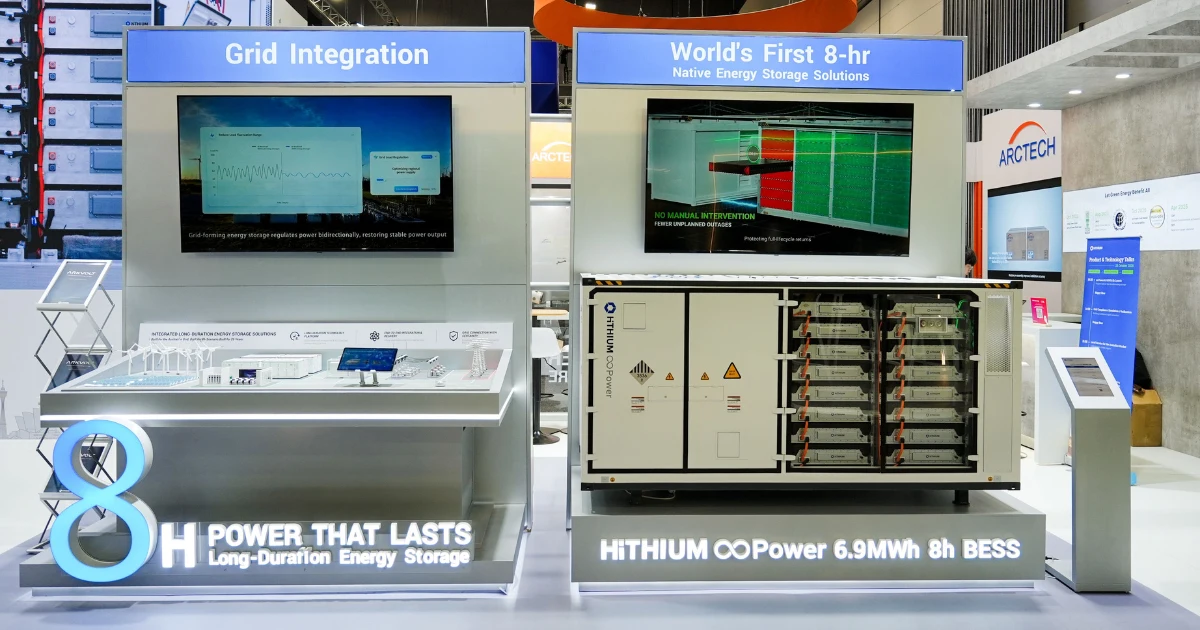
HiTHIUM, a battery manufacturer focused solely on energy storage, thinks that number needs to grow. Its answer is the ∞Power 6.9 MWh, a system it describes as the world’s first battery built from the cell up for eight hours.
A battery that runs out at 8pm is useful. A battery that runs past midnight is infrastructure.
TL;DR
- Duration is the new pressure point: Most of Australia’s grid batteries hold two hours or less, but high-price events are expected to stretch from about 1.5 hours today to 5–10 hours by the 2040s.
- Policy is already moving to eight hours: NSW and South Australia now contract storage that can run for eight hours or more.
- HiTHIUM has built for that standard: Its ∞Power 6.9 MWh uses a dedicated 1,300 Ah cell designed for eight-hour discharge, backed by a 25-year design life.
What happened in South Australia on 26 January 2026?
South Australia had the quarter’s most expensive evening, and its batteries ran low before the evening ended. The Australian Energy Regulator (AER) set out what happened in its report on significant electricity prices.[2]
Parts of Adelaide passed 44°C. Evening demand topped 3,100 MW, within 300 MW of the state’s record. Wind output fell to around 337 MW, about 12% of installed capacity.
Prices ran high from 6:30pm to 10:30pm, peaking at $20,158/MWh for a 30-minute period. AEMO declared an actual lack of reserve from 8:30pm to 9:45pm.
Batteries delivered plenty of power early in the evening. But from around 7:50pm, operators began withdrawing offers, mostly citing state of charge. By 8:55pm, battery offers had fallen below 100 MW, down from an average of 839 MW when high prices began.
The AER attributed the evening’s prices to more than heat alone: high demand, low wind, network constraints and rebidding all played a part. Yet much of that rebidding was itself a duration story — Neoen shifted 130–200 MW at Blyth toward the high-priced evening hours as its forecast state of charge fell, and Vena Energy withdrew 40 MW at Tailem Bend.
The heat continued overnight. When prices spiked again the next morning, the AER found very little battery capacity was on offer.
The batteries did their job. They simply couldn’t last long enough.
A battery that starts discharging at 6:30pm with eight hours of storage could, in principle, keep going until 2:30am— through the morning spike that followed. The AER found that across that quarter, prices above $5,000/MWh added $63/MWh to South Australia’s average wholesale price.[2]
Why is battery duration becoming the big question?
The grid’s hardest hours are getting longer, while most of the battery fleet was built for short bursts. A battery’s duration is how many hours it can discharge at full power. A 100 MW / 200 MWh battery is a two-hour battery.
Two-hour systems make up 5.2 GW of the NEM’s 7.3 GW of operating battery capacity, Modo Energy’s July 2026 long-duration outlook found.[3] Those batteries were designed for a grid with sharp, brief price spikes.
That grid is changing. In the same analysis, Modo forecasts that price events above $300/MWh will lengthen from about 1.5 hours today to between five and 10 hours by the 2040s.
The reliability outlook points the same way. Modo’s reading of AEMO’s 2026 Electricity Statement of Opportunities is that most shortfall events will run longer than four hours by 2030.[4] The existing fleet and pipeline can already cover shorter events.
The industry has moved to four hours. Is that enough?
Developers have already stretched duration. Four hours is now the default for new NEM battery investment, according to Modo Energy’s analysis of duration trends.[5]
The future pipeline holds 24.4 GW of four-hour-or-longer capacity, but only 2.6 GW at eight hours, Modo’s July outlook shows. Four hours would have covered the high-price window on 26 January. It would not have covered the next morning, when batteries that had discharged overnight had little left to offer.
As coal retires, the grid needs storage that can cover a whole evening and still have something left.
How do Australia’s storage schemes treat duration?
Australia’s storage schemes don’t agree on how long is long enough. National tenders mostly buy four-hour batteries, while NSW and South Australia now write eight hours into their contracts, and WA’s requirement is climbing towards seven.
| Scheme | How it treats duration | Latest result or status |
| Capacity Investment Scheme (CIS), NEM dispatchable | Minimum two hours at commercial operation; target set in four-hour equivalents | Tender 8 (June 2026): 15 batteries, 4.2 GW / 16.1 GWh, the vast majority clustered at four-hour |
| NSW Long-Term Energy Service Agreements (LTESA) | Long-duration storage must discharge for at least eight hours | Six batteries totalling 1.17 GW / 11.98 GWh contracted in February 2026 |
| South Australia Firm Energy Reliability Mechanism (FERM) | Contracted capacity must run continuously for eight hours when called | Six batteries totalling 517 MW / 4,136 MWh contracted in May 2026 |
| WA Reserve Capacity Mechanism | Battery duration requirement rises from six hours in 2027–28 to seven hours in 2028–29 | Set in AEMO’s 2026 WEM ESOO |
| Electricity Services Entry Mechanism (ESEM), proposed | Firming services of at least eight hours, with a proposed $600/MWh cap contract | Draft legislation out for consultation since September 2026 |
| UK long-duration storage cap and floor | At least eight hours at full power; 25-year default term | 16 projects provisionally selected in June 2026 |
NSW: the country’s biggest long-duration tender
In February 2026, ASL awarded LTESAs to six battery projects totalling 1.17 GW / 11.98 GWh, all eight hours or longer.[6] The largest, Neoen’s Great Western Battery, has a nominal duration of 10.6 hours.[7]
The round took NSW’s contracted storage to 30 GWh. A further 12 GWh tender has been scheduled to start in Q2 2026, with another 12 GWh in 2027.
South Australia: four-hour batteries derated to fit
South Australia’s first FERM round shows what an eight-hour rule does to a fleet built around shorter durations. Modo Energy’s analysis found that the six winning batteries hold 1,334 MW of nameplate capacity but commit only 517 MW to the scheme.[8]
That’s because four-hour batteries had to derate their power to stretch their energy across eight hours. The state still expects its large-scale battery capacity to grow from 1.1 GW to 2.5 GW.[9]
Derating works. But it means buying more inverters, transformers and grid connection than the firm power you actually get.
National tenders still default to four hours
The federal CIS has been the biggest driver of new batteries, and it mostly buys four hours. Tender 8 projects needed at least two hours of storage at commercial operation.[10] Of the 15 batteries selected in June 2026, 13 are four-hour systems.[11]
The proposed ESEM could change that. Released as draft legislation in September 2026, it would contract firming services that can run for at least eight hours, according to law firm Corrs Chambers Westgarth.[12]
The detail still matters. Some sellers have argued a $600/MWh cap may not reflect the value of assets that can run beyond eight hours, Corrs notes.[12]
WA is lengthening its own requirement
Western Australia runs a separate market with its own rules. In its 2026 WEM ESOO, AEMO lifted the battery duration requirement from six hours in 2027–28 to seven hours in 2028–29, as batteries flatten the evening peak.[13]
What it means for Victorian projects
Victoria has the targets but not yet a dedicated long-duration contract. The Victorian Government aims for at least 6.3 GW of new short- and long-duration storage by 2035.[14]
Much of its new storage arrives through national CIS tenders. Victorian projects won 875 MW / 3,533 MWh in CIS Tender 8, about four hours on average.[15]
That leaves Victorian developers choosing duration largely on merchant returns and national tender rules. Unless the economics change, the state could end up with plenty of four-hour batteries and too few that can last the night.
Overseas regulators are setting similar rules. The UK’s cap-and-floor scheme for long-duration storage requires eight hours of continuous output and runs for 25 years by default.[16] In June 2026, Ofgem provisionally selected 16 projects for the scheme.[17]
What is HiTHIUM’s native eight-hour battery?
HiTHIUM’s ∞Power 6.9 MWh is a battery system designed for eight-hour discharge from the cell level up, rather than a shorter-duration product stretched to fit. The company unveiled it in December 2025 as the ∞Power⁸ 6.9 MW / 55.2 MWh solution, built from one medium-voltage module and eight energy storage modules.[18]
Each 20-foot container holds 6.9 MWh and discharges at 0.125P.[19] In plain terms, it delivers its full energy over eight hours.
Why build a dedicated eight-hour cell?
At the centre of the system is the ∞Cell 1300Ah, a lithium iron phosphate (LFP) cell made specifically for eight-hour storage. HiTHIUM says the cell delivers several times the capacity of mainstream cells and is designed to last more than 25 years.
A battery that discharges over eight hours doesn’t need the same power-handling components as one that empties in two. HiTHIUM says thicker electrodes in the 1,300 Ah cell cut foil and other power-component costs by more than 50% compared with two-hour cells.[20]
Bigger cells also mean fewer parts. Fewer cells and connections per megawatt-hour can simplify assembly, monitoring and maintenance across a large site.
What does HiTHIUM claim for the ∞Power 6.9 MWh?
HiTHIUM lists the following specifications and benefits for the system. Its benefit figures compare the system with HiTHIUM’s own 6.25 MWh container.
- Fully designed for eight hours: 0.125P discharge from a 20-foot container.
- Efficiency: round-trip efficiency of 96% or more, according to HiTHIUM.
- Design life: 25 years.
- Energy density (cell-level): 406 Wh/L volumetric energy density.
- Site footprint: about 15% less land, according to HiTHIUM.
- Project returns: a 5–8% increase in internal rate of return (IRR), according to HiTHIUM’s comparison.
- Layout: side-by-side and back-to-back installation, with low noise levels.
- Compatibility: works with leading power conversion system (PCS) and energy management system (EMS) products.
At SNEC 2026 in Shanghai, HiTHIUM showed the mass-production version of the cell and system. The system uses liquid cooling and is designed to comply with the US fire code NFPA 855.[21]
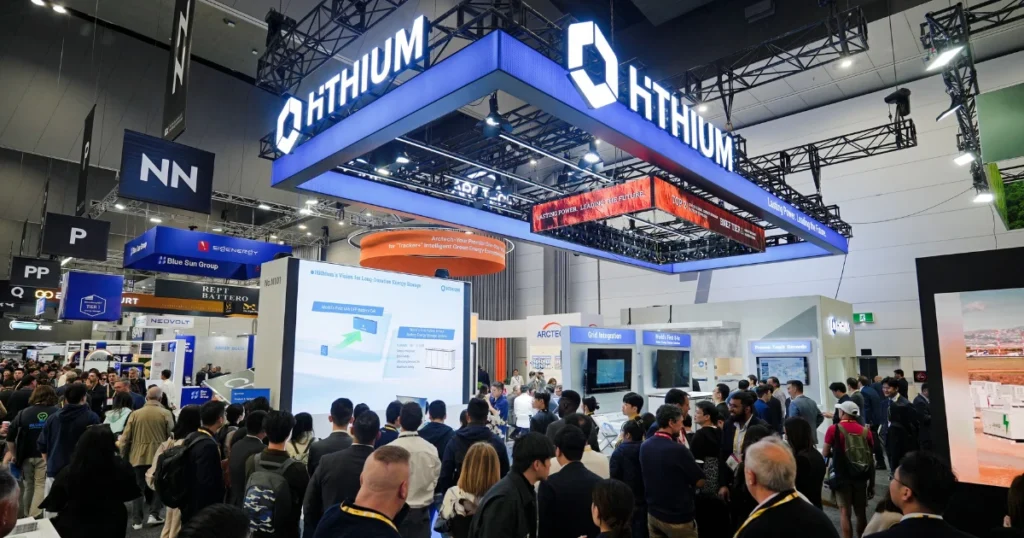
According to HiTHIUM, the planned manufacturing capacity for long-duration energy storage in Chongqing and Heze will exceed 70 GWh, with deliveries set to commence in 2027.
“An eight-hour battery holds twice the energy of a four-hour one for only 60 per cent more per kilowatt — every extra hour adds cells, not inverters,” said Kevin Zhang, Director of Emerging Business & Application at HiTHIUM.
Why native design matters: a four-hour battery derated to deliver eight hours carries power equipment it can’t fully use. A battery designed for eight hours matches its cells, inverters and grid connection to the job from the start.
How safe are large batteries now?
Grid-scale battery failures have fallen sharply, and fire authorities now expect proof at full scale. Bigger cells and longer durations put more energy in each container, so that proof matters even more for eight-hour systems.
The Electric Power Research Institute (EPRI) found in its October 2026 report that global battery storage failures per deployed gigawatt-hour fell 98% between 2018 and 2025.[22] The rate halved again from 2024 to 2025.
EPRI puts annual failure rates for stationary storage at 0.04% to 0.14%. That’s comparable to the roughly 0.1% annual failure rate of oil-filled electrical transformers.[23]
What do Australian fire services expect?
Fire and Rescue NSW updated its guidance for large outdoor battery sites in July 2026.[24] It sets out what a project’s fire safety study must cover, from toxic smoke and firefighting water to hydrants and emergency plans.
The key test is a tough one. The test leaves an entire enclosure to burn with its fire protection switched off, and an independent lab must confirm the fire doesn’t spread to the unit next door.
How did HiTHIUM test its long-duration system?
In February 2026, HiTHIUM completed what it calls the world’s first open-door large-scale fire test of its ∞Power 6.25 MWh four-hour system, which uses its 1,175 Ah cells.[25] UL Solutions, US authorities having jurisdiction and fire protection engineers supervised the test.
The test conditions were deliberately severe:
- Doors open: container doors stayed fully open to maximise oxygen and flame impact.
- Tight spacing: neighbouring containers sat back-to-back and side-by-side, just 15 cm apart.
- Fully charged: the system was at 100% state of charge.
- No suppression: all active fire suppression was disabled.
The fire stayed confined to a single battery system, with no explosions or debris ejection, HiTHIUM said.[26] The test followed the latest UL 9540A (2025) and NFPA 855 (2026) requirements.[27]
HiTHIUM also builds safety into the battery management system (BMS). HiTHIUM says its BMS is certified for functional safety to SIL2 under IEC 61508 and for cybersecurity to SL2 under IEC 62443.
What does a 25-year battery need in Australia?
A battery planned as infrastructure needs three things beyond good cells: a long service life, local support when something goes wrong, and a smooth path through grid connection. HiTHIUM is building all three into its Australian offer.
Built to last 25 years
HiTHIUM expects the ∞Power 6.9 MWh to still hold about 70% of its original capacity after 25 years. That’s based on one full charge-discharge cycle per day, spread over eight hours, and the company says real-world results will depend on how the battery is run.
The company also rates key components for expected lives beyond the battery itself: more than 25.2 years for mechanical parts, 26.7 years for electrical and 27.1 years for thermal management.
That matters because contracts are often shorter than asset lives. South Australia’s FERM agreements run for 15 years,[28] while the batteries behind them could keep operating for a decade longer.
Local service, local parts
HiTHIUM’s Australian service model covers 18+ project sites, 200+ service personnel and warehousing of 1,000 m² or more across Sydney, Brisbane and Melbourne. The company targets on-site response within four hours for all projects and within two hours for 80% of them.
Spare parts sit in four tiers:
- On site: temperature-controlled storage for consumables and fast-moving parts.
- Local warehouse: core parts such as battery modules, held in Australia for short lead times.
- Regional backup: a Brisbane and Melbourne network for wider coverage and replenishment.
- Global hub: Xiamen and Malaysia for bulk replenishment and long-tail parts.
A dedicated service centre in Brisbane, due by mid-2027, will combine offices, a training area, a 200–500 m² warehouse and a rework and maintenance area. HiTHIUM also offers annual preventive maintenance and tiered training so owners can build their own capability.
HiTHIUM works with Australian partners including Raystech.
Grid connection without late surprises
Connecting a big battery to the NEM is slow and paperwork-heavy. Projects move through R0, stability assessment, R1 and R2 stages, and performance changes can trigger a formal reassessment under National Electricity Rules clause 5.3.9.
HiTHIUM’s grid compliance platform is designed to find problems early. It uses in-house PSCAD, PSS®E and DIgSILENT models, automated simulation runs and hardware-in-the-loop testing of real inverter and plant controllers.
HiTHIUM also runs system integration test (SIT) sites in Xiamen, Chongqing and Dallas, with a fourth in Pamplona, Spain, due by Q3 2027. These test project-specific hardware before it ships.[19]
The aim is to find compliance issues in simulation, not during commissioning.
What does this mean for Australia’s energy transition?
Australia doesn’t need fewer short-duration batteries. It needs storage that can also cover the long, hot, windless evenings that test the grid hardest. That means valuing firm hours, not just megawatt-hours.
At Energy Matters, we’ve watched storage go from a niche add-on to the backbone of Australia’s energy transition. As demand grows and coal retires, the question is no longer whether renewables can power the grid, but whether we can store enough of that power for when the sun and wind drop away.
NSW and South Australia have started down that path. The next step is for developers, investors and policymakers to treat long-duration storage as 25-year infrastructure. That means contracts, safety testing, and service plans built for the asset’s full life.
HiTHIUM’s ∞Power 6.9 MWh is built for that job: a native eight-hour system, backed by local service and grid connection support.
“Eight firm hours, starting at 6:30, run until half past two in the morning. That is not a model; it is the clock ,”Kevin Zhang said.
HiTHIUM presented Beyond megawatt-hours: Why long-duration storage must be valued as infrastructure, not just energy at All Energy Australia 2026 at MCEC, Melbourne, on Wednesday 28 October.
On a commodity grid, storage is judged on an average day. On an infrastructure grid, it’s judged on the worst one.
Exploring storage for a business or large site? Learn more about commercial energy storage with Energy Matters.
Frequently asked questions
What is long-duration energy storage (LDES)?
Long-duration energy storage can discharge at full power for many hours, not just one or two. In Australia, NSW’s LTESA scheme and South Australia’s FERM both use eight hours as the benchmark. The UK uses the same eight-hour minimum for its cap-and-floor scheme.
How long do Australia’s grid batteries last on a full charge?
The NEM’s grid-scale battery fleet averaged 2.3 hours of discharge at full power at the end of Q2 2026, according to Modo Energy.[1] Two-hour batteries still make up most operating capacity, although most new investment now targets four hours or more.
What is the HiTHIUM ∞Power 6.9 MWh?
The ∞Power 6.9 MWh is HiTHIUM’s eight-hour battery energy storage system. Each 20-foot container holds 6.9 MWh and discharges over eight hours, using HiTHIUM’s dedicated 1,300 Ah LFP cell. HiTHIUM quotes a 25-year design life for the system.
Why not just use two four-hour batteries?
You can, but power equipment is sized for full output. A four-hour battery derated to cover eight hours carries inverters and grid capacity it can’t fully use. South Australia’s FERM winners, for example, hold 1,334 MW of nameplate capacity to provide 517 MW of firm eight-hour power.
Product specifications and performance claims are as provided by HiTHIUM. This article is sponsored by HiTHIUM.
References
- Modo Energy, NEM BESS build-out report: 2 GW goes live in Q2 2026, July 2026.
- Australian Energy Regulator, Significant electricity prices, January to March 2026, May 2026.
- Modo Energy, NEM BESS Outlook July 2026: The investment case for long-duration storage, July 2026.
- Modo Energy, AEMO’s 2026 NEM ESOO: 5 takeaway opportunities to deliver reliability, August 2026.
- Modo Energy, Duration: Why four-hour BESS is pulling ahead in the NEM, March 2026.
- Energy-Storage.news, Australia’s biggest LDES tender: NSW contracts six battery storage projects totalling 1.17GW/12GWh, February 2026.
- pv magazine, Australian state awards 12 GWh of long-duration storage contracts, February 2026.
- Modo Energy, South Australia FERM: Tender 1 sees BESS win out, June 2026.
- Energy Magazine, SA more than doubles battery capacity with six BESS contracts, June 2026.
- pv magazine Australia, NEM dispatchable capacity CIS Tender 8 opens, targets 16 GWh, November 2025.
- Modo Energy, CIS Tender 8 awards 16 GWh of standalone BESS, the largest dispatchable round yet, June 2026.
- Corrs Chambers Westgarth, Could the ESEM’s warehouse model reshape renewable generation and storage investment across Australia?, 2026.
- AEMO, 2026 WEM Electricity Statement of Opportunities, June 2026.
- Victorian Government, Batteries and energy storage, accessed October 2026.
- Power Peak Digest, Australia approves 4.2 GW of energy storage under Capacity Investment Scheme, June 2026.
- Clifford Chance, Navigating the UK LDES regime after Window 1, July 2026.
- Energy UK, Energy UK Explains: Long duration energy storage, July 2026.
- Modern Power Systems, HiTHIUM ∞Power8 6.9 MW/55.2 MWh launch, December 2025.
- HiTHIUM, presentation materials supplied to Energy Matters: ∞Power 6.9 MWh product overview; Local Service for Australian Market; Grid Compliance Simulation and Verification Platform; Beyond megawatt-hours, 2026.
- HiTHIUM, HiTHIUM unveils the world’s first 8-hour-native energy storage solution for all-weather green power, PR Newswire, December 2025.
- ESS News, Hithium targets 8-hour storage with 1300 Ah cell and 6.9 MWh system, June 2026.
- Energy-Storage.news, Global BESS failure rates declined 98% between 2018 and 2025, October 2026.
- Facilities Dive (Utility Dive), Battery system failures fell 98% in 7 years, but older systems need special attention, October 2026.
- Fire and Rescue NSW, Large-scale external lithium-ion battery energy storage systems: technical information sheet, version 03, July 2026.
- HiTHIUM, HiTHIUM completes world’s first open-door large-scale fire test of a 6.25MWh system with kAh battery cells, February 2026.
- HiTHIUM, Paving the way for mass LDES deployment: ∞Power 6.25MWh 4h passes open-door fire test, May 2026.
- ESS News, Hithium says it completed the world’s first open-door fire test of its 6.25 MWh BESS, February 2026.
- Modo Energy, Explainer: South Australia’s FERM tender, November 2025.
- Modo Energy, NEM hybrid solar and BESS equipment suppliers, 2026.