





6 “lavanauts” have rejoined the community after spending a year participating in Earth’s longest NASA-sponsored simulated Mars mission, living and working in a solar powered habitat.
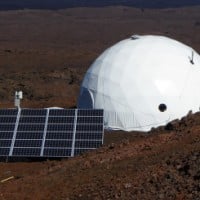
The HI-SEAS IV simulator is located in an abandoned quarry on the northern slope of Mauna Loa, Hawaii at an elevation of just under 2.5 kilometres.
Since August 2015, three men and three women have been going about life as it may be experienced on a Mars mission; including donning simulated space suits when venturing outside the habitat once a week.
The crew were effectively cut off from the outside world aside from infrequent re-supplies and electronic communications. Even communications with “ground control” were challenging as a 20 minute comms lag was used to simulate the lag that would occur in a real world (or more accurately, out of this world) scenario.
The habitat they called home for the past 365 days is a two-story geodesic dome structure . On the ground floor (~92 square metres) are common areas including a kitchen, dining, bathroom, lab and gym. The second level (~39 square metres) hosts the crew quarters and another smaller bathroom. Attached to the dome structure is a 15 square metre workshop.
The dome’s power is supplied by solar panels and also a solar hot water system on the workshop.
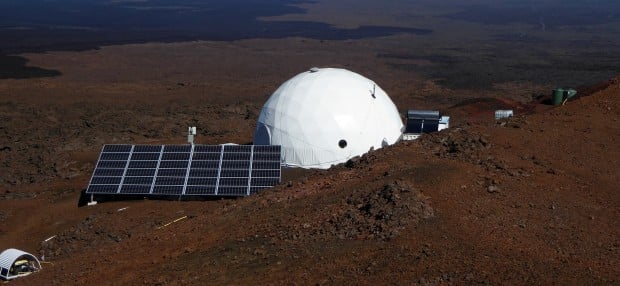
According to an April 4 entry on the Live From Mars blog, the solar panel array has a 10 kW capacity. At that point in time the system had been performing well.
“Here on Mars, we’ve made it through 7 months with less than a dozen days where we’ve needed to rely on backup power,” blogged crew member Sheyna E. Gifford, the project’s Chief Medical and Safety Officer & Crew Journalist.
“When we did, that backup power ran for only a couple of hours before we went back to using stored solar energy. That’s pretty darn good, considering that we have 6 people, twice as many computers, dozens of plants and a full kitchen to support.”
We weren’t able to locate the specifications of the energy storage system referred to, other than it was a “bank of batteries”.
The goal of the mission was to develop effective team composition and support strategies to enable crews to successfully travel to Mars and back. The crew and their interactions were closely monitored.
Some might say it was a little like Big Brother, just with a real purpose.
There will be two more HI-SEAS missions, each eight months long, starting around January 2017 and January 2018
Image credit: Sheyna Gifford
*Hat-tip to the late, great David Bowie
Our professional solar installers in Melbourne will assess and determine your energy needs. We customise a solar panel system in Melbourne to fit the roof size of your property, ensuring you receive the most suitable solar panel system for your Melbourne home, meeting to property’s energy requirements.