






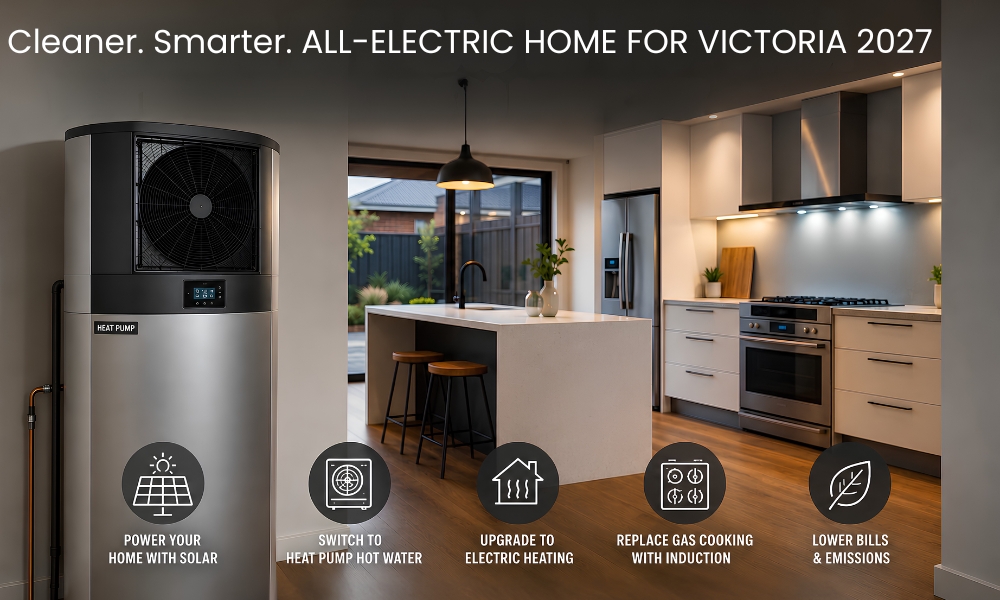
Victoria is Australia’s most gas-reliant state, with around 80% of homes still connected to the network, more than in any other state. That reliance is about to change rapidly.
From 1 January 2027, getting off gas in Victoria is no longer optional for anyone planning a new build: new homes won’t be able to connect to gas at all, and existing gas hot water systems must switch to electric once they reach the end of their life.
For homeowners, the Victoria gas ban 2027 raises real questions: what has to change, what can wait, and how much it will cost. This guide walks through the timeline, the numbers, and the practical steps to electrify your home in Victoria before the deadline, so you can plan ahead rather than scramble later.
Quick summary
- From 1 January 2027, every new Victorian home must be built all-electric, with no new gas connections permitted anywhere in the state.
- From 1 March 2027, gas hot water systems in existing homes must be replaced with an electric alternative when they reach the end of their life.
Combined state and federal rebates can cut the cost of switching by up to roughly $2,600, with full electrification saving eligible households up to $1,820 a year.
What is getting off gas in Victoria and why does it matter for Australian homes?
Getting off gas in Victoria means shifting a home’s cooking, heating and hot water away from reticulated natural gas and onto electric alternatives, ideally powered by rooftop solar. It’s the centrepiece of the state’s Gas Substitution Roadmap, the policy driving Victoria’s Building Electrification Regulations.
Key terminology
- Gas Substitution Roadmap: Victoria’s overarching policy for phasing gas out of homes and buildings.
- All-electric home: A home with no gas connection at all, using electric appliances for every function.
- Heat pump: An efficient electric appliance that moves heat rather than generating it, used for hot water and space heating.
- Reverse-cycle air conditioner: An electric heater and cooler in one unit, the standard replacement for gas heating.
- VEU (Victorian Energy Upgrades): A state scheme offering point-of-sale discounts on efficient appliances.
- STC (Small-scale Technology Certificate): A federal incentive that reduces the upfront cost of solar and eligible hot water systems.





Why it matters in 2026
Victoria’s gas use isn’t a small quirk. Gas heats water, homes, and stovetops in around 88% of Victorian households, according to Sustainability Victoria’s State of Sustainability Report. That reliance also means gas accounts for roughly 17% of the state’s net emissions, far higher than its share in most other states.
With wholesale gas prices climbing and Bass Strait supplies running down, Victoria’s gas phase-out policy is as much about energy security as it is about climate.
Electric appliances paired with home solar systems are also simply cheaper to run over their lifetimes, especially once high-quality solar panels cover your daytime electricity use.
How getting off gas in Victoria works in Australia
The transition isn’t a single switch-flip; it’s staged, and different rules apply depending on whether you’re building new or living in an existing home.
Step-by-step
- New homes and subdivisions requiring a planning permit have had to go all-electric since 1 January 2024, with the rule set to close further from 1 January 2027 to cover homes that don’t need a permit too.
- From 1 January 2027, no new residential or most new commercial buildings can connect to the gas network at all.
- From 1 March 2027, a gas hot water system in an existing home must be replaced with an electric one once it can no longer be repaired.
- Existing gas cooktops and heaters in current homes are not banned — you can keep and even repair them, though replacing them earlier unlocks rebates now.
- Rental properties face their own minimum energy standards, including a ban on replacing gas heaters and hot water at end of life from March 2027.
Real-world examples
A Melbourne family with an ageing gas hot water system that fails in 2026 can still install a like-for-like gas replacement today. But if it fails after March 2027, only an electric heat pump system will be compliant.
Planning the switch before the unit fails, rather than during an emergency, is what saves both money and stress.
Costs and savings
Electrification isn’t free, but Victoria’s rebate package is designed to bring the upfront cost down significantly. Here’s what typical upgrades cost and how much they save.
| Upgrade | Average Installed Cost | Rebates Available | Estimated Annual Saving |
| Heat pump hot water system | ~$4,544 | Up to $2,600 (Solar Victoria + VEU + STC) | ~$220 vs gas |
| Reverse-cycle air conditioner | Varies by system size | Up to $1,610 (VEU) | ~$215 vs gas heating |
| Induction cooktop | Varies by model | Up to $140 (VEU) | Modest — mainly health and safety |
| Rooftop solar system | Varies by size | Up to $1,400 + interest-free loan | Boosts total household savings |
| Full home electrification | Varies by home | Combined rebates + upgrade loans | Up to $880, or $1,820 with solar |
Upfront costs
Full electrification usually costs more upfront than a like-for-like gas repair, but the Building Electrification Regulations are backed by a genuine rebate package designed to soften that gap.
Savings calculation
The Victorian Government estimates that electrifying an average household could save around $880 a year on energy bills, rising to about $1,820 a year for homes that pair electrification with home solar systems.
Payback period
For a heat pump hot water system alone, stacking the Solar Victoria rebate, VEU discount and federal STCs can cut close to $2,600 off the sticker price — often bringing payback down to well under five years once the annual saving is factored in.
Not sure what you’re eligible for? Browse current energy rebates, or jump straight to the Energy Rebates Victoria page for state-specific details relevant to your electrification plan.
Want to know exactly what your home could save? Energy Matters compares tailored electrification and solar quotes from trusted local installers.
State-by-state considerations
Victoria’s rules are the strictest in the country, but every state is moving in a similar direction, just at a different pace.
- Victoria (VIC): All new homes all-electric from 1 January 2027; gas hot water replacement mandate from 1 March 2027. The strictest and most gas-reliant state.
- New South Wales (NSW): No statewide gas ban yet, though several councils require all-electric new developments; gas contributes a much smaller share of the state’s emissions than in Victoria.
- Queensland (QLD): No mandated gas phase-out; incentives currently favour solar and battery uptake over appliance switching.
- South Australia (SA): World-leading rooftop solar penetration and a very clean grid, but no blanket residential gas ban.
- Western Australia (WA): Highest overall gas consumption of any state, largely industrial rather than residential; no residential all-electric mandate.
Comparison table: Gas vs electric appliances
| Feature | Gas appliance | Electric alternative |
| Running cost trend | Rising, as network costs spread over fewer users | Falling, especially paired with solar |
| Indoor air quality | Emits nitrogen dioxide, linked to respiratory issues | No combustion emissions |
| Compliance from 2027 | Not permitted in new Victorian builds | Required in new Victorian builds |
| Status in existing homes | Can still be used and repaired | Always compliant and future-proof |
| Best paired with | N/A | Rooftop solar and energy efficiency upgrades |
How to get started: Step-by-step guide
- Check which parts of your home already run on gas — heating, hot water, and cooking.
- Prioritise your hot water system if it’s more than 8 to 10 years old, since it’s the most likely appliance to fail before 2027. A heat pump or solar hot water system is the standard-compliant replacement.
- Get solar quotes if you don’t already have solar, and size the system for your future electricity loads, not just today’s usage.
- Check your eligibility for Solar Victoria and VEU rebates before booking any installation.
- Use a Solar Accreditation Australia (SAA)-accredited installer for solar, battery, and heat pump work to protect your warranty and rebate eligibility, and consider broader energy-efficiency upgrades like insulation while you’re at it.
- Book replacements as appliances age, rather than waiting for an emergency breakdown.
- If an electric vehicle is part of your future plans, ask about EV chargers at the same time as your electrical upgrades.
Powering up your EV with solar
If you’re thinking of buying an EV, adding an EV charger to your solar system is a smart way to “fuel” your car with clean, renewable energy.
Common mistakes to avoid
- Waiting for a gas appliance to fail before researching alternatives, then paying emergency prices with no time to compare.
- Installing solar sized only for today’s usage, rather than the higher loads that new electric appliances will add.
- Missing rebate windows or income caps, such as the Solar Victoria cap that dropped to $150,000 from 1 July 2026.
- Assuming existing homes must disconnect from gas immediately — the mandate applies at end-of-life replacement, not as a blanket removal.
- Skipping accredited installers, which can void manufacturer warranties and disqualify rebate claims.
Frequently asked questions
Do I have to get off gas in my existing Victorian home right now?
No. The Victorian gas ban 2027 doesn’t require you to disconnect a working gas appliance. The mandate applies to new homes from 1 January 2027 and to gas hot water systems in existing homes only once they reach end of life and need replacing, from 1 March 2027.
What happens if I build a new home in Victoria after 2027?
No new home or subdivision will be able to connect to the gas network. Builders must design all-electric homes with electric cooking, heating, and hot water from the outset, so budgeting for electric appliances needs to be done at the design stage, not after handover.
How much can I save by switching from gas to electric appliances?
The Victorian Government estimates average savings of around $880 a year for a fully electrified home, or up to $1,820 a year when paired with rooftop solar. Actual savings depend on household size, appliance choices, and which rebates you claim.
Can I still use LPG after the gas ban?
Yes. The Victorian gas ban 2027 applies to reticulated natural gas connections, not bottled LPG. Regional homes and barbecues can continue to use LPG, which remains unaffected by the Building Electrification Regulations.
What rebates are available to help with electrification?
Victorian households can access Solar Victoria rebates of up to $1,400, Victorian Energy Upgrades discounts on heat pumps and induction cooktops, and federal STCs, which together can reduce the cost of a hot water switch by up to roughly $2,600.

Key takeaways
- Victoria’s gas ban 2027 applies to new homes from 1 January and to existing gas hot water end-of-life replacements from 1 March.
- Around 80–88% of Victorian homes currently use gas — more than any other state in Australia.
- Combined rebates can cut electrification costs by up to roughly $2,600 on hot water alone.
- Full electrification can save households up to $1,820 a year when paired with solar.
Existing gas appliances aren’t banned outright — the rules bite at replacement time, so planning ahead beats waiting for a breakdown.
Take the next step towards an all-electric home with Energy Matters
With Victoria shifting toward clean energy, transitioning off gas is one of the smartest upgrades you can make for your home and your budget. Recent data show that over 180,000 energy upgrades were delivered across Victoria in a single year through state incentive programs, demonstrating how quickly smart households are embracing electrification.
By planning your staged transition today, taking advantage of generous government rebates, and replacing ageing appliances before regulations tighten in 2027, you lock in long-term savings and lower your carbon footprint.
Ready to get off gas before the deadline?
Don’t wait for an unexpected breakdown to leave your home without hot water or heating. Take steps now to future-proof your property, eliminate daily gas supply charges, and take control of your energy bills. Partner with Energy Matters today to request your free, no-obligation solar quotes and get expert, tailored guidance on electrifying your home effortlessly!
References and External Sources
- Victorian Government Department of Energy, Environment and Climate Action (DEECA): Building Electrification & Gas Substitution Roadmap
- Solar Victoria: Solar Homes & Hot Water Rebates Program
- Essential Services Commission (ESC): Victorian Energy Upgrades (VEU) Program Overview
- Clean Energy Council (CEC): Consumer Solar & Battery Accreditation Standards
- Australian Renewable Energy Agency (ARENA): Residential Electrification Insights
- Australian Energy Market Operator (AEMO): Gas Statement of Opportunities (GSOO)