




Gas abolishment fees dropped sharply in NSW and the ACT on 1 July 2026, making it cheaper than ever to permanently disconnect. At the same time, many electricity retailers lifted daily supply charges by 60 to nearly 100 per cent in the same period, according to reports from NSW and Queensland customers. For households that already have solar, batteries and efficient appliances, that combination raises a genuinely fair question: is getting off gas still worth it once you account for what electricity now costs to have connected at all?
Quick summary
- Gas abolishment costs have fallen (as low as $259 in NSW, $747 in the ACT), but electricity daily supply charges have risen sharply in the same period, narrowing the gap for some households.
- The math depends heavily on how much gas you still use. Households with only a gas cooktop and low winter heating load see the weakest case for staying connected; those with unreplaced gas heating or hot water systems still generally save more by electrifying fully.
- Households with solar and batteries that already cover most daytime and evening usage are the ones most likely to find the fixed cost of keeping a second (gas) connection harder to justify, once the appliances themselves are replaced.
Why this question is being asked now
Two changes landed close together in 2026, and they pull in opposite directions for anyone weighing whether to finish electrifying their home.
On the gas side, abolishment costs fell substantially after separate regulatory decisions in NSW and the ACT. In NSW, the Australian Energy Regulator’s final decision on Jemena Gas Networks’ 2025–2030 pricing set the standard abolishment fee at $259.06 plus GST, well below the $1,472 Jemena had proposed. In the ACT, Evoenergy’s basic permanent disconnection fee dropped to $747 plus GST for the new 2026–2031 pricing period.
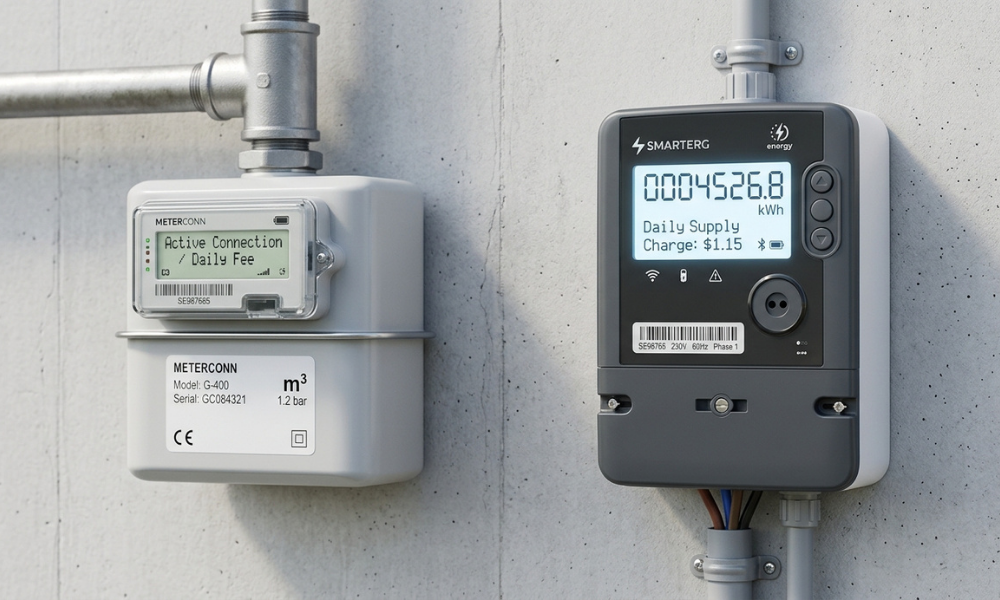
On the electricity side, the Australian Energy Regulator’s Default Market Offer for 2026–27 shifted the balance of household bills toward fixed daily supply charges and away from usage-based rates, a structural change that applies regardless of how much electricity a household actually consumes. Retailers implementing changes from 1 July reportedly increased daily supply charges substantially in NSW and Queensland even as headline usage rates fell, and customer reports described increases of 60 to nearly 100 per cent to the fixed component of some bills.
For a household still connected to both networks, that means the fixed cost of simply being connected to electricity, independent of usage, has grown. If a household also has ample rooftop solar covering most of its own consumption, the case for paying to stay connected to gas as well starts to look different depending on how much gas that household still genuinely needs.
The case for finishing the job
For most households actively electrifying, the numbers still tend to favour getting off gas completely, for a few reasons that don’t disappear just because electricity daily charges went up.
Gas connections carry their own fixed daily supply charge, on top of any abolishment or disconnection fee, for as long as a household stays connected. Some households discover this the hard way: after switching off gas use entirely, they continue receiving bills for months, because a temporary disconnection alone does not remove the standing network charge. Fully abolishing a connection removes that charge permanently, rather than trading one fixed cost for another.
Households that still use gas for hot water or space heating are typically the ones with the strongest case for full electrification. Hot water heating is gas-intensive, and heat pump hot water systems are generally cheaper to run once installed, particularly for a household already generating its own solar during the day. A household weighing whether to disconnect while still relying on gas for these larger loads is really asking a different question: whether to replace the appliances at all, which is usually the bigger saving, rather than whether disconnection itself is worth it once those appliances are already electric.
There is also a structural trend worth factoring in. Regulators have signalled that gas network costs will increasingly be spread across a shrinking pool of remaining customers, and abolishment pricing is set to move toward “cost-reflective” pricing once each distributor’s current five-year period ends (2030 for NSW’s Jemena network, 2031 for the ACT and South Australia). Gas is broadly expected to become relatively more expensive over time as more households leave the network, even if electricity fixed charges also continue to shift.
The case for pausing before you disconnect
The counterargument is narrower, but genuine, and applies most clearly to a specific kind of household: one that has already replaced gas heating and hot water with electric alternatives, has rooftop solar and a battery covering most of its daytime and evening usage, and is left using gas for little more than cooking.
For that household, the maths can flip. If most electricity usage is already self-supplied from solar and battery storage, feed-in tariffs for exported solar have fallen in most states in 2026, reducing the value of any exported surplus. The main remaining cost of the electricity connection is increasingly the fixed daily supply charge rather than usage, and that fixed charge has risen. If the household’s total gas bill, including its own fixed supply charge, is genuinely lower than what an equivalent-sized fixed charge would cost on the electricity side, staying connected to gas for cooking alone, while relying on solar and battery for the rest, can be cheaper in raw dollar terms.
This is a minority case. It generally requires all three conditions to hold: solar and battery capacity large enough to cover most usage, low remaining gas consumption limited to cooking, and a household unbothered by paying two separate fixed connection charges rather than consolidating onto one energy source. It does not apply to a household still running gas heating through a cold Melbourne or Canberra winter, where usage-based gas costs remain the larger factor.
What the numbers don’t capture
Cost comparisons of this kind leave out two things worth naming directly.
The first is indoor air quality. Gas cooktops and heaters release combustion by-products, including nitrogen dioxide and carbon monoxide, indoors. This is a health consideration independent of the dollar comparison, and it is one reason some households choose to electrify even when the pure cost case is close to even.
The second is that electricity pricing is not settled. The AER’s Default Market Offer resets annually, and 2026’s shift toward higher fixed charges is itself a recent structural change rather than a fixed, permanent state. A household’s decision made today on current pricing may look different again once the next annual DMO determination lands.




How to work out your own numbers
- Total your actual gas usage bill, not just the connection fee, over a full year including a winter quarter if you use gas heating.
- Check your current electricity daily supply charge against your latest bill, and confirm whether it changed at your last annual reset.
- Estimate your abolishment cost using your state’s current published rate, since NSW and ACT figures dropped substantially in mid-2026 and other states may differ.
- Model what full electrification would remove, including any remaining gas fixed charges, against what it would add in appliance running costs.
- Factor in solar and battery coverage specifically for the months where gas use is highest, typically winter, since summer solar generation tells you little about a winter heating decision.
FAQs
Is it still worth disconnecting from gas in 2026? For most households, yes, particularly those still using gas for heating or hot water. The exception is households with solar and battery systems already covering most electricity use, and only gas cooking remaining, where rising electricity fixed charges can narrow or reverse the saving.
Why have electricity daily supply charges gone up in 2026? The AER’s 2026–27 Default Market Offer shifted the balance of household bills toward fixed daily charges and away from usage-based rates, and several retailers implemented related increases to standing and market offers from 1 July 2026, in some cases raising fixed charges by 60 to nearly 100 per cent.
Does keeping a gas connection for cooking only make financial sense? It can, for a specific household profile: solar and battery covering most other usage, low overall gas consumption, and a gas fixed charge lower than the electricity fixed charge would be for an equivalent connection. This is not the typical case for most households.
Will gas abolishment get more expensive later? Yes, eventually. Regulators have approved a shift toward “cost-reflective” abolishment pricing once each distributor’s current five-year pricing period ends, meaning today’s lower fees in NSW and the ACT are not guaranteed to last past 2030–2031.
What should I check before deciding whether to disconnect? Compare your full annual gas bill, including its own fixed charge, against your current electricity daily supply charge, and check whether you still rely on gas for heating or hot water, since that usually outweighs the cooking-only comparison.
Key takeaways
- Gas abolishment costs fell sharply in NSW ($259) and the ACT ($747) in mid-2026, while many electricity daily supply charges rose over the same period.
- Households still using gas for heating or hot water generally still save more by fully electrifying, since those are the largest gas loads.
- The narrower case for staying partly connected to gas applies mainly to households with solar and battery systems already covering most usage, where only gas cooking remains.
- Gas network costs are expected to keep rising over time as more households leave the network, so today’s low abolishment fees are a temporary window, not a permanent price.
- Run your own numbers using a full year of gas and electricity bills, including a winter quarter, rather than relying on general cost comparisons.