



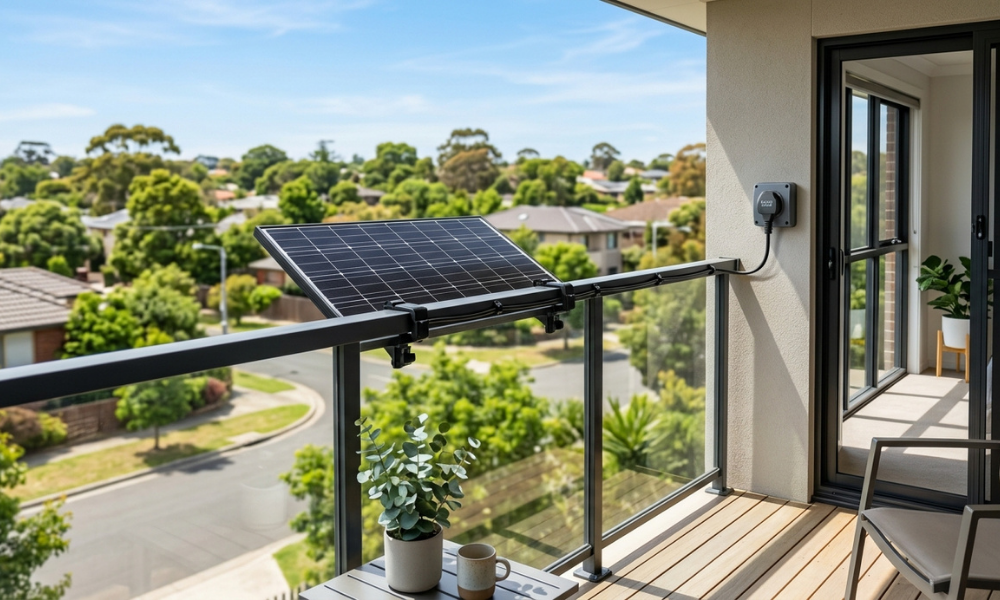
Back in August, we explained why a portable power station is fully legal for a renter to use today, while plug-in “balcony” solar and batteries that feed power back through a regular wall socket sit in a legal grey area Australia hasn’t resolved yet. That grey area just got a deadline attached to it.
Quick summary
- Federal and state energy ministers have agreed to formally explore a legal pathway for plug-in solar and batteries, with findings due back later this year- not legalisation yet, but a real step forward.
- Advocacy group Solar Citizens is pushing for a hard deadline of 1 July 2027, pointing to renters and lower-income households currently locked out of rooftop solar.
- A Standards Australia committee member says the technical fix isn’t complicated: an instant auto-shutoff on unplug, an ~800-watt power cap, and simple network registration.
Ministers agreed to look into it, and to report back. That’s the whole announcement. Nobody’s flipped a switch to make plug-in solar legal, and Climate Change and Energy Minister Chris Bowen was upfront about that, describing the process as requiring real work on safety standards through Standards Australia, coordination with state safety regulators, and a review of state strata laws before anything changes on the ground.
That last part matters more than it might sound. We covered the core safety issue in our piece on apartment battery storage: plug-in batteries produce direct current, and feeding that back through a standard AC safety switch creates a fault-detection problem the switch was never designed to catch. That’s a genuine engineering question, not a bureaucratic stalling tactic, and it’s part of why this can’t just be waved through.
The deadline campaign pushing back on “eventually”
Solar Citizens, the advocacy group that’s been running this campaign, isn’t content to wait for an open-ended review. They’re publicly calling for plug-in solar and batteries to be legal by 1 July 2027, pointing squarely at renters and lower-income households as the group missing out while rooftop solar keeps getting cheaper for owner-occupiers.
The comparison they’re leaning on is New Zealand, whose own government review concluded legalisation could realistically happen within 9 to 12 months, given the groundwork on standards has already started. If a comparable market can move that fast, the argument goes, Australia’s timeline is a choice, not a technical necessity.
The part of this story that’s actually useful right now
Most of the coverage of this announcement focuses on the politics, who’s pushing whom, what the minister said. The more useful detail, and the one worth sitting with, came from Glen Morris, a solar and battery engineer who sits on the Standards Australia committees that write the actual installation rules. His argument: this isn’t a hard engineering problem. Three things would cover it, a requirement that the inverter cuts power instantly the moment it’s unplugged, a power cap (he suggested roughly 800 watts) low enough that it can’t overload a standard household circuit, and a simple registration process so the local network knows the device exists.
Expert tip: If you’re evaluating plug-in solar products while this plays out, Morris’s three criteria are a useful personal checklist: look for auto-shutoff, a capped output, and whatever registration process eventually applies, since products meeting these are the most likely to qualify once rules are finalised.
That’s a genuinely different kind of statement than “we’re working on it.” It’s a specific, checkable claim from someone who actually writes these standards: that the remaining work is regulatory will, not unsolved technology. Germany has run over a million of these systems for years under rules along these lines. The UK wrote equivalent rules into its wiring regulations only recently. Neither country invented new hardware to get there.
What this means if you’re a renter or apartment owner today
Nothing changes immediately. If you’re weighing options right now, the legal picture is exactly what we described in June and August: a portable power station you charge separately and use like any other appliance is fine today, no grey area involved. A plug-in device that exports through your existing wiring still isn’t approved for that use in Australia, regardless of what it’s legal to do in Germany or the UK.
One detail worth banking for later: Bowen indicated that once proper standards exist, plug-in solar and batteries should be automatically eligible for the same rebates already available for other systems, the Cheaper Home Batteries program and the Small-scale Renewable Energy Scheme. That’s not locked in, but it’s a reasonable signal that whenever this does clear, it won’t launch as a rebate-free category.
Key takeaways
- Ministers agreed to explore a legal pathway for plug-in solar and batteries, with a report due later this year; this is a process step, not legalisation.
- Solar Citizens is campaigning for a hard 1 July 2027 deadline, using New Zealand’s faster 9–12 month timeline as a benchmark.
- Glen Morris’s proposed fix (auto-shutoff, ~800W cap, network registration) reframes this as a regulatory decision rather than an unsolved technical problem.
- Nothing is legal to use today that wasn’t already; portable power stations remain fine, plug-in solar and batteries exporting through wall sockets remain in a grey area.
- Once standards exist, these devices are expected to become eligible for existing rebates rather than launching as a new, unsupported category.
Source: Sophie Vorrath, “Plug-in solar ‘not an overnight proposition,’ says Bowen, as pressure mounts to legalise it within 10 months,” RenewEconomy, September 14, 2026.