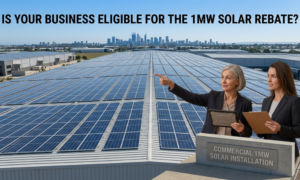






From 1 October 2026, the federal government’s expanded Small-scale Renewable Energy Scheme (SRES) will let commercial solar systems up to 1MW claim the same upfront, point-of-sale rebate previously reserved for systems under 100kW. That is a tenfold increase in the eligibility cap, and it is expected to cut around 20% off the installed cost of an eligible system.
For CFOs, operations directors and property managers weighing a warehouse, factory or campus solar project, the 1MW SRES expansion in Australia turns a multi-year payback into something closer to three years, but only for facilities that get their engineering, grid approvals and contracts in order before commissioning day.
How the October 1 threshold shift changes commercial solar CapEx
Under the current rules, only systems under 100kW qualify for the SRES’s upfront Small-scale Technology Certificate (STC) discount. Anything larger has had to rely on Large-scale Generation Certificates (LGCs), which are earned progressively over roughly a decade rather than delivered at the point of sale. That difference matters enormously for a facility’s capital planning: LGC income trickles in over years and is exposed to certificate price volatility, while an STC discount is locked in and subtracted from the invoice before the system is even switched on.
From October 1, systems up to 1MW move into the STC bucket. In practical terms, an 850kW system, the size the government itself modelled, previously earned LGCs over ten years but can instead receive an immediate discount of around $232,000 off the gross installed cost. That shift compresses payback periods from the 6–8 year range typical of LGC-financed commercial solar down to an estimated 2.8–3.5 years, materially changing the internal rate of return case that finance teams use to approve capital projects.
Ask your installer to model both the STC and LGC pathway side by side for your specific system size and postcode zone rating. Certificate value depends on your solar zone rating and the STC market price at the time certificates are created, so a generic 20% figure is a starting estimate, not a guaranteed number for your site.
Sector savings breakdown
The scale of the discount depends heavily on system size, which in turn is shaped by roof footprint, load profile and daytime energy use. The federal government has published two official worked examples alongside the announcement; figures for other system sizes below are estimated by scaling those examples and should be treated as indicative only.
| Target sector | Typical profile | System size | Gross installed cost (est.) | ~20% point-of-sale STC discount | Net upfront CapEx outlay (est.) |
| Educational institutions | Schools, university buildings, campuses | 250 kW | ~$340,000 | -$68,000 (official government estimate) | ~$272,000 |
| Manufacturing & processing | Medium manufacturing, cold storage facilities | 500 kW | ~$680,000 | -$136,000 (estimated, not government-published) | ~$544,000 |
| Logistics & warehousing | Distribution centres, large roof footprints | 850 kW | ~$1,160,000 | -$232,000 (official government estimate) | ~$928,000 |
These are indicative figures except where marked as official. Actual certificate value depends on your postcode’s solar zone rating, the STC market price at the time of installation, and final regulations, which were still being finalised as of this writing.
Sector playbook: how specific facilities maximise the 1MW rebate
Logistics hubs and warehouses (500kW to 1MW arrays)
Distribution centres typically have the largest, least obstructed roof spans of any commercial building type, making them the best-suited sector for systems approaching the full 1MW cap. That scale of daytime generation matches well against refrigeration, conveyor, forklift charging and lighting loads that run through business hours, and any excess can offset rising exposure to spot market electricity pricing.
Before sizing your system to the roof’s full physical capacity, check your export limit with your local distributor. Oversizing generation beyond what the grid connection allows wastes CapEx on capacity you cannot use or export profitably.
Heavy manufacturing and cold storage (250kW to 750kW arrays)
Manufacturing and cold storage facilities tend to run heavy daytime shift machinery and refrigeration loads that closely track solar production curves. Beyond the upfront discount, a right-sized system reduces exposure to peak demand tariffs, which are often the single largest controllable line item on a manufacturing energy bill.
Pull 12 months of interval load data before finalising system size. Cold storage and manufacturing loads can look deceptively flat on a monthly bill but spike sharply at specific times of day, and undersizing against those spikes leaves demand-tariff savings on the table.
Schools and educational campuses (100kW to 300kW arrays)
School boards and councils often struggle to justify solar CapEx through committee approval processes, particularly when the payback period stretches past a budget cycle. An instant ~20% discount at point-of-sale changes that calculus, frequently making a system fundable from an operational budget rather than requiring long-term debt or a separate capital works approval.
Present the STC discount as a line-item reduction on the quoted price, not as a rebate paid later. Boards and councils respond far better to a lower headline number than to a rebate promised for after commissioning.
The 3-step execution plan: how to lock in your discount before October 1
Grid pre-approvals for 100kW+ systems take 4–6 weeks on average, so submitting your application early ensures your system is ready for certificate creation the moment the scheme opens on October 1.
Step 1: Conduct 12-month interval data and structural roof audits (immediate)
Start by pulling a full year of interval load data from your energy retailer and commissioning a structural roof assessment. This lets your installer size the system against your actual daytime consumption rather than roof space alone, avoiding a system oversized for your export capacity or undersized against your genuine load.
Step 2: Clear the DNSP grid connection bottleneck (weeks 2–5)
Submit your network connection application to your local distribution network service provider (DNSP), such as Ausgrid, Endeavour Energy, Energy Queensland or Powercor, as early as possible. These approvals commonly take 4–6 weeks, and facilities that wait until after October 1 to apply risk queuing behind a wave of applications from every other business trying to move at once.
Step 3: Structure SAA-accredited contracts for October 1 commissioning (weeks 6–8)
Only installers accredited through Solar Accreditation Australia (SAA), which took over the accreditation scheme from the Clean Energy Council in 2024, can generate STCs that are eligible under the Small-scale Renewable Energy Scheme. Make sure your contract explicitly states that the certificate value will be subtracted from the invoice at point-of-sale once Clean Energy Regulator processing opens for the expanded threshold, rather than treated as a rebate to be claimed separately later.




Incentive stacking: combining SRES with tax and state programs
The SRES discount does not need to be your only source of savings. Businesses can typically layer the upfront STC discount with the instant asset write-off provisions available through the Australian Taxation Office for eligible capital equipment, and with relevant state-based energy efficiency schemes such as the NSW Business Energy Advice Program or Victoria’s Energy Upgrades program (VEU), depending on your state and eligibility. Because rules and thresholds for these programs change independently of the federal SRES expansion, confirm current eligibility with your accountant or energy advisor before finalising a contract.
FAQs
What is the 1MW SRES expansion? From 1 October 2026, the federal government is raising the Small-scale Renewable Energy Scheme’s eligibility cap from 100kW to 1MW, letting mid-sized commercial and industrial solar systems claim an upfront, certificate-based discount worth roughly 20% of installed cost, instead of the slower Large-scale Generation Certificate pathway.
Which businesses benefit most from the SRES expansion? Warehouses, distribution centres, manufacturers, cold storage facilities and schools with large, unshaded roof space and daytime energy loads are best placed to benefit, since system sizing between 100kW and 1MW now qualifies for the same point-of-sale rebate previously limited to smaller systems.
How much can a business save under the expanded SRES? The government’s own worked examples put the discount at around $68,000 on a 250kW system and more than $232,000 on an 850kW system. Figures for other system sizes, including the full 1MW cap, are estimates that scale from those examples and depend on your solar zone rating and the STC market price at installation.
Do I need to wait until October 1 to start my solar project? No. Interval data audits, roof structural assessments and DNSP grid connection applications can all begin now, so your system is ready for commissioning and certificate creation as soon as the expanded scheme takes effect.
Who is eligible to install a system that qualifies for the SRES discount? Only installers accredited through Solar Accreditation Australia (SAA), operating under the Clean Energy Regulator, can generate valid Small-scale Technology Certificates. Confirm your installer’s SAA accreditation status before signing a contract.
Key takeaways
- The SRES eligibility cap rises from 100kW to 1MW on 1 October 2026, cutting the upfront cost of eligible commercial solar systems by roughly 20%.
- Warehouses and logistics facilities are best positioned to use the full 1MW cap, given their large roof footprints and daytime load profiles.
- Locking in the discount requires interval data audits, early DNSP grid connection applications, and contracts with SAA-accredited installers that explicitly net the certificate value off the invoice.
- Grid connection approvals typically take 4–6 weeks, so applications submitted before October 1 avoid the administrative backlog expected once the scheme opens.
- The SRES discount can often be stacked with instant asset write-off tax provisions and relevant state energy efficiency schemes, subject to individual eligibility.