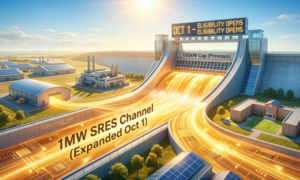






From October 1, 2026, Australian businesses can access the federal solar rebate for systems up to 1MW, a tenfold increase on the previous 100kW cap. That’s a significant change, but “eligible for the scheme” and “right for your business” are two different questions. This guide walks through how to work out where your business actually fits, from the compliance basics through to matching a system size to your real roof space and energy use.
Quick Summary
- Eligibility comes down to system size, equipment standards, and using an accredited installer; business type alone doesn’t determine it.
- As a rough guide, 1MW of solar needs somewhere around 4,000 to 5,000m² of usable roof space, so most businesses will land well under the cap.
- State-based incentives can often be combined with the federal rebate, so it’s worth checking both before assuming you know your full savings.
The basic eligibility requirements
Qualifying for the commercial solar rebate, formally the Small-scale Renewable Energy Scheme (SRES), comes down to a handful of concrete requirements about the system and installation itself.
- System size: Your solar system’s DC nameplate capacity, the rated output of the panels themselves, needs to sit at or below 1MW from October 1, 2026.
- Approved equipment: Panels and inverters need to be Clean Energy Council-approved products. Most reputable commercial suppliers already meet this, but it’s worth confirming with your installer directly.
- Accredited installer: The system needs to be installed by a Clean Energy Council accredited installer for the STCs (Small-scale Technology Certificates) to be valid.
- Certificate timing: STCs must be created within 12 months of the system’s installation date.
- Standards compliance: The installation needs to meet relevant Australian Standards and local regulations, the same baseline requirement that applies to any solar system, commercial or residential.
There’s no separate eligibility list based on business type. A warehouse, a school, a shopping centre, and a farm shed are all assessed the same way, on system size and compliance, not on what the building is used for.
Expert tip: Ask your installer to confirm in writing that your specific panel and inverter models are Clean Energy Council approved for the system size you’re planning. This is a quick check that avoids finding out about a compliance gap after installation.
How much roof space do you actually need?
A useful way to make the 1MW figure concrete is to translate it into roof area. As a rough guide, commercial solar installations typically need somewhere around 5m² of usable roof space per kW of system capacity, accounting for panel size, mounting angle, and the spacing needed for maintenance access and shading avoidance.
Using that rule of thumb:
| System size | Approximate roof space needed |
| 100kW (old cap) | ~500m² |
| 250kW | ~1,250m² |
| 500kW | ~2,500m² |
| 850kW | ~4,250m² |
| 1MW (new cap) | ~5,000m² |
For context, 5,000m² is roughly the footprint of a large supermarket or a mid-sized warehouse. Most businesses evaluating commercial solar will find their available roof space puts them well under the 1MW ceiling, which is a useful thing to know upfront. It means the new cap is mainly about removing a barrier for larger sites that were previously locked out of the scheme entirely.
Expert tip: Roof orientation and shading affect how much of your available space is actually usable. Get an installer to assess your roof directly, since a north-facing roof with no shading can support meaningfully more capacity than a similarly sized roof split across multiple orientations.
Matching system size to business type
System size depends on two things working together: how much roof space you have, and how much electricity your business actually uses during daylight hours, since that’s when solar generates. A rough sense of where different business types typically land:
- Retail (standalone stores, small shopping strips): Often in the 30 to 250kW range, depending on roof size and trading hours, since energy use is fairly steady across the day.
- Warehouses and distribution centres: Frequently among the larger commercial installations, given expansive flat roof space, sometimes reaching several hundred kW to the higher end of the new range.
- Manufacturing facilities: Sizing depends heavily on the specific operation, particularly for sites running energy-intensive equipment during the day, which can justify larger systems even on a more modest roof footprint.
- Agricultural buildings and farm sheds: Often have generous roof space relative to daytime electricity use, so system size is frequently set by what the farm actually needs on any given day.
- Schools and aged care facilities: Daytime-heavy usage patterns tend to align well with solar generation, making these strong candidates even at a moderate system size.
- Cold storage facilities: Continuous high daytime energy draw for refrigeration often supports larger systems relative to available roof space compared to other business types.
Expert tip: Ask your installer to size your system around your actual daytime electricity consumption pattern as well as your maximum roof capacity. A system larger than your daytime usage can still make sense if you’re planning to add a battery or increase usage later, but it’s worth understanding that trade-off upfront, since bigger isn’t automatically better for every business.
What if your ideal system is close to or over 1MW
For a smaller number of businesses with very large roof space or high energy needs, particularly bigger manufacturing sites, major distribution hubs, or large agricultural operations, the ideal system size may sit at or beyond the 1MW threshold. A few approaches worth discussing with your installer:
- A hybrid SRES and LGC arrangement, where the portion of the system up to 1MW qualifies for STCs under the SRES, while capacity beyond that threshold may be eligible for Large-scale Generation Certificates (LGCs) instead, a separate but related incentive scheme for bigger installations.
- Phased installation, staging the project so an initial system takes advantage of the current settings, with a plan for further expansion later.
- Working with your installer to optimise layout and equipment choice within the 1MW cap, to get the most generation possible from the allowed capacity.
Expert tip: If you’re anywhere near the 1MW threshold, get advice on the SRES and LGC interaction early in the design process, since it can affect how your installer structures the project and certificate arrangements from the outset.
Federal rebate vs state incentives: can they stack
The SRES expansion is a federal scheme, but several states run their own commercial incentives that can often be combined with it. NSW, for example, has separately introduced discount schemes for business battery storage, on top of and independent from the federal solar changes. Other states periodically run their own grants, low-interest loan schemes, or battery-specific incentives for commercial customers.
Because these programs are run separately, with different eligibility rules, application processes, and timing, it’s worth checking what’s currently available in your state specifically. An installer experienced in commercial projects in your state should be able to confirm what can realistically be combined.
FAQs
How do I know if my business qualifies for the 1MW solar rebate? Eligibility depends on your system size (up to 1MW DC nameplate capacity), using Clean Energy Council-approved equipment, and installation by an accredited installer. It isn’t based on business type, so most commercial buildings can qualify if these requirements are met.
How many kW of solar can fit on my roof? As a rough guide, allow around 5m² of usable roof space per kW of system capacity, though actual figures depend on roof orientation, shading, and layout. An installer can provide an accurate assessment based on your specific site.
Can my business combine the federal solar rebate with state incentives? Often, yes. Several states run separate commercial solar or battery incentive schemes alongside the federal rebate. Check what’s currently available in your state, since eligibility rules and timing vary by program.
Does my business need a certain type of building to qualify? No, eligibility is based on system size and compliance requirements, not building type. Retail stores, warehouses, farms, schools, and manufacturing facilities are all assessed the same way.
What happens if my ideal system is bigger than 1MW? Businesses with larger roof space or energy needs may combine SRES eligibility for the first 1MW with Large-scale Generation Certificates (LGCs) for additional capacity, or consider a phased installation. Discuss options with an experienced commercial installer early in planning.
Key Takeaways
- Eligibility for the expanded commercial solar rebate comes down to system size, approved equipment, and an accredited installer, not business type.
- A useful rough guide is around 5m² of roof space per kW, meaning 1MW typically needs somewhere around 4,000 to 5,000m² of usable roof area.
- System size should be matched to your actual daytime electricity use as well as available roof space, since the two don’t always align.
- Businesses with very large roof space or energy needs near or above 1MW have options, including combining SRES with LGCs or phasing installation.
- State-based incentives can often be combined with the federal rebate, so check what’s available in your state before finalising your plans.