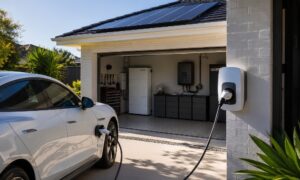








If you’ve got solar, a battery, and an EV, there’s a good chance you’re picturing your setup as one seamless system: sun charges the battery, battery backs up the house, house charges the car, all of it working together even when the grid goes down. It’s a reasonable thing to assume. It’s also, for a lot of battery systems sold in Australia, not quite true.
Most home battery quotes promise “blackout backup” without spelling out what that actually covers. In many cases, your fridge, lights and a few power points will keep running just fine during an outage. Your EV charger, quietly, will not. Nobody’s hiding this on purpose; it’s usually just not explained clearly at the quoting stage, and it’s worth understanding before you sign, not after the power goes out and your car doesn’t charge.
Quick summary
- Most home battery backup circuits are sized for essential loads (fridge, lights, some power points), not an EV charger, which often draws more than the entire backup budget on its own.
- This isn’t a fault; it’s a default design choice, but it’s rarely spelled out clearly in battery quotes unless you ask directly.
- If EV charging matters to your blackout plan, it can usually be added to backup coverage, but it typically means a bigger inverter or a dedicated backup circuit, both worth getting quoted explicitly.
Why EV chargers get left off backup in the first place
Most residential hybrid inverters don’t back up your whole switchboard during an outage. They back up a dedicated “backup circuit” or “essential loads” circuit, wired to a limited number of power points and lights, sized to whatever the inverter’s backup port can handle.
That backup capacity is often smaller than people expect. A common entry-level single-phase hybrid inverter sits around 5kW of backup output, and some brands offer an even more basic backup tier as standard, with a smaller dedicated backup socket rather than whole-home coverage, reserving full-property backup for a separate, higher-cost option.
Now compare that to a standard home EV charger. A typical single-phase AC home charger draws around 7kW, which is more than most entry-level backup ports can supply on their own. Put an EV charger on a 5kW backup circuit alongside a fridge and some lighting, and you’ve either blown the budget or the installer has quietly excluded the charger from the backup circuit altogether. Almost always, it’s the latter, and almost always, nobody tells you that in plain language before you sign.
Expert tip: When comparing battery quotes, don’t just ask “is there battery backup?” Ask “what is the backup port rated for in kW, and is my EV charger’s load included in that figure or excluded from it?” The answer changes what you’re actually buying.
What “partial backup” really means if you own an EV
Here’s the scenario in plain terms. The power goes out. Your battery kicks in within milliseconds; most modern hybrid inverters switch to backup mode in under 10 milliseconds, so you won’t even notice the interruption. Your fridge keeps running. Your lights stay on. Whatever’s plugged into a power point on the backup circuit keeps working.
Your EV charger, sitting on a separate circuit that isn’t part of the backup loop, simply loses power. Your car stays at whatever charge level it had when the outage started. It’s not a fault, it’s not a malfunction, it’s the system working exactly as designed, just not the way most buyers assumed it would when they pictured “battery backup” covering everything in the house.
This isn’t a reason to distrust battery systems. It’s a reason to know, specifically, what your quote includes before you’re relying on it.
Five questions to ask before you sign a battery quote
If you’re shopping for a battery and you own or plan to own an EV, these are the questions that actually matter, not just “how many kWh” and “what’s the price.”
- Is EV charging included on the backup circuit, or excluded by default? Get a direct yes or no, in writing, not a general assurance that “you’ll have backup power.”
- What’s the backup port rated for, in kW, and does that cover an EV charger running alongside my other essential circuits? A 5kW backup port with a 7kW charger and a fridge already running doesn’t add up.
- Can EV charging be added to the backup circuit as an option, and what does that require? Usually this means a larger-capacity inverter, a dedicated backup circuit sized specifically for the charger, or both.
- If EV charging isn’t backed up, how long could I realistically go without topping up the car in an extended outage? This depends on how much charge you typically keep in reserve and how long outages tend to last in your area (more on that below).
- Does my specific EV charger model draw more or less than the standard 7kW single-phase figure? Faster chargers, or three-phase installations, change this calculation.
Expert tip: Ask your installer to put the answer to question 1 on the quote itself, not just in conversation. “EV charger backup: included/excluded” as a single line item removes any ambiguity later.
When this actually matters (and when it mostly doesn’t)
It’s worth being honest about scale here, because most Australians won’t notice this gap in practice. According to Australian Energy Regulator reliability data, a typical customer experiences somewhere around 200 minutes of outages a year across planned and unplanned interruptions combined, and individual unplanned outages typically last somewhere between roughly 80 and 120 minutes on average in most urban and regional networks. For most people, that’s a handful of short interruptions a year, not extended multi-day blackouts. If your EV already has a comfortable buffer of charge, an unbacked-up charger for an hour or two during an occasional outage is a non-issue.
It matters more in a few specific situations:
- Single-EV households with no backup transport, where the car being unable to top up matters more if an outage coincides with a day you need to drive somewhere urgently.
- Regional and rural properties on long feeder lines, where AER data shows outages can run considerably longer, sometimes several hours rather than minutes, particularly after storms.
- Anyone who wants to treat the EV as an emergency power source or backup vehicle during an extended outage, where charge level at the start of the blackout matters a lot more.
If none of that describes your situation, this is good-to-know information rather than something to lose sleep over. If any of it does, it’s worth paying for backup capacity that actually covers the charger.
What it costs to actually get EV charging backed up
If you want EV charging included in your backup circuit rather than excluded from it, the practical options are usually one of two things: stepping up to a higher-capacity inverter with a bigger backup port (moving from an entry-level 5kW unit to something in the 8 to 10kW-plus range), or wiring the EV charger onto its own dedicated backup circuit sized specifically for that load, in addition to your standard essential-loads circuit.
Either option adds cost to a battery system, and the right one depends on your specific setup, your existing switchboard, and how far the charger sits from the inverter. This is exactly the kind of detail worth getting quoted explicitly, alongside your standard battery and solar quote, rather than assumed or glossed over.
The takeaway
A home battery is genuinely useful for blackout backup; most systems just don’t back up everything by default, and EV charging is one of the loads most commonly left out. That’s not a flaw in the technology; it’s a design choice driven by how much backup capacity a standard inverter provides versus how much power an EV charger draws. The fix isn’t complicated: ask directly whether EV charging is included in your backup circuit, get the answer in writing, and if it matters to you, ask what it costs to change that.
If you’re comparing quotes for solar, a battery, or an EV charger and want to know exactly what you’d actually be covered for during an outage, get a free personalised quote and ask us to spell out the backup coverage in plain terms before you sign anything.
Sources: GoodWe EHB series product documentation; Australian Energy Regulator (AER) network reliability data, including AusNet Services and Powercor/CitiPower published reliability targets for FY2025-26. Backup port ratings and EV charger draw figures are typical/indicative; always confirm exact specifications for your specific inverter model and EV charger with your installer.