



Full home electrification, cooktop, hot water, heating, and battery, can add up to $20,000 to $30,000 once everything’s priced out, a number that stops plenty of Australians before they start.
Home electrification loans in Australia in 2026 are built to solve exactly this problem: the Clean Energy Regulator’s own data shows the federal battery rebate alone has already supported over 160,000 installations in its first ten months, backed by $7.2 billion in funding through to 2030. Add in state-based zero-interest loans now running in NSW, the ACT and WA, and most households don’t need $25,000 sitting in a bank account today, they need a plan for sequencing smaller, fundable stages.
Quick summary
- Federal support includes a roughly 30% point-of-sale battery discount and CEFC-backed below-market-rate green loans, neither of which requires a lump-sum application.
- State loan caps ($15,000 to $20,000 in NSW and the ACT, plus WA’s rebate-and-loan combination) are usually smaller than a full electrification project, which is why staging matters more than most guides explain.
- Queensland and South Australia no longer offer a state battery purchase rebate, so budgeting expectations need to reflect what’s actually still open, not what used to exist.
What’s available federally
The Cheaper Home Batteries Program, administered by the Clean Energy Regulator, gives roughly a 30% upfront discount on eligible battery systems (5kWh to 100kWh), delivered as a point-of-sale reduction on the invoice rather than a rebate claimed later. Funding was expanded from $2.3 billion to $7.2 billion in December 2025, and the program changed structurally from 1 May 2026: the discount now tapers by battery size (full support for the first 14kWh, 60% for 14 to 28kWh, 15% for 28 to 50kWh) and steps down every six months rather than annually. Energy Matters has covered exactly what changed in our dedicated piece on the May 2026 changes, worth reading if battery storage is part of the plan.
Separately, the Clean Energy Finance Corporation (CEFC) has committed an additional $2 billion to fund below-market-rate green loans through partner lenders, covering solar, batteries, and broader electrification upgrades. It’s cheaper borrowing rather than a rebate, typically accessed through a participating bank or lender rather than applied for directly.
One timing note if solar is part of the plan: the STC deeming period dropped from 6 years to 5 years on 1 January 2026, cutting the upfront solar rebate by roughly 15 to 20% compared with the previous year, with a further scheduled reduction in 2027.
Expert tip: Federal Energy Minister Chris Bowen described the battery program’s expanded funding as designed to keep the scheme “fair and sustainable” as demand grew faster than expected. That’s a useful signal for planning: rebate values are structured to reduce gradually over time as battery prices fall, so earlier installations generally capture a larger discount than later ones under the same category.
What’s available state by state
The loan caps below are usually smaller than a full electrification project, which is exactly why sequencing matters.
| State | What’s live in 2026 | Cap |
| NSW | Home Energy Saver: zero-interest loan (solar, batteries, insulation, reverse-cycle aircon, switchboard upgrades); separate income-tested discount opening later in 2026 | $15,000 loan, repaid over 10 years; $4,000 discount for households under $80,000 income |
| ACT | Sustainable Household Scheme: zero-interest loan (EVs under $60,000, induction cooktops, insulation, e-cargo bikes from Sept 2026) | $20,000 for new applicants, repaid over 10 years |
| WA | Residential Battery Scheme: rebate plus optional no-interest loan; requires VPP enrolment | $1,300 rebate (Synergy) or $3,800 (Horizon Power), plus up to $10,000 loan |
| VIC | Solar Homes rebate for heat pump hot water and solar hot water; no current state battery rebate | Up to $1,400 |
| SA | No state battery purchase rebate (closed 2022); REPS incentive for VPP-connected batteries stacks with federal rebate | Up to roughly $2,050 |
| QLD | No state battery rebate (Battery Booster closed May 2024); federal program only | N/A |
Queensland genuinely has no state-level battery incentive left, if you’re in QLD, the federal program is your only battery-specific support, so budget accordingly rather than expecting a state top-up that used to exist. South Australia is similar for a straight battery purchase, but its REPS VPP incentive is real money if you’re willing to enrol your battery in a virtual power plant. WA’s scheme is genuinely generous but comes with a hard condition: VPP enrolment is mandatory to receive either the rebate or the loan, not optional, so factor that into your decision if you’d rather keep your battery entirely private.
Expert tip: Before assuming a state scheme applies, check your electricity retailer area, not just your state. WA’s rebate value, for example, differs by roughly three times depending on whether you’re a Synergy or Horizon Power customer.
How to sequence upgrades against a loan cap
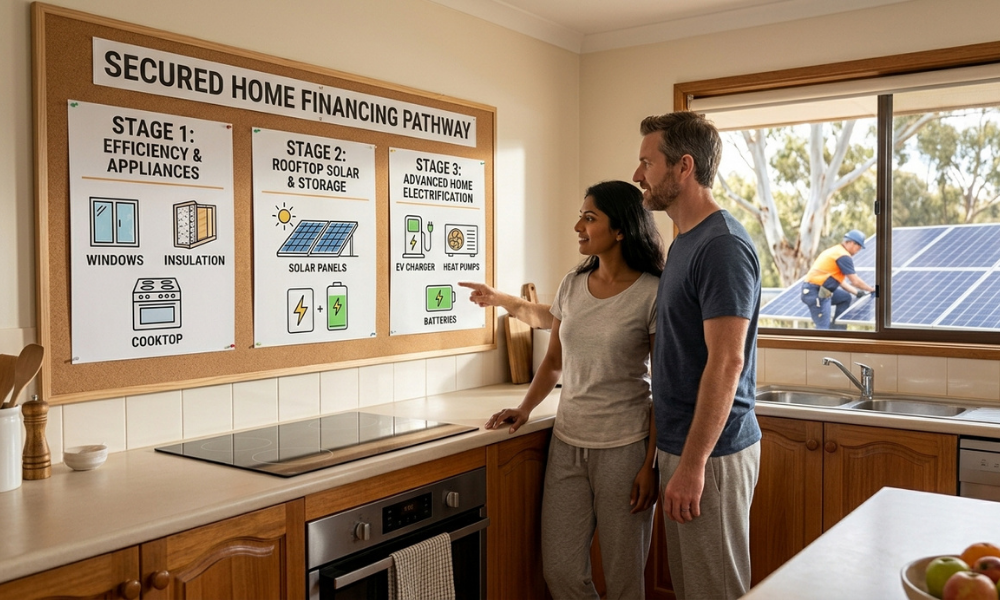
If you’re in NSW or the ACT, you’ve got access to a $15,000 to $20,000 zero-interest loan, but a full electrification project can easily cost more than that once a battery is added on top. Rather than trying to stretch one loan across everything, a more realistic approach looks like this:
Stage one: the highest-return upgrade first
Heat pump hot water typically has the fastest payback of any electrification upgrade (commonly 3 to 5 years through running-cost savings alone), so it’s a sensible first draw against a state loan, especially since several of these schemes list hot water systems explicitly as an eligible category.
Stage two: cooktop or heating, financed from the remaining balance
If the loan cap has room left after hot water, add the next highest-priority appliance. If it doesn’t, this is genuinely fine to defer, most of these are zero-interest loans with 10-year terms, not urgent debt.
Stage three: battery and solar, financed through the federal program
Since the Cheaper Home Batteries Program is a point-of-sale discount rather than something that competes for space in a state loan cap, it’s often cleaner to treat battery and solar as their own financing track, funded through the federal rebate plus, where available, a state battery-specific rebate or loan (WA) or VPP incentive (SA), rather than folding it into the same loan used for hot water and cooktop.
This exact order won’t suit everyone, but treating “electrification finance” as one lump sum to solve in a single application is generally the wrong mental model. The schemes themselves are structured category by category; a financing plan can be too.
Expert tip: Ask your installer to quote each stage separately, even if you plan to do them all within a year. A single combined quote makes it harder to see which parts are loan-eligible and which aren’t.
What these loans typically don’t cover
This is the detail that trips people up after they’ve already committed to a plan. NSW’s Home Energy Saver loan, for example, explicitly excludes preparatory or remedial work, rewiring, structural changes, that sort of thing, unless the specific item (like a switchboard upgrade) is itself a listed eligible category. If a home needs electrical work done before a heat pump or induction cooktop can even be installed, that cost may sit entirely outside the loan, and needs to be budgeted for separately rather than assumed to be bundled in.
The practical fix is simple but easy to skip: get the installer to itemise the quote against the scheme’s specific eligible category list before signing anything, not after. A quote that says “$14,200, all included” isn’t good enough; ask which line items are loan-eligible and which aren’t.
Expert tip: If in doubt, call the scheme administrator directly (Service NSW, Access Canberra, or the WA Government portal) before signing, rather than relying solely on an installer’s interpretation of what’s covered.
FAQs
Are home electrification loans in Australia interest-free? Several are. NSW’s Home Energy Saver and the ACT’s Sustainable Household Scheme both offer genuinely zero-interest loans, repaid over up to 10 years. WA’s no-interest loan works similarly but requires battery enrolment in an approved virtual power plant as a condition of eligibility.
Can I combine a state loan with the federal battery rebate? Yes, in most cases. The federal Cheaper Home Batteries Program is a point-of-sale discount, not a loan, so it typically stacks with a separate state loan or rebate used for a different upgrade, rather than competing for the same funding cap.
Does every state offer a battery rebate in 2026? No. Queensland’s Battery Booster closed in May 2024, and South Australia’s Home Battery Scheme closed in 2022. Both states rely on the federal rebate only for battery purchases, though South Australia still offers a separate VPP participation incentive.
What’s the biggest home electrification loan available in Australia right now? The ACT’s Sustainable Household Scheme offers the largest state-based loan, up to $20,000 for new applicants from July 2026, repaid over 10 years at zero interest, covering EVs, induction cooktops, insulation and more.
Do electrification loans cover the cost of rewiring or switchboard upgrades? Not usually, unless the switchboard upgrade is itself a listed eligible item under the specific scheme. General rewiring or structural work is commonly excluded, so it’s worth confirming this with the installer and scheme administrator before signing.
Key takeaways
- Federal support (battery rebate, STCs, CEFC-backed green loans) doesn’t require financing a whole project in one hit, it works alongside state loans rather than replacing the need for them.
- NSW and the ACT both offer zero-interest loans ($15,000 and $20,000 respectively), while WA combines a rebate with an optional $10,000 no-interest loan tied to mandatory VPP enrolment.
- Queensland and South Australia no longer offer a state battery purchase rebate, budget around the federal program only in those states.
- Sequencing upgrades (hot water first, then cooktop or heating, then battery/solar via the federal program) generally fits within existing loan caps better than trying to fund everything at once.
- Loans commonly exclude remedial or preparatory work like rewiring, get every quote itemised against the scheme’s eligible category list before signing.
Sources: Department of Climate Change, Energy, the Environment and Water (DCCEEW), Cheaper Home Batteries Program; energy.gov.au and wa.gov.au, WA Residential Battery Scheme; South Australian Department for Energy and Mining (energymining.sa.gov.au); Clean Energy Finance Corporation (CEFC); NSW Government Home Energy Saver program; ACT Government Sustainable Household Scheme (climatechoices.act.gov.au); Victorian Solar Homes program. Rebate figures, loan caps, and eligibility criteria are current as of September 2026 and subject to change; confirm details directly with the relevant state or federal program before applying.