



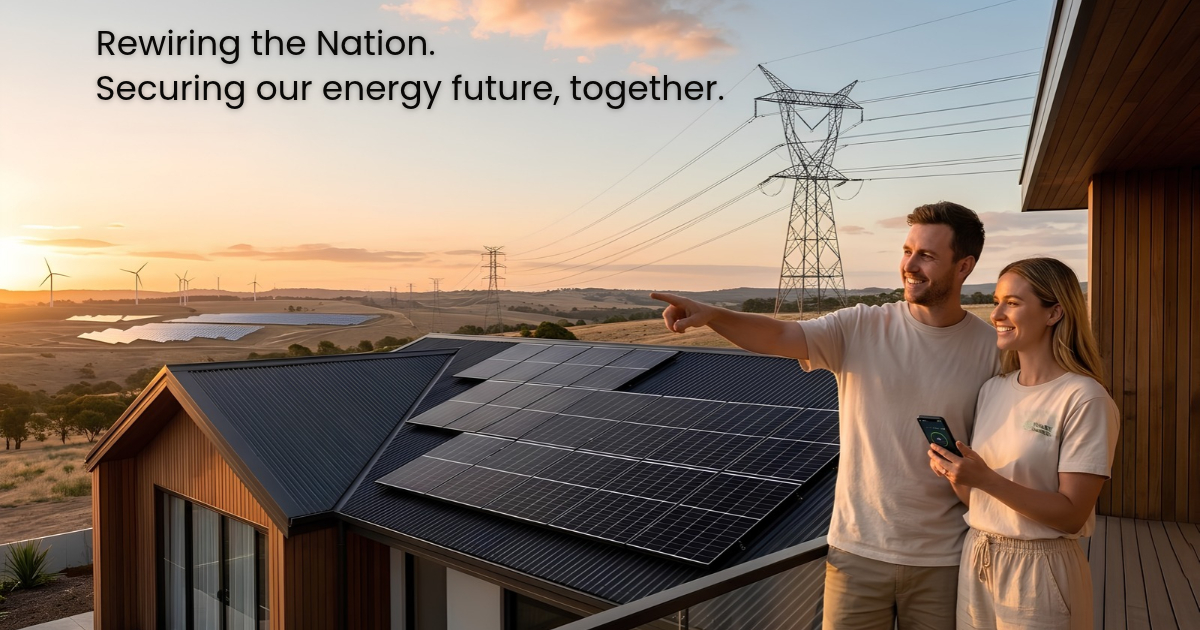
Australia’s energy landscape is changing at a breathtaking pace, with over three million households now generating clean electricity directly from their roofs. To support this rapid transition, the federal government’s $20 billion initiative to rewire the nation, which Australian homeowners are watching closely, is modernising our national electricity grid.
According to the Australian Energy Market Operator (AEMO), renewable energy regularly supplies over 70% of the National Electricity Market (NEM) during peak generation periods.
However, our legacy grid infrastructure was built decades ago around centralised coal plants, creating significant bottlenecks. This landmark scheme funds major transmission upgrades nationwide to deliver cheaper wind and solar power directly to consumers.
Quick answer: What does Rewiring the Nation mean for homeowners?
- A stronger electricity grid: Australia’s Rewiring the Nation initiative supports investment in transmission infrastructure needed to connect renewable energy projects and improve electricity supply.
- Potentially more affordable electricity over time: Better access to low-cost wind and solar generation could put downward pressure on wholesale electricity prices, although network costs, retail margins and other factors will still affect household bills.
- New opportunities for solar and batteries: A more renewable electricity system could increase the value of household energy management, but the benefits will depend on local network conditions, electricity tariffs and individual consumption patterns.


What is Rewiring the Nation Australia homeowners should care about?
The Rewiring the Nation scheme is a $20 billion commitment managed by the Clean Energy Finance Corporation (CEFC). It provides low-cost finance to build critical electricity transmission projects across Australia.
The key facts
- Targeted capital: $20 billion in concessional loans and equity to lower the building costs of new transmission lines.
- Grid capacity: Designed to unlock regional Renewable Energy Zones (REZ) and integrate large-scale storage projects like HumeLink and VNI West.
- National reach: Connects Tasmania, Victoria, New South Wales, Queensland, and South Australia into a flexible power network.
Why this matters right now in Australia
Our existing power lines were never designed to handle two-way power flow from millions of residential solar systems and utility-scale projects. Without significant transmission upgrades, grid congestion leads network providers to switch off or throttle solar exports.
Modernising the high-voltage grid protects residential solar system owners from severe export curtailment. It ensures that the clean power produced on suburban roofs can be shared efficiently across town lines or stored safely in community batteries.
Expert insight: Connecting cheap renewable energy to population centres requires a 21st-century grid. Rewiring the Nation is the missing link that secures lower power costs for Australian households over the coming decades.
How the scheme works and the current state in Australia
To understand how high-voltage transmission lines impact your suburb, it helps to look at the link between wholesale energy markets and local distribution networks.
Technical explanation
Transmission lines act as Australia’s energy superhighways. They carry high-voltage electricity across vast distances from power stations to regional hubs.
Local distribution lines then deliver that power down your street and into your switchboard. When high-voltage transmission lines are congested, local lines back up, forcing network operators to dial back residential solar feed-in limits.
Australian examples and data
Major Australian news outlets like ABC News and the Australian Financial Review routinely report on the progress of critical transmission builds. Projects like Marinus Link, which connects Tasmania’s hydro assets to mainland Victoria, rely heavily on this funding.
Major transmission projects funded by scheme
| Project Name | Regions Connected | Primary Benefit |
| Marinus Link | Tasmania to Victoria | Shares hydro and wind storage |
| HumeLink | Southern NSW | Connects Snowy 2.0 to load centres |
| VNI West | Victoria to NSW | Increases cross-border capacity |
| CopperString 2032 | Townsville to Mount Isa | Unlocks QLD mineral/solar zones |
Recent CSIRO reports confirm that solar and wind backed by storage remain the cheapest form of new electricity generation in Australia. Building out this transmission framework is the fastest way to replace retiring coal generators and maintain system reliability.
Expert insight: The Commonwealth Bank and national market bodies consistently emphasise that early investment in transmission prevents far more expensive grid emergency intervention later.
What does this mean for your electricity bills?
Every household wants to know how a $20 billion infrastructure investment affects their quarterly power bill. The financial impact falls into distinct short-term and long-term phases.
Short-term impact
In the immediate term, transmission builds represent upfront capital expenditure. Because network costs make up roughly 30% to 40% of a typical residential electricity bill, regulated network operators pass through a portion of construction costs.
However, government financing through concessional low-interest loans directly reduces borrowing costs. This safeguards consumers from the sharp rate hikes typically tied to private infrastructure debt.
Long-term implications
Over the long term, the savings far outweigh the early capital investment. By allowing cheap solar and wind to displace expensive gas peaking plants and failing coal units, wholesale energy prices drop significantly.
When wholesale prices fall, energy retailers lower their usage rates. Higher grid stability also reduces the need for expensive emergency network interventions, protecting household budgets from sudden market spikes.
Expert insight: Every gigawatt of low-cost renewable power we successfully connect to the grid exerts downward pressure on retail energy bills. Upgrading transmission is fundamentally a household cost-reduction strategy.
What Australian homeowners can do right now?
While the federal government builds large-scale grid connections, Australian property owners can take practical steps to insulate their homes from rising retail prices and maximise energy value.
Actionable steps
- Upgrade household generation: Install high-efficiency solar panels to maximise daytime power generation while grid updates are underway.
- Invest in home batteries: Pair your array with a modern battery to store excess solar power for evening use, avoiding peak electricity tariffs entirely.
- Adopt Smart Energy Management: Use smart meters and home management systems to run appliances like heat pumps during peak solar-generation hours.
- Prepare for electric vehicles: Install smart EV chargers that automatically charge your car when solar generation is high or wholesale rates are low.
Powering up your EV with solar
If you’re thinking of buying an EV, adding an EV charger to your solar system is a smart way to “fuel” your car with clean, renewable energy.
Questions to ask your installer or retailer
- Does this inverter support flexible export limits so I can export as much solar power as possible as local grid capacity expands?
- What battery capacity do I need to achieve high self-consumption and reduce my reliance on grid imports?
- Are there active Virtual Power Plant (VPP) programs in my suburb that reward me for sharing battery power during grid stress events?
- How will future network dynamic pricing structures impact my daily solar return on investment?
Use Energy Matters’ easy-to-use solar power and solar battery storage system calculator to determine the right size for your solar system with storage. Our solar calculator will generate performance information and potential savings.
We can send this information to 3 pre-vetted, trusted local installers so they can provide obligation-free solar quotes and help you take the first step toward true energy independence.

Expert insight: Taking control of your household generation gives you immediate independence. Combining solar, batteries, and smart control systems shields your family from retail price shifts while the grid improves.
State-by-state considerations
Grid updates, government incentives, and network conditions vary widely across Australian states. Here is how regional policies align with the national scheme:
Victoria (VIC): Victoria’s grid is undergoing a massive transformation as offshore wind farms develop along the Gippsland and Portland coasts. The state government’s VicGrid body works alongside national initiatives to ensure new transmission lines connect smoothly to local substations. Victorian homeowners can leverage solar and heat pump rebates to switch away from residential gas connections.
New South Wales (NSW): NSW is building five dedicated Renewable Energy Zones across regions like the Central-West Orana and New England. High-voltage builds like HumeLink will carry power directly into Sydney, Newcastle, and Wollongong. NSW property owners can use the Peak Demand Reduction Scheme to access incentives for batteries and smart appliances.
Queensland (QLD): Under the Queensland Energy and Jobs Plan, the state is investing heavily in transmission projects like CopperString 2032. This connects sunny western regions to industrial coastal hubs. Sunshine State households continue to set rooftop-generation records, making battery additions vital for managing local grid feed-in limits.
South Australia (SA): South Australia already generates a massive share of its electricity from wind and solar. The state is linked into Project EnergyConnect, an interconnector connecting SA to NSW. SA homeowners are leading the nation in Virtual Power Plant (VPP) enrollment, earning income by trading stored battery energy with the broader network.
Western Australia (WA): While WA operates on the isolated South West Interconnected System (SWIS) rather than the NEM, state-based transmission investments mirror federal goals. Western Power is expanding network capacity to support heavy electrification and is offering grants to regional WA property owners for standalone power systems and residential solar upgrades.
Expert insight: Understanding your state’s energy roadmap ensures you choose the right residential solar equipment. Local incentives, combined with national grid upgrades, can drastically shorten system payback periods.
Expert predictions for 2027 and beyond
As transmission builds mature over the next few years, the way Australian households interact with the national grid will change fundamentally:
- Dynamic flexible exports become standard: Fixed solar export limits will be phased out across eastern states. Homeowners with smart inverters will be able to export more energy when the grid has available capacity.
- Expansion of neighbourhood storage: Community batteries funded through clean energy grants will capture excess local solar and balance distribution transformers at the street level.
- Two-way vehicle-to-grid integration: Vehicle-to-Grid (V2G) technology will let EV owners discharge battery power back into their home switchboard or the grid during peak demand events, unlocking new revenue streams.
- Higher energy-efficiency standards: Electric home conversion, including energy-efficient space heating and solar hot water system options, will become standard practice in suburban renovations.
Explore practical energy-efficiency improvements before paying for a larger solar system than you need.
Energy Matters recommends switching to energy-efficient appliances now to save money and live more sustainably.

Frequently asked questions
Will Rewiring the Nation make electricity cheaper for my household?
Yes, in the long term. Connecting cheaper utility-scale solar, wind, and storage to major cities reduces reliance on expensive fossil fuel generation. This structural shift lowers wholesale energy market prices, leading to lower retail electricity rates for everyday Australian consumers.
Does the grid upgrade affect my current solar feed-in tariff?
Grid upgrades help protect feed-in potential by relieving regional congestion. Without transmission upgrades, networks would have to lower export limits. A modernised grid allows network managers to accept higher levels of residential solar exports during peak production hours.
Do I need to buy a home battery because of these changes?
A home battery isn’t mandatory, but pairing storage with solar gives you maximum flexibility. Storing self-generated energy protects your household from high peak electricity rates and allows you to participate in profitable Virtual Power Plant programs as grid networks modernise.
How are transmission projects funded through this program?
The federal government provides $20 billion in low-cost loans and equity via the Clean Energy Finance Corporation. This low-interest, concessional financing keeps construction costs significantly lower than private commercial borrowing, reducing the pass-through of network fees on residential power bills.
What is the timeline for seeing major grid improvements?
Major transmission projects are being constructed progressively through the late 2020s. Projects like Project EnergyConnect and critical REZ hookups are coming online now, with full national network integration expected to streamline power delivery continuously through 2030 and beyond.
Key takeaways
- $20 billion capital commitment: The scheme builds thousands of kilometres of vital high-voltage transmission lines to modernise Australia’s aging grid.
- Protection for solar investments: Upgrading network infrastructure prevents severe solar curtailment, keeping household systems exporting efficiently.
- Long-term cost reductions: Connecting cheaper renewable energy sources lowers wholesale prices and provides sustained relief on household power bills.
- State-specific progress: Tailored state infrastructure strategies, like NSW REZs and SA interconnectors, unlock regional clean energy access.
- Actionable homeowner strategy: Combine rooftop solar, home storage, and smart EV charging to maximise your financial returns as the grid evolves.
Get ready for Australia’s clean energy transition
Thinking about solar or a home battery? Australia’s electricity network is changing, but you don’t have to wait for every transmission project to finish before exploring ways to manage your household energy costs.
Energy Matters helps Australians understand residential solar, battery storage and clean energy options. Start by assessing your home’s electricity consumption, roof suitability, and available installation options.
Sources and References
- Department of Climate Change, Energy, the Environment and Water: Rewiring the Nation program
- Australian Energy Market Operator: 2026 Integrated System Plan
- Australian Energy Market Operator: 2025 Integrated System Plan toolkit
- Department of Climate Change, Energy, the Environment and Water: Powering Australia policy overview