


Australia’s 2050 net-zero transition to cleaner energy is already reshaping how households generate electricity, heat water, and power their cars. The federal government has legislated a net-zero greenhouse gas emissions target for 2050, along with a 2035 target to reduce emissions by 62% to 70% below 2005 levels.
For homeowners, understanding Australia’s 2050 net zero is about more than climate policy. It is about preparing for changes in energy costs, household technology, home comfort, and how electricity is supplied. Energy Matters helps Australians explore home solar systems and choose upgrades that suit their properties.
The good news is you don’t need to renovate your entire home overnight. By understanding the targets and planning improvements in stages, you can make informed decisions that suit your budget and circumstances.
Start your net zero journey with a free solar quote → Compare solar quotes with Energy Matters.
Quick answer
- Australia’s 2050 net zero target means reducing greenhouse gas emissions as far as possible and balancing remaining emissions with removals. It does not mean every household must have zero emissions by 2050.
- For homeowners, the transition will likely mean more renewable electricity, greater use of rooftop solar and batteries, more efficient electric appliances, and more electric vehicles over time.
- You can start now by improving energy efficiency, comparing solar and battery options, and checking current government incentives before investing.


What is Australia’s 2050 net zero target and why should homeowners care?
Net zero balances the greenhouse gases released into the atmosphere with those removed. It doesn’t require every activity to stop producing emissions, but it does require deep reductions across the economy, with removals balancing the remaining emissions.
The federal government has legislated the 2050 target under Australia’s climate change framework. The next major milestone is the 2035 target, which requires emissions to fall by 62% to 70% compared with 2005 levels.
The key facts
| Milestone | What it means |
| 2030 | Existing legislated target of a 43% emissions reduction below 2005 levels |
| 2035 | National target of a 62% to 70% reduction below 2005 levels |
| 2050 | Net zero greenhouse gas emissions across the Australian economy |
| Homeowners | No universal requirement to install solar, batteries or an electric vehicle solely because of the national target |
| Energy transition | More renewable electricity, storage, efficient appliances and electrification are expected |
Source: Australian Government, Department of Climate Change, Energy, the Environment and Water.
Why this matters right now for Australia’s 2050 net zero homeowners
The transition is already underway. Australia’s National Greenhouse Gas Inventory update for the year to March 2026 estimated emissions at 455.6 million tonnes of carbon dioxide equivalent, down 1.6% from the previous year. Electricity emissions fell 3.7%, reflecting increased renewable generation and reduced coal and gas generation.
The challenge is that progress across the economy is uneven. Transport, industry, buildings and other sectors must also reduce emissions, so the transition will involve more than building solar farms.
For households, the implications may include changing electricity tariffs, incentives for cleaner technology, and more choices about how to power and heat a home.
Expert insight: The net zero target is an economy-wide objective, not a deadline for every Australian home to become self-sufficient. Homeowners can focus on practical improvements that reduce energy waste and make household energy use more flexible.
How Australia’s 2050 net-zero target works in homeowner practice
Australia’s path to net zero involves changes to electricity generation, transport, buildings, industry, agriculture and land management. For homeowners, the most visible changes are likely to be in the electricity system and the technologies used at home.
The Australian Energy Market Operator’s 2026 Integrated System Plan identifies renewable energy supported by storage, transmission and other dispatchable generation as the planned pathway for the National Electricity Market through to 2050.
The technical explanation for net zero 2050 Australia
Think of the transition as three connected changes.
- Cleaner electricity: More wind and solar generation replaces emissions-intensive electricity generation over time.
- Electrification: Households increasingly use electricity instead of burning gas or petrol for everyday activities, such as heating water, cooking and driving.
- Smarter energy use: Batteries, energy-efficient appliances and flexible electricity demand help households use energy when it is cheaper or cleaner.
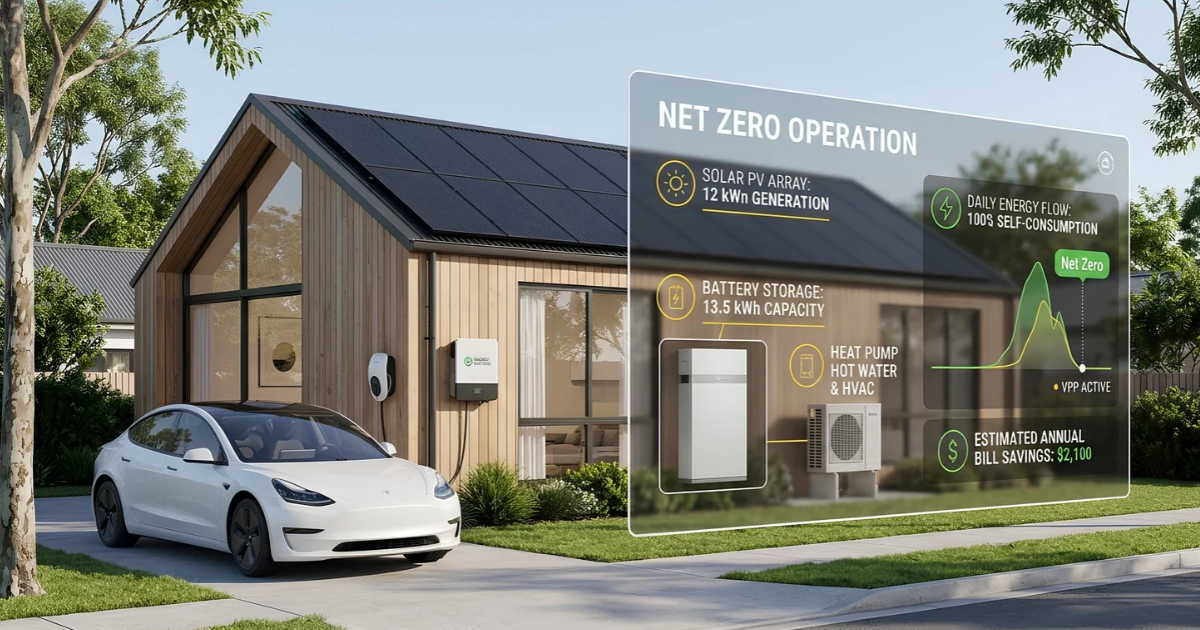
These changes work together. For example, an efficient electric hot water system can use rooftop solar during the day rather than relying on gas or buying electricity during a more expensive evening period.
Homeowners do not have to adopt every technology. The right combination depends on the property’s existing equipment, electricity usage, local climate, budget and how long the owner expects to stay.
Australian examples and data
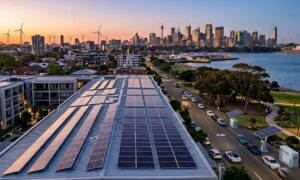
Australia is already a major rooftop solar market. The Australian Centre for Advanced Photovoltaics reported that the country had more than 39 gigawatts of installed solar capacity by the end of 2024, making it a global leader in solar deployment per person.
Household batteries are also becoming more common. In October 2026, the Australian Energy Market Operator’s chief executive reported more than 700,000 household batteries installed across Australia, with combined capacity exceeding 5 gigawatts and 16 gigawatt-hours.
That growth matters because rooftop solar generates most of its electricity during daylight hours, while many households need energy after sunset. Batteries can store surplus generation for later use, although their financial value depends on installation costs, tariffs and household consumption.
Expert insight: A net zero home is not necessarily a house covered in technology. It uses energy intelligently, reduces unnecessary consumption, and chooses lower-emissions energy sources where practical.
To understand your options, read Energy Matters’ guides on choosing solar panels and energy efficiency.
What does net-zero 2050 Australia mean for your electricity bills?
For homeowners, the financial question is often more immediate than the emissions target itself. Solar, batteries, insulation, and efficient appliances can reduce some household costs, but savings aren’t automatic.
Your results depend on how much electricity you use, when you use it, what you pay for grid electricity, the feed-in tariff you receive and the upfront cost of upgrades.
Short-term impact
You do not need to wait until 2050 to make changes. Small improvements, such as sealing draughts, adjusting hot water settings where appropriate and using efficient appliances, can reduce energy waste.
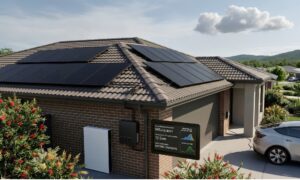
Rooftop solar may lower electricity purchases when generation matches household demand. A battery can increase the amount of solar electricity used at home, but it adds cost and does not guarantee a lower total bill in every situation.
The federal Cheaper Home Batteries Program, introduced on 1 July 2025, provides an upfront discount for eligible battery systems connected to new or existing solar installations. From May 2026, program rules changed, and the discount is based on eligible capacity and certificates rather than a guaranteed flat percentage for every installation.
Long-term implications
As electricity generation changes, tariff structures and the value of exporting solar power may also change. More midday solar generation can reduce wholesale prices during some periods, while evening demand can make stored energy valuable at other times.
However, retail bills include network costs, retailer charges and other components, so wholesale electricity prices do not translate directly into household savings.
| Home energy option | Potential household benefit | Important consideration |
| Rooftop solar | Reduces grid purchases when solar generation is used at home | Roof orientation, shading and daytime usage affect performance |
| Home battery | Stores surplus solar for later use and may support backup power | Upfront cost, usable capacity and warranty matter |
| Insulation and draught sealing | Reduces heating and cooling demand | Suitability depends on the building |
| Efficient electric hot water | Can reduce energy use and replace gas consumption | Installation and running costs vary by system |
| Electric vehicle | May lower transport running costs for some drivers | Purchase price, charging access and driving patterns matter |
For a clearer picture of your options, request solar quotes and compare the proposed system sizes, warranties and estimated performance.
Expert insight: Compare whole-of-system costs rather than headline discounts. Before signing a contract, ask for estimated annual savings, assumptions about your electricity usage, maintenance costs, and the expected payback period.

What Australian homeowners can do right now?
Preparing for net zero does not mean replacing every appliance at once. A staged approach can help you prioritise the upgrades that make the most sense for your household.
Actionable steps
1. Understand your current energy use.
Review several electricity bills and identify your average consumption, peak-use periods and tariff. If your retailer provides interval data, check how much electricity you use during the day compared with the evening.
2. Improve the home’s efficiency first.
Consider insulation, draught sealing, external shading and efficient heating and cooling. Energy-efficient homes can require less heating and cooling, making other upgrades more effective.
3. Assess whether solar suits your roof.
Check roof space, orientation, shading, switchboard condition and likely daytime consumption. Compare home solar systems and ask installers to explain their generation estimates.
4. Consider a battery based on your usage.
A battery may be useful if you have substantial evening demand, low solar export returns, or need backup power. Check whether the battery and installation qualify for current government support before budgeting for a rebate.
5. Plan for electric appliances.
When your gas hot water system, heater or cooktop reaches the end of its life, compare efficient electric alternatives. Replacing equipment at the natural end of its service life can save you the cost of discarding a working appliance early.
6. Explore electric vehicle charging.
If an EV suits your transport needs, home charging can offer convenience and let you use surplus solar generation. See Energy Matters’ guide to EV chargers.
7. Check incentives before making a purchase.
Eligibility rules, program budgets and application windows change. Check the Australian Government’s solar rebates and loans guide and your state government’s official energy website.
Questions to ask your installer or retailer
Before investing, ask:
- What annual solar generation do you estimate for my roof, and what assumptions support that estimate?
- How much of the electricity my home generates will it use?
- What is the total installed price after confirmed incentives?
- What are the inverter, panel and battery warranties?
- Will the system support backup power during an outage, and what circuits will remain operational?
- Which electricity tariff and feed-in rate did you use in the savings estimate?
- Are there export limits or network approval requirements at my address?
- What happens if the installer or equipment manufacturer ceases trading?
Expert insight: Ask for estimates based on your actual bills, not just a generic household profile. An appropriately sized system that fits your usage can be more useful than a larger system selected on panel capacity alone.
Start your net zero journey with a free solar quote → Compare options with Energy Matters.
State-by-state considerations for homeowners
Victoria (VIC): The Victorian Gas Substitution Roadmap has banned gas connections in new residential developments requiring building permits. Solar Victoria provides targeted rebates and interest-free loans for solar PV and heat pump installations.
New South Wales (NSW): The Peak Demand Reduction Scheme offers incentives to replace inefficient air conditioners and hot water units with energy-efficient heat pumps.
Queensland (QLD): High solar deployment rates mean network distribution businesses are trialling dynamic export limits, making battery storage essential for capturing excess midday generation.
South Australia: With the nation's highest renewable grid penetration, SA requires all new solar inverters to support dynamic export capabilities to maintain grid stability.
Western Australia: The South West Interconnected System (SWIS) actively encourages residential storage options to mitigate low-load challenges during peak sunny periods.
Expert predictions for 2027 and beyond
Industry models from CSIRO's GenCost report project that residential battery storage capital costs will continue to fall over the coming years, driven by global manufacturing scale. By 2027, automated energy management software will routinely manage home appliances, discharging household batteries during high-value peak events to maximise return on investment.
Integrating Vehicle-to-Home (V2H) and Vehicle-to-Grid (V2G) technology will turn electric vehicles into home batteries, providing 50 to 90 kWh of usable storage that can run an average residence for days.

Frequently asked questions about Australia 2050 net zero and homeowners
1. Does every Australian homeowner need to reach net zero by 2050?
No. Australia's national net zero target applies to the economy as a whole, not to individual household emissions. The target does not require homeowners to install solar panels, buy batteries, or replace gas appliances. Voluntary upgrades can nevertheless reduce household energy use and emissions.
2. How does net zero affect me if I already have solar panels?
Existing solar owners can keep using their systems while considering whether a battery, more efficient appliances, or an electric vehicle suits their needs. As tariffs and export conditions change, it may be worth reviewing when you use electricity and how much surplus solar you send to the grid.
3. Is a net zero home Australia project expensive?
Costs vary widely. Some improvements, such as reducing draughts and adjusting energy habits, are inexpensive, while solar, batteries and major appliance replacements require greater investment. Government assistance may reduce eligible upfront costs. Compare the total installed price, likely savings, and maintenance requirements before deciding.
4. Can I make my home net zero without installing solar?
Yes. You can reduce household emissions through energy efficiency, efficient electric appliances, lower-emissions electricity plans and changes to transport. Renters and apartment residents may have limited control over building upgrades, but they can explore energy-saving measures and eligible shared or community solar arrangements.
5. What is the first step towards a net zero home?
Start by reviewing your electricity bills and identifying where your home uses the most energy. Address efficiency issues first, then investigate solar, batteries or electric appliances based on your circumstances. Check current incentives and get comparable quotes from appropriately accredited installers before you proceed.
Key takeaways
- Australia's 2050 net zero target is a national emissions goal, not a universal requirement for every household to eliminate its emissions.
- The 2035 target is a major milestone, with Australia aiming to cut emissions by 62% to 70% below 2005 levels.
- Solar, batteries, energy efficiency, and electrification can help homeowners reduce energy consumption, household emissions, and electricity purchases.
- Government incentives vary by state and can change, so verify eligibility and current terms before committing financially.
- A staged approach based on your energy bills, property and budget can make the transition more manageable.
Prepare your home for Australia's net zero future
Australia's 2050 net zero target will reshape the country's energy system over time, but homeowners can prepare without making every change at once. Improving energy efficiency, exploring solar and batteries, and planning for efficient electric appliances can help households respond to the transition on their own terms.
Start by understanding your energy use and comparing upgrades with your budget and long-term needs. Energy Matters can help you explore your options and compare solar quotes from accredited installers.
Take the first step today. Get a free solar and battery quote from Energy Matters to see which solutions could work for your home.
Sources and References
- Department of Climate Change, Energy, the Environment and Water: Net zero
- Australian Government: National greenhouse gas inventory, March 2026 update
- Australian Government: Solar rebates and loans
- Australian Energy Market Operator: 2026 Integrated System Plan
- Clean Energy Council: Accelerating Australia’s clean energy transition