


In October 2026, NSW Parliament passed changes to the Strata Schemes Management Act that stop strata committees from unreasonably refusing EV chargers. It’s been dubbed a “right to charge”. But if you rent, there’s a catch: that right belongs to the apartment’s owner, not you.
That makes EV charging for renters in NSW a two-step process. You still need your landlord’s written permission, and your landlord then applies to the strata on your behalf. The good news is that once your landlord is on board, the new rules make the second step much easier.
This guide explains what the right to charge in NSW means for tenants, who pays for a charger, how to ask your landlord, what happens when you move out, and how to keep charging while you wait.
Quick summary
- Yes, but through your landlord. Tenants can’t apply to the strata directly. Your landlord must agree, then apply to the owners corporation on your behalf.
- Strata can no longer say no without good reason. Under the new laws, committees can’t unreasonably object to an owner’s charger request, even if it involves common property.
- Expect to pay for the charger yourself. In most cases, the owner or tenant covers the charger, while the building-wide system is a strata decision.
What’s changed in NSW strata laws for EV charging?
The October 2026 amendments build on earlier reforms and make it much harder for strata committees to block EV chargers. The key shift is that refusals now need a genuine reason.
How the rules have evolved
| Reform | What it did |
| 2021 sustainability infrastructure changes | Classed EV charging as “sustainability infrastructure”, so approval needs a simple majority rather than a special resolution |
| 1 July 2025 changes | Banned refusals based on appearance alone |
| October 2026 amendments | Strata can’t unreasonably object to an owner’s charger request, including common property work; by-laws that unreasonably prohibit chargers can be invalidated; strata must respond within set timeframes |
What the new laws don’t change
The right to charge isn’t a free pass to install any charger. The owners corporation still decides how EV charging works across the whole building, and any individual approval must fit a plan that can scale as more residents buy EVs.
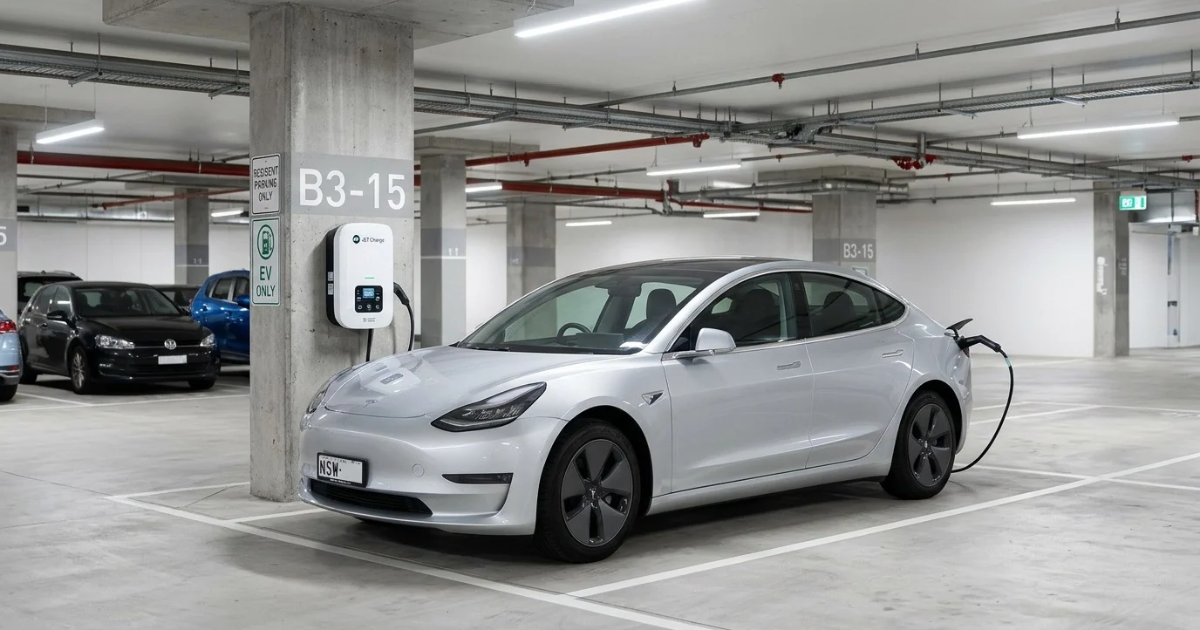
In practice, that usually means a managed, load-balanced charging system rather than a basic power point wired to one apartment’s switchboard. If your building isn’t yet “EV ready”, the strata may need to plan and install shared infrastructure before individual chargers can connect.
For a broader look at what’s possible in apartments, see our guide to electrifying your apartment.
Expert tip
Ask your strata manager or building manager whether the building already has an EV charging plan. If it does, your landlord’s request may be a simple connection to existing infrastructure rather than a new approval.
Can tenants get an EV charger in a NSW apartment?
Yes, but you need two approvals, and you can only ask for one of them yourself. Your landlord must agree first, then the landlord seeks approval from the owners corporation.
Approval 1: your landlord
Under NSW tenancy rules, you can make changes to a rental property only if your lease allows it or your landlord gives written permission. Landlords can’t unreasonably refuse a short list of prescribed “minor changes”, such as fly screens or picture hooks, but an EV charger isn’t on that list.
That means your landlord can say no to a charger, as long as it’s reasonable to do so. NSW Government guidance on making changes to a rental property explains how consent works and when disputes can go to the NSW Civil and Administrative Tribunal (NCAT).
Approval 2: the strata
Once your landlord agrees, they apply to the owners corporation as the lot owner. This is where the new right to charge helps: the strata committee can’t unreasonably object to the owner’s request.
Why tenants can’t apply to strata directly
Strata law deals with lot owners, not tenants. Installing a charger usually involves the building’s common property, such as cabling, switchboards or car park walls, and only the owner can seek approval for that work.
Expert reference
The NSW Government’s EV-ready strata guidance states that tenants must seek their landlord’s approval, and the landlord can then act on their behalf with the owners corporation, because tenants have limited ability to change common property.
Expert tip
Read your lease before you ask. Some leases include clauses about alterations, fixtures or electrical work. Knowing what it says helps you frame your request in a way your landlord or property manager can approve quickly.
Who pays for an EV charger when you rent?
In most cases, whoever requests the charger pays for it. Under NSW rental rules, tenants pay for changes they make unless the landlord agrees otherwise, and the new strata laws also place the cost of an individual charger on the owner or tenant.
Typical cost split
| Cost | Who usually pays |
| Charger hardware and installation for your car space | You, unless your landlord agrees to contribute |
| Building-wide infrastructure (cabling, load management) | The owners corporation, through strata levies |
| Electricity used to charge your car | You, through the building’s metering or billing system |
| Any app or billing subscription | You, as the user |
| Removing the charger at the end of your lease | You, unless your landlord agrees to keep it |
A smart charger suited to apartment buildings typically costs around $1,200 to $3,000 or more installed. Our guide to apartment and strata EV charging options compares the main options.
Why your landlord might chip in
An EV charger can make a rental more attractive to future tenants and add value to the apartment. That gives you room to negotiate. You could ask your landlord to share the cost, or agree to leave the charger behind in return for a contribution.
Expert tip
Put any cost-sharing deal in writing before installation. Note who owns the charger, who pays for repairs and whether it stays when you move out. A clear written agreement avoids disputes at the end of your lease.
How do you ask your landlord for an EV charger?
A clear, costed proposal is far more likely to be approved than an open-ended request. Follow these steps to give your landlord everything they need to say yes.
- Check whether your building is EV ready. Ask the building or strata manager if there’s an existing EV charging system or plan. Connecting to existing infrastructure is simpler and cheaper.
- Read your lease and the strata by-laws. Landlords must give tenants a copy of the strata by-laws. Check for any rules on alterations, electrical work or car park use.
- Get a quote. Ask a licensed electrician or EV charger installer for a quote that’s compatible with your building’s system, including any load management requirements.
- Send a written proposal to your landlord. Include the charger model, installer, total cost, who pays, how electricity will be billed and what happens when you move out.
- Your landlord applies to the strata. Once your landlord agrees in writing, they lodge the request with the owners corporation, which must respond within the timeframes set by the new laws.
- Install and set up billing. Use a licensed installer and register with the building’s billing or metering system so your electricity use is charged to you.
If your landlord or strata says no
Ask for the reasons in writing. If you think a refusal is unreasonable, contact NSW Fair Trading on 13 32 20 or a tenant advocacy service for advice. Some disputes can go to NCAT. Remember, the strata’s “right to charge” obligations apply to your landlord’s request as the owner, so your landlord would need to pursue a strata refusal.
Expert reference
The NSW Government’s EV-ready strata resources include templates for charging requests, resident surveys and building energy assessments, plus sample meeting motions. Sharing these with your landlord and strata manager can speed up the process.
Expert tip
Frame your request around the landlord’s benefits. Point out that EV-ready apartments are increasingly sought after by tenants, and offer to cover the cost or leave the charger behind. Landlords are more likely to agree when the request adds value at little or no cost to them.




What happens to your EV charger when you move out?
Unless you agree otherwise with your landlord, you’re generally expected to leave the property as you found it, apart from fair wear and tear. That includes any charger you installed. Agreeing on this upfront saves time, money and bond disputes later.
Your three main options
| Option | What it involves | Best for |
| Leave it behind | The charger stays as a fixture, ideally with an agreed contribution from your landlord | Longer leases, or when the landlord shares the cost |
| Remove it | You pay a licensed electrician to remove the charger and make good any damage | Tenants who want to reuse the charger at their next home |
| Use a portable option | A portable charger plugged into an approved outlet, with little or no fixed installation | Short leases, where the building allows it |
Protect your bond
If you remove a charger, make sure the work is done by a licensed electrician and that walls, cabling and fittings are left in good condition. Any damage could be deducted from your bond.
Also check whether the building’s charging system or billing account needs to be transferred or closed when you leave.
Expert tip
Take dated photos of the car space and wall before installation and after removal. Keep copies of your landlord’s written consent and any agreement about who owns the charger. This evidence is invaluable if there’s a bond dispute.
How can you charge while you wait for approval?
Getting landlord and strata approval, and in some cases waiting for the building to become EV ready, can take months. In the meantime, these options can keep your car charged.
Public and kerbside charging
Public AC chargers in shopping centres, council car parks and on streets are often cheaper than fast chargers and suit overnight or long stays. Many NSW councils have been rolling out kerbside chargers in apartment-heavy suburbs, some with NSW Government support.
DC fast chargers are quicker but usually cost more per kWh, so they work best as a top-up rather than your main charging source.
Workplace charging
If your employer offers charging, it could cover most of your weekday needs. If not, it’s worth asking. Workplace charging is often simpler to set up than apartment charging.
Avoid shortcuts
Don’t plug into a common property power point without permission. You’d be using electricity paid for by all owners, which can breach strata by-laws, and standard outlets may not be designed for hours of continuous charging.
For more tips, read our apartment EV charging guide for strata residents and tenants.
Expert tip
Use a charging app to map public chargers near your home and work, then filter by price and charger type. Regular slow charging at a cheap nearby site can cost far less than relying on fast chargers.
Make EV Charging at Home Easier
Explore EV charging solutions suited to your home or apartment, compare quotes from trusted local installers, and find the right charger for your needs.
Frequently asked questions
Can I install an EV charger if I rent an apartment in NSW?
Yes, but only with your landlord’s written permission. Tenants can’t apply to the strata directly, so your landlord must lodge the request with the owners corporation on your behalf. Under the October 2026 amendments, the strata committee can’t unreasonably object to the owner’s request, even when installation involves common property.
Can my landlord refuse an EV charger request?
Yes. An EV charger isn’t on NSW’s list of prescribed minor changes that landlords can’t unreasonably refuse, so your landlord can say no if it’s reasonable to do so. A clear, costed proposal that covers who pays and what happens when you leave improves your chances of approval.
Who pays for an EV charger in a rental apartment?
Usually the tenant. NSW rental rules say tenants pay for changes they make unless the landlord agrees otherwise, and the new strata laws generally put the cost of an individual charger on the owner or tenant. The owners corporation typically funds building-wide infrastructure such as cabling and load management.
Do I have to remove my EV charger when I move out?
Generally yes, unless your landlord agrees it can stay. Tenants are expected to leave the property as they found it, apart from fair wear and tear. You can negotiate to leave the charger behind, ideally in exchange for a contribution, and should get any agreement in writing.
What is the right to charge in NSW?
The right to charge refers to October 2026 amendments to the NSW Strata Schemes Management Act. Strata committees can no longer unreasonably object to an owner’s EV charger request, by-laws that unreasonably ban chargers can be invalidated, and strata must respond within set timeframes. The building still chooses its overall charging system.
Key takeaways
- NSW’s new right to charge belongs to apartment owners, so tenants must go through their landlord.
- Landlords can refuse a charger request if it’s reasonable, because EV chargers aren’t a prescribed minor change.
- Once a landlord applies, strata can’t unreasonably object, and must respond within set timeframes.
- Tenants usually pay for the charger, while strata funds building-wide infrastructure.
- Agree in writing on costs, ownership and what happens at move-out before any installation.