




Roughly one in three Australians live in an apartment or another strata property, yet most electrification advice assumes you own the roof and control the switchboard. If you live in strata or you rent, the barriers to going electric aren’t usually technical; they’re procedural, financial, and sometimes contractual. This guide breaks down what you can actually electrify in an apartment today, what’s changed in 2025 and 2026 that makes it easier, and the two things that quietly kill most electrification proposals before they get anywhere.
Quick Summary
- Portable appliances like induction cooktops generally need no approval at all, since they don’t modify the property
- NSW has the most advanced strata EV charging rules in Australia, with simple-majority voting and aesthetic-based refusals banned since 1 July 2025
- Even a passed vote isn’t the finish line: if your building’s capital works fund doesn’t have the money allocated, or you’re locked into an embedded network contract, that’s the real fight
Which path applies to you
| Your situation | What it means |
| You’re changing a plug-in appliance in your own unit (induction cooktop, smart plug) | No approval needed, just do it |
| You’re changing something fixed in your unit that doesn’t touch shared wiring or plumbing (e.g. a split-system in a rental, in some states) | Your landlord or OC generally can’t unreasonably refuse; ask in writing |
| You’re changing something touching common property (EV charger, rooftop solar, building hot water) | Keep reading, you’ll need approval, so the next few rows matter |
| You’re a renter | Your leverage depends on your state’s current minimum rental standards; talk to your landlord directly, you can’t bring a strata motion yourself |
| You’re an owner in NSW | Ask whether your proposal qualifies as “sustainability infrastructure” for the simple-majority vote, instead of a special resolution |
| You’re an owner in VIC, QLD, or elsewhere | Confirm with your strata manager whether it’s classed as minor or major works before drafting anything |
| Your building is on an embedded network for hot water or electricity | This is likely your real blocker, and it’s a contract exit problem, not a vote; read the embedded network section before doing anything else |
| Your building’s capital works fund already has the money allocated | You mainly need a vote; get quotes first and draft a specific motion |
| Your building’s capital works fund does not have the money allocated | A passed vote isn’t the end of it; you’re also asking for a special levy or a loan. Budget for both fights, not just one |
Expert Tip: Work through this before you raise anything with your committee. Knowing in advance whether you’re fighting a vote, a fund shortfall, or a locked-in contract changes what you actually ask for.
What you can electrify without asking anyone
Before dealing with committees and votes, there’s a genuine quick win: several electrification steps need no approval at all because they don’t modify the property.
- A portable induction cooktop. Plugs into any standard power point, no rewiring, and can go with you when you move.
- Energy monitoring and smart plugs. Fully within your control, no structural change.
- A split-system reverse-cycle heater, in some cases. Under Victorian rental law, for example, landlords cannot unreasonably refuse non-structural, temporary modifications like this, provided nothing is permanently altered.
Expert Tip: Even for a “temporary” appliance, check your lease or strata by-laws first. What counts as non-structural is sometimes contested, and it’s a five-minute check that avoids a dispute later.
EV charging in strata: what’s actually changed
This is where the rules vary significantly by state, so it’s worth knowing exactly where you stand before raising it with your committee.
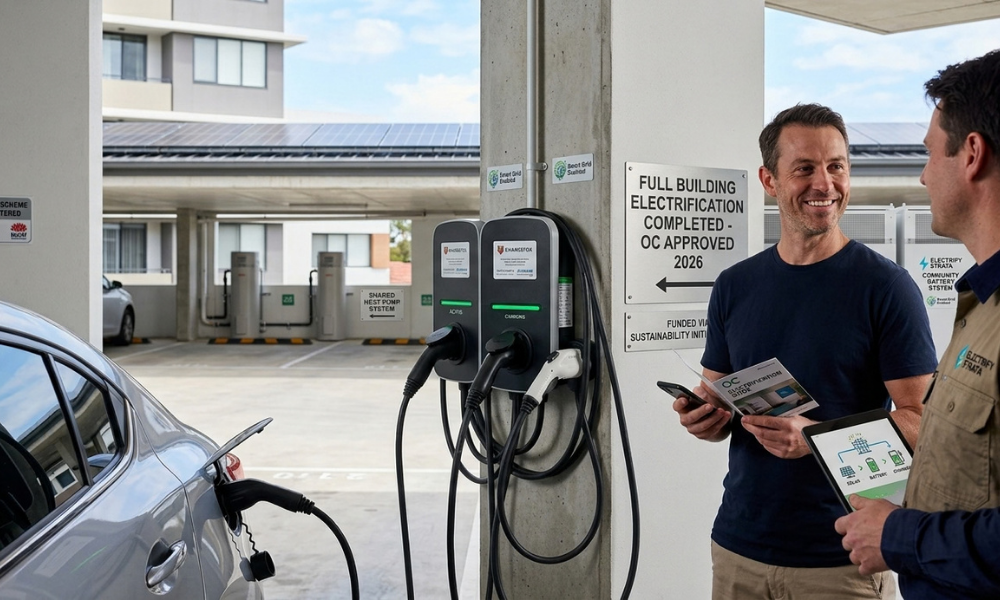
NSW has the most advanced legislation in the country. Under the Strata Schemes Management Act, EV charging is classified as Sustainability Infrastructure. That means proposals now pass on a simple majority (more than 50% of votes cast), down from the old 75% special resolution threshold. From 1 July 2025, by-laws can no longer block EV chargers purely on aesthetic grounds, except in heritage-listed buildings. NSW also now requires Owners Corporations to formally consider sustainability at every Annual General Meeting, with EV infrastructure required to be factored into Capital Works Fund planning. If a strata committee unreasonably refuses an EV charger, an owner can apply to the NSW Civil and Administrative Tribunal (NCAT) to have the refusal overturned.
Victoria works differently. EV charging is treated as common property works requiring a special resolution for major changes. The National Construction Code has mandated EV-readiness in new residential builds since May 2024, and in August 2026 the Victorian Department of Energy, Environment and Climate Action published a dedicated EV-ready guide for Owners Corporations, covering technical assessment, cost allocation, and legal approval pathways.
Queensland treats it as a body corporate resolution, ordinary for minor works and special for major ones, with guidance evolving alongside the state’s Zero Emission Vehicle Strategy.
SA, WA, Tasmania, and the ACT each have their own strata legislation, generally less standardised than NSW, though all are trending toward simplified sustainability approvals.
Expert Tip: Ask your strata manager whether your state has an equivalent to NSW’s “sustainability infrastructure” classification. Even where the vote threshold hasn’t officially changed, many committees are now more receptive to EV proposals simply because the policy direction nationally is so clearly set.





The hard part: shared hot water and gas
Individual appliance swaps only get you so far. In many apartment buildings, hot water runs through a shared system serving the whole building, and this can’t be changed unit by unit. Moving a shared system to heat pump hot water is a building-level capital works decision, involving cost-sharing across all owners and, often, a multi-year planning process.
But for a meaningful number of buildings, there’s a harder problem sitting underneath this one: the embedded network.
The embedded network trap
An embedded network is a privately run energy (and sometimes water) network serving an entire building, set up by the developer before the building is even sold. In theory, it lets the building buy energy in bulk at a discount. In practice, strata law expert Professor Cathy Sherry of Macquarie University has found many owners end up paying well above standard retail rates, with no ability to switch providers, and cites one case of a resident billed $9,700 for just 14 months of hot water.
The structural problem is timing: developers can lock a building into an embedded network contract before the first Annual General Meeting even happens, meaning owners have no say before they’re bound to it. One submission to a NSW parliamentary inquiry came from residents of a 134-apartment building in south-western Sydney who only discovered they were on an embedded network from a folder left on the kitchen bench during their pre-settlement inspection. The Owners Corporation Network, the peak body representing strata owners, has formally called for the repeal of the Strata Schemes Management Act’s section 132A exemption that allows this.
If your building is on an embedded network, electrifying shared hot water isn’t primarily a vote you need to win; it’s a contract you may be locked into until its term ends. Check your embedded network agreement’s expiry date and exit terms before planning anything else.
Expert Tip: Ask your strata manager directly whether your building is on an embedded network, and get a copy of the contract. Many owners don’t find out until they try to act on it.
How to actually get something approved
- Raise it with the strata committee or manager first, ideally with a concrete, costed proposal rather than an open-ended request. Committees move faster on specifics.
- Check which resolution type applies in your state. In NSW, ask if it qualifies as sustainability infrastructure for the lower voting threshold; in other states, confirm whether it counts as minor or major works.
- Budget for legal or lodgement costs if a new by-law is required, particularly in NSW where a new by-law needs land titles lodgement.
- Know your escalation path. In NSW, an unreasonable refusal can be challenged at NCAT. Other states have their own tribunal or dispute pathways if a proposal is blocked without valid grounds.
Why passing the vote isn’t the finish line
Here’s what most electrification advice leaves out: winning the vote doesn’t mean the money exists. NSW strata schemes are legally required to maintain a 10-year capital works fund plan, but historical survey data found roughly a third of special levies raised in NSW strata schemes existed specifically because the Owners Corporation hadn’t budgeted adequately for major capital works.
That matters here because if your building’s capital works fund doesn’t already have money allocated for electrification, a successful motion just opens a second fight: either a special levy, a lump sum owners have to pay on short notice, or a loan the scheme takes out and repays through higher ongoing levies. Special levies for major works can run into the thousands, sometimes tens of thousands, of dollars per lot. This is where a lot of otherwise well-supported electrification proposals actually stall, not at the vote, but when owners realise what it will cost them personally and when.
Expert Tip: Ask to see your building’s current capital works fund plan and balance before raising a motion. If electrification isn’t already budgeted, be upfront in your proposal about whether you’re also asking for a special levy; it builds trust and avoids a second, angrier debate later.
What if you’re renting, not owning?
Renters have less leverage than owners, and where you stand depends heavily on which state you’re in, since minimum rental standards are being introduced state by state, not nationally.
The ACT already has minimum standards in place, though currently limited to ceiling insulation.
Victoria has gone furthest, with standards covering space heating and cooling, water heating, insulation, and draught-proofing already partly in effect, and a requirement to replace gas appliances with efficient electric alternatives at end of life phasing in from March 2027.
NSW is mid-consultation. The Department of Climate Change, Energy, the Environment and Water ran a formal consultation on Minimum Energy Efficiency Rental Standards (MEERS), with submissions closing 31 May 2026 and strong backing from groups including the Energy Efficiency Council, Energy Consumers Australia, and the Tenants’ Union. One relevant data point from that consultation: only 10% of NSW renters had rooftop solar as of 2024, compared to 38% of homeowners, and renters spend roughly 8% more on energy as a result. Whether NSW proceeds, and on what timeline, is still an open question.
Other states haven’t moved yet. Queensland, SA, WA, Tasmania, and the NT currently have no equivalent minimum energy efficiency rental standards, though national advocacy groups like Rewiring Australia are pushing for every state and territory to require gas appliances be replaced with efficient electric alternatives at end of life, and for renters to be allowed to use things like plug-in balcony solar and portable batteries without needing landlord sign-off.
In the meantime, regardless of state, most residential tenancy law includes a general “fit for habitation” obligation. That’s given renters some ability to push back on genuinely unsafe heating or cooling, though it’s a much weaker and more contested lever than a hard minimum standard.
Expert Tip: If you’re a renter, check whether your state has an active consultation open (like NSW’s MEERS process). Public submissions are one of the few direct ways renters can influence what standards eventually apply to their own homes.
Does electrifying an apartment actually add value?
It’s not just a running-cost argument. A Domain study found apartments listed with energy-efficiency features attached sold for a meaningful premium over comparable listings without them. That’s a useful data point to raise with a reluctant committee; electrification isn’t only a climate or bill-saving case, it’s also a building-wide asset value case.
Real-world proof
Apartment electrification is genuinely being done, not just discussed. A Canberra apartment owner’s experience getting a full electrification project through strata, achieved through persistence and a supportive strata manager, is a useful reminder that committee-level resistance isn’t necessarily permanent; it often comes down to how the proposal is framed and who champions it.
Frequently asked questions
Can I install an EV charger in my apartment car space?
It depends on your state and whether the installation touches common property. NSW has the clearest pathway, with EV charging classified as sustainability infrastructure and passing on a simple majority vote. Other states require special or ordinary resolutions depending on the scope of works, so check with your strata manager first.
What is an embedded network, and how does it affect electrification?
An embedded network is a privately operated energy network serving an entire building, often set up by the developer before owners have any say. If your building is on one, upgrading shared systems like hot water may be blocked by contract terms, not just by a vote, so check your building’s contract and exit terms first.
Do I need Owners Corporation approval to install an induction cooktop?
Generally no, if it’s a portable, plug-in unit that doesn’t modify wiring or fixtures. A built-in, hardwired induction cooktop replacing a gas cooktop is more likely to need approval, since it may involve electrical work to common property.
If our strata votes to approve an upgrade, is that enough to make it happen?
Not always. If your building’s capital works fund doesn’t already have the money allocated, a successful vote can still require a special levy or a loan to actually fund the work, a second decision that has caused many otherwise-approved projects to stall.
What can renters ask their landlord to upgrade?
It depends on your state. Victoria has the most comprehensive protections, including gas-to-electric replacement at end of life phasing in from March 2027. NSW is consulting on similar standards, while most other states don’t yet have equivalent rules, so renters there are largely limited to requesting non-structural changes a landlord can’t unreasonably refuse.
Key takeaways
- Portable, plug-in appliances like induction cooktops generally need no approval and are the easiest electrification step available to any apartment resident
- NSW has the most advanced strata EV charging rules in Australia, with simple-majority voting and a ban on aesthetic-based refusals since 1 July 2025
- If your building is on an embedded network, electrifying shared systems is a contract exit problem first, and a vote second
- A passed motion doesn’t guarantee funding; check your capital works fund balance before assuming the fight is over
- Renters’ options vary significantly by state, with Victoria leading, NSW mid-consultation, and most other states not yet regulated
Sources cited: NSW Strata Schemes Management Act provisions (via legal and industry analysis), Victorian Department of Energy, Environment and Climate Action EV-ready guide for Owners Corporations (Aug 2026), Domain 2022 energy efficiency property value study, Professor Cathy Sherry (Macquarie University) via SwitchedOn podcast on embedded networks, Owners Corporation Network policy submissions on embedded networks, NSW strata capital works fund and special levy data, NSW DCCEEW MEERS consultation paper (April 2026), Rewiring Australia policy submissions.