



We spoke with thousands of Australians at the recent Everything Electric Sydney. From renters to homeowners, one key question kept cropping up: are balcony batteries available in Australia?
It’s easy to understand the interest.
According to the 2021 Australian Census, 14.2% of occupied private dwellings are flats or apartments. That represents more than 1.3 million Australian homes. Historically, many of these households have had limited access to rooftop solar and home battery storage.
At the same time, Australia’s home battery market is booming. The Australian Government’s Cheaper Home Batteries Program has accelerated battery uptake by reducing the upfront cost of eligible systems. But millions of Australians do not have a suitable roof, control of their roof, or permission to install a conventional solar and battery system.
That’s where balcony solar and plug-in batteries could change the game.
These systems are already emerging overseas. Rather than requiring a permanently installed rooftop solar and battery system, they can provide a smaller and potentially portable energy solution.
There’s just one rather important catch.
You can’t legally plug one into an Australian home today.
That could soon change.
TL;DR: balcony batteries in Australia
- Plug-in balcony solar and battery systems are not currently approved for connection through a standard Australian power point.
- On 11 September 2026, Australia’s energy ministers agreed to explore pathways for their safe deployment.
- The Australian Government will work with states and territories and report back to energy ministers before the end of 2026.
- Technical hurdles include electrical safety, grid connection, inverter protection, household wiring, and product standards.
- Apartment rules, owners corporations, landlords, and safe balcony mounting also need consideration.
- Countries including Germany and the United Kingdom provide useful examples of how plug-in solar can operate under dedicated safety requirements.
- There is currently no confirmed Australian launch date, rebate, or final regulatory framework.
- For renters and apartment dwellers, however, plug-in energy could eventually provide access to solar and energy storage without a conventional rooftop system.
What is a balcony battery?
The terminology can become confusing because “balcony battery”, “balcony solar”, and “plug-in solar” can describe different systems.
A typical overseas plug-in solar system uses one or more small solar panels and a micro inverter. The panels may attach to a balcony, sit in a courtyard, or be installed in another suitable location.
The micro inverter converts the solar panels’ DC electricity into AC electricity suitable for household use.
Unlike conventional Australian rooftop solar, some overseas systems connect through a power point. Electricity generated by the system then helps supply appliances within the home.
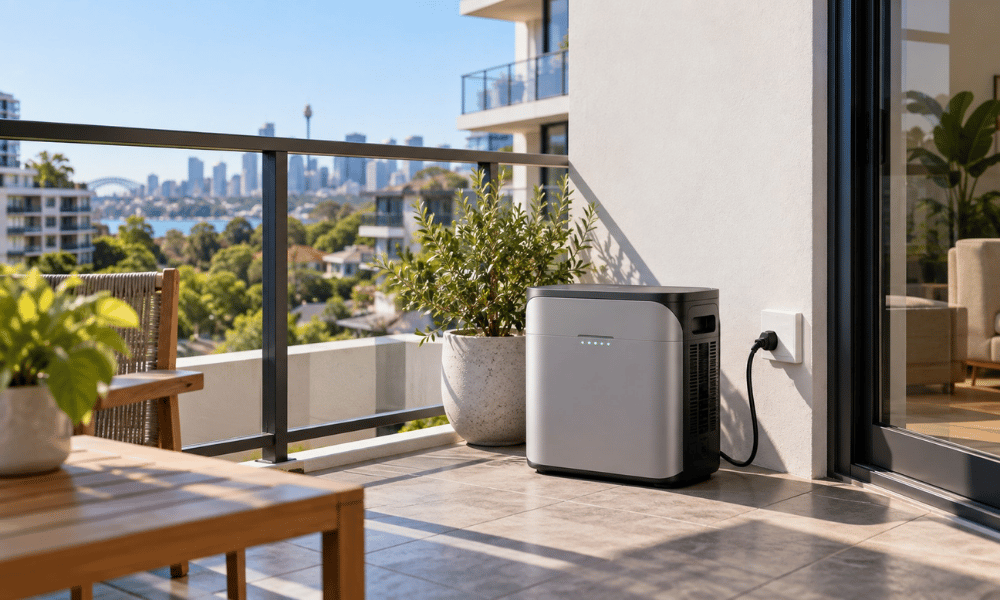
Some products add a battery between the solar panels and the home. The battery can store excess solar energy for later use. Other concepts involve a plug-in battery without dedicated solar panels. Such batteries could potentially charge when grid electricity is cheap, or even free, then discharge later.
The result is effectively a miniature home energy system.
Most importantly for renters, the equipment could potentially move with its owner.
Are balcony batteries legal in Australia?
At present, Australians should not buy an overseas plug-in solar or battery system and simply connect it to a household power point. Australia’s existing electrical and grid-connection framework was not designed around these consumer plug-in energy systems.
Research published by UNSW in July 2026 noted that no tested and certified plug-in solar systems were then available for Australia. The researchers identified technical, regulatory, and social barriers requiring attention before widespread deployment.
Australia’s current rules also treat grid-connected inverter equipment very differently from an ordinary household appliance. So, while similar products may be available internationally, that does not make them compliant with Australian requirements.
This distinction matters.
A portable power station that you charge from a power point and use to directly power appliances is not necessarily the same thing as a battery designed to feed electricity back into your home’s electrical circuits.
Australia is now actively looking at plug-in energy
This is where things get interesting.
On 11 September 2026, Australia’s federal, state, and territory energy ministers agreed to explore pathways supporting the safe deployment of plug-in consumer energy resource devices. The Commonwealth will work with states and territories to identify measures that could enable their safe use. It will report back to energy ministers before the end of 2026.
Federal Energy Minister Chris Bowen said the work could extend solar access to Australians who do not have their own roof. This is significant because the discussion is no longer simply about whether overseas technology could work here.
Australian governments are now examining what would need to change to make it work safely. There is also broader regulatory work underway.
In September 2026, energy ministers endorsed a Consumer Energy National Technical Regulatory Framework. It provides for a National Consumer Energy Resources Technical Code covering technologies such as solar inverters, batteries, and EV charging equipment.
That framework does not automatically legalise balcony batteries. However, it demonstrates the broader shift towards nationally consistent technical requirements for consumer energy technologies.
Why can’t we simply use the systems sold overseas?
Because Australian electrical systems, regulations, product standards, and installation requirements matter; plugging an energy source into a wall socket is fundamentally different from plugging in a toaster.
A toaster only consumes electricity. A grid-connected plug-in solar or battery system can supply electricity into the household circuit.
That introduces several questions regulators need to answer.
1. Can existing household wiring safely handle it?
A conventional electrical circuit has protective equipment designed around electricity flowing from the switchboard towards appliances. A plug-in energy system can introduce another source of electricity further along that circuit.
Australian rules therefore need to establish suitable power limits and protection requirements.
Older homes add another complication. Their wiring and switchboards can vary considerably from modern installations.
2. What happens during a blackout?
Grid-connected generation must stop supplying the grid when network power disappears unless specifically designed to operate safely in an isolated backup configuration. This protection is known as anti-islanding. It helps prevent electricity being unexpectedly supplied to infrastructure that workers may reasonably expect to be de-energised.
Any Australian plug-in system would therefore need appropriate inverter and disconnection protections.
3. What happens when somebody unplugs it?
An ordinary appliance receives power through its plug. A plug-in energy system can generate power. Australia therefore needs requirements ensuring exposed plug pins cannot remain energised after a system is disconnected.
Product design, inverter behaviour, and automatic shutdown protection become particularly important.
4. How much power should a plug-in system be allowed to supply?
Australia will need to determine appropriate limits. International rules provide useful evidence, but Australia’s electrical standards and housing stock must still be considered.
A lower power limit could reduce risks while still providing meaningful energy savings.
The eventual Australian framework may therefore look quite different from the rules governing conventional rooftop solar systems.
5. What about battery fire safety?
Lithium-ion battery safety is another important consideration. Australia already places strict requirements on permanently installed home batteries.
Under the Cheaper Home Batteries Program, eligible batteries must appear on the Clean Energy Council’s approved product list. Installations must also satisfy program and electrical safety requirements.
Australia’s battery product requirements are evolving too. Standards Australia published technical specification SA TS 5398 for home batteries in October 2025. The Clean Energy Council is transitioning its approved battery requirements towards the new specification.
Plug-in batteries create a different use case, particularly if consumers can install and relocate them themselves. Regulators will need confidence that products entering Australian homes provide appropriate electrical, thermal, and fire protection.
Balconies create another safety challenge
The electrical system is only half the equation. Putting solar panels on the outside of a multi-storey building creates structural considerations too.
A panel secured to a balcony must withstand wind and weather. A poorly secured panel several storeys above the ground presents an obvious hazard.
Building rules, strata requirements, fire safety, emergency access, and the structural suitability of balcony railings may therefore influence Australia’s eventual approach. These issues become particularly important for high-rise buildings.
The Victorian Parliament’s 2026 inquiry into renewable and affordable energy for apartments specifically considered balcony and façade solar among the options for improving apartment access to renewable electricity.
The inquiry highlighted a broader problem. Apartment electrification is not simply a technology challenge. Building governance, ownership, infrastructure, and regulation all play a role.
Why balcony batteries could be a big deal for renters
Australia has become extraordinarily good at rooftop solar. Access to those benefits, however, depends heavily on the type of home you live in.
Someone who owns a detached house can generally investigate solar, batteries, EV charging, and other electrification technologies themselves. Renters and apartment residents face additional hurdles.
They may not control the roof. They may need landlord approval. An owners corporation may control common property. Shared roofs can also provide limited solar area for large apartment buildings.
A portable system changes that equation.
Imagine buying a small solar and battery system, using it while renting one apartment, then taking it with you when you move. That would shift ownership of the energy asset from the building owner towards the person paying the electricity bill. It could also make smaller-scale energy storage accessible to households that cannot justify, accommodate, or obtain approval for a conventional home battery.
Could a balcony battery work without balcony solar?
Potentially, and this could become one of the technology’s most interesting applications. A battery does not necessarily need rooftop solar beside it to provide value.
Australia’s electricity market increasingly has periods when abundant daytime solar pushes wholesale electricity prices very low. Retail electricity offers are also emerging that encourage households to shift consumption into these periods.
A future plug-in battery could potentially charge during cheap daytime periods and supply stored energy during more expensive evening periods. That could make portable batteries relevant even for apartments without a sunny balcony.
However, whether Australian regulations eventually permit this arrangement, and under what conditions, remains to be determined.
Expert tips for Australians interested in balcony batteries
Don’t import a system assuming overseas approval applies here. Australian electrical and grid-connection requirements are different.
Don’t confuse portable power stations with plug-in batteries. A portable battery supplying connected appliances is different from equipment feeding energy into household wiring.
Watch the standards, not just the products. A manufacturer announcing a product does not mean Australians can legally connect it.
Apartment owners should expect building rules to remain relevant. Electrical approval does not necessarily override strata, structural, fire, or planning requirements.
Renters should wait for clear rules. One of the biggest potential benefits is portability, but landlord and tenancy requirements may still apply.
Keep an eye on the end of 2026. Australia’s energy ministers expect further work on safe deployment before the year ends.
Will balcony batteries qualify for the Cheaper Home Batteries Program?
There is currently no indication that plug-in balcony batteries will automatically qualify.
The Cheaper Home Batteries Program currently supports eligible battery systems with a nominal capacity between 5 kWh and 100 kWh. Eligible products must meet the program’s requirements, including product approval and installation requirements.
The Australian Government has not announced whether future plug-in batteries would receive Small-scale Technology Certificates or another form of support. That question will become particularly important if the technology receives regulatory approval.
If plug-in batteries are intended partly to improve energy equity, policymakers will need to consider whether renters and apartment dwellers should receive comparable support to households installing conventional batteries.
For now, however, any claim that balcony batteries will receive the federal battery discount would be premature.
When will balcony batteries become available in Australia?
We don’t know yet.
Australia’s energy ministers have opened the door, but they have not provided a date for legalisation. The next major milestone should come before the end of 2026. The Commonwealth is expected to report back to energy ministers after working with states and territories on measures that could enable safe deployment.
From there, changes could involve Australian Standards, electrical safety regulations, grid-connection requirements, product certification, and state-based rules.
Apartment and rental regulations may also need attention. In other words, don’t expect to walk into Bunnings next weekend and leave with a balcony battery under your arm.
But the direction of travel has changed significantly. Australia is now actively investigating how plug-in consumer energy systems could operate safely, rather than simply leaving them outside the existing regulatory framework.
FAQs about balcony batteries in Australia
Can I buy a balcony battery in Australia?
Portable power stations are already sold in Australia. However, plug-in solar and battery systems designed to feed electricity into household wiring through a normal power point are not currently approved for use under Australia’s existing framework.
Is balcony solar legal in Australia?
Not in the plug-in form commonly used overseas. Australia’s current electrical and grid-connection requirements do not provide a general pathway for consumers to plug a grid-connected solar inverter into an ordinary household power point.
Is Australia going to legalise balcony solar and batteries?
Australia’s energy ministers agreed in September 2026 to explore pathways for the safe deployment of plug-in consumer energy devices. The Commonwealth will work with states and territories and report back before the end of 2026. This does not yet amount to legalisation.
Why are plug-in batteries a safety concern?
A plug-in battery can supply electricity into a household circuit rather than simply consuming it. Regulators must consider circuit loading, inverter protection, anti-islanding, safe disconnection, battery safety, and the condition of existing household wiring.
Could renters use balcony batteries?
Renters could eventually be among the biggest beneficiaries because portable systems could potentially move between properties. However, future electrical rules will not necessarily remove landlord, strata, building, or tenancy requirements.
Will balcony batteries qualify for the federal battery discount?
No eligibility pathway has been announced for plug-in balcony batteries. The existing Cheaper Home Batteries Program has specific capacity, product, installation, and accreditation requirements.
When will balcony batteries be available in Australia?
There is currently no confirmed date. Australia’s energy ministers expect further advice on pathways for safe deployment before the end of 2026.
The future of balcony batteries in Australia
Balcony batteries will not replace conventional home battery systems. They don’t need to.
Their potential lies in solving a different problem.
Australia’s rooftop solar success has largely been built around detached homes with usable roofs. Yet more than 1.3 million occupied Australian dwellings are flats or apartments. Renters create an even larger group of households that may have little control over permanent energy upgrades.
Plug-in solar and batteries could give some of these Australians something they have largely lacked during the rooftop solar boom: direct ownership of their own energy technology.
Australia still has important safety questions to answer. Those hurdles should not be dismissed, particularly when equipment generates electricity within household circuits or places batteries and solar panels in multi-storey buildings.
But other countries are already developing regulatory pathways for plug-in solar. Australia has now officially started exploring its own. The question is therefore shifting. It is becoming less about whether balcony energy technology will ever reach Australia, and more about what rules will be needed before Australians can safely plug it in.
Sources
- Australian Bureau of Statistics, 2021 Census, Australia QuickStats.
- Australian Government, Department of Climate Change, Energy, the Environment and Water, Cheaper Home Batteries Program and eligibility information.
- Australian Government, energy.gov.au, Consumer Energy National Technical Regulatory Framework, September 2026.
- Clean Energy Council, Approved Batteries and SA TS 5398 battery safety requirements.
- Parliament of Victoria, Inquiry into Renewable and Affordable Energy for Apartments, 2026.
- UNSW, “Balcony solar and plug-in systems could help cut your energy costs. But only if rules change”, July 2026.
- ABC News, “Balcony solar could soon become legal in Australia”, September 2026.
- UK Department for Energy Security and Net Zero, Plug-in Solar Regulatory Amendment and Interim Product Specification, 2026.