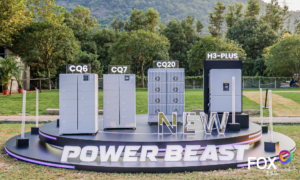
Three-Phase | Hybrid Inverter
The Fox ESS H3 Plus Three-Phase Hybrid Inverter is a commercial-focused option for Australian businesses considering large solar and battery storage systems. Its 50–125 kW power range, 98.5% maximum efficiency rating, high-voltage battery support and EPS functionality make it worth including in a suitably scoped project evaluation.
Its ultimate value depends on battery compatibility, installation design, warranty conditions, network requirements, and the property’s energy profile. If you’re planning a commercial solar project, compare the Fox ESS H3 Plus with appropriately sized alternatives and request a site-specific proposal before deciding.



Did you know Energy Matters is Australia’s largest renewable news, blog and educational resource? Subscribe to Energy Matters’ weekly newsletter and keep updated even with incentives, rebates and recommended solar product offers.
Key features of the Fox ESS H3 Plus Hybrid Inverter
The Fox ESS H3 Plus series uses advanced power-electronic topologies engineered for commercial-scale performance and seamless battery integration. Its modular design allows commercial sites to balance heavy electrical loads with precision and peace of mind.
- High DC input & multiple MPPTs: Equipped with up to 8 Independent MPPTs supporting up to 250A maximum input, enabling complex commercial roof orientations without string-mismatch losses.
- Seamless backup capability: Features an Integrated Emergency Power Supply (EPS) with a sub-10ms switching time to protect critical business infrastructure during grid outages.
- Unbalanced three-phase output: Delivers up to 100% unbalanced three-phase output to handle asymmetrical load distributions seamlessly across commercial facilities.
Specifications of the Fox ESS H3 Plus Hybrid Inverter
The Fox ESS H3 Plus Three-Phase Hybrid Inverter is a commercial-scale product, with six nominal output options and support for compatible high-voltage battery systems. The specifications below summarise key details published by Fox ESS; confirm the latest Australian datasheet for the exact model before purchasing.
Specification | Published details |
Product type | Three-phase hybrid inverter |
Manufacturer | Fox ESS |
Model range | H3-50-Plus, H3-60-Plus, H3-75-Plus, H3-80-Plus, H3-100-Plus and H3-125-Plus |
Nominal AC power | 50 kW, 60 kW, 75 kW, 80 kW, 100 kW and 125 kW |
Maximum efficiency | 98.5% |
European efficiency | 98.1% |
Battery chemistry | Compatible LFP (LiFePO₄) batteries |
Battery voltage range | 180–950 V |
Maximum battery charge/discharge current | 240 A combined specification across three ports |
Battery ports | 3 |
Nominal AC voltage | 380/400 V, three-phase |
EPS switching time | Less than 10 ms |
EPS output | Model- and configuration-dependent; verify the applicable datasheet |
Three-phase load balancing | Supports 100% unbalanced three-phase output |
Maximum PV input voltage | 1,000 V |
MPPT voltage range | 180–850 V |
Number of MPPT trackers | Model-dependent: 2, 4 or 8 |
Ingress protection | IP65 |
Fox ESS H3 Plus Hybrid Inverter warranty
Fox ESS provides comprehensive warranty structures for commercial installations across Australia, backed by local support offices. Understanding product coverage helps ensure reliable operational continuity throughout your system’s life cycle.
- Standard warranty terms: Standard 5-year to 10-year factory warranty coverage (depending on registration and local installation agreements) covering defects in materials and manufacturing.
- Local Australian support: Direct service representation through FoxESS Australia Pty Ltd in Victoria ensures fast claim processing and technical service dispatch.
Pros of the Fox ESS H3 Plus Hybrid Inverter
A review of the Fox ESS H3 Plus three-phase hybrid inverter in Australia highlights clear operational advantages for commercial enterprises.
- Exceptional 98.5% peak efficiency: Minimises conversion losses and delivers maximum solar energy directly to site loads or battery storage.
- Flexible multi-MPPT architecture: Up to 8 MPPTs allow complex panel layouts on uneven commercial roofs.
- Ultra-fast EPS switching: Sub-10ms transfer rate prevents sensitive digital hardware and commercial machinery from resetting during blackouts.
- Full unbalanced load support: Handles uneven phase distribution up to 100%, protecting internal electronics from phase instability.
- High-voltage battery compatibility: A wide 180V–950V battery voltage window enables integration with large-scale high-voltage battery banks.
- IP65 weatherproof enclosure: Robust build rated for challenging Australian outdoor environments.
Cons of the Fox ESS H3 Plus Hybrid Inverter
While the system excels in large installations, a complete review requires considering its constraints.
- Substantial unit weight: Weighing up to 120 kg, installation requires specialised lifting gear and structural wall reinforcement.
- Overkill for small residential sites: High power ratings (50kW–125kW) make this model unsuitable for typical single-phase or small three-phase homes.
- Active cooling fan noise: Smart air cooling produces operational noise (<70 dB), so place it away from noise-sensitive office spaces.
- App dependency for advanced configuration: Full commissioning and battery optimisation rely heavily on a stable Wi-Fi/4G connection and the FoxCloud app.
Applications for the Fox ESS H3 Plus Hybrid Inverter
The H3 Plus is best suited to sites where large-scale solar generation, battery storage, and three-phase power management are central to the energy strategy. Its suitability depends on actual demand, the available installation space, grid conditions and the business case for storage.
Commercial buildings: Office buildings, retail premises and larger commercial facilities may benefit from coordinating rooftop solar and battery storage. Depending on the configured operating strategy, stored energy could support selected loads when solar production declines.
A load analysis should establish whether the building has sufficient daytime consumption and whether shifting energy use can deliver meaningful savings.
Warehouses and industrial facilities: Warehouses, manufacturing sites and industrial facilities can have substantial electricity requirements, making higher-capacity inverters worth investigating. Battery storage may help support selected operational loads or manage consumption during specific tariff periods.
However, system design must account for machinery starting currents, load fluctuations, and the consequences of power interruptions.
Agricultural operations: Some farms and agricultural businesses operate pumps, processing equipment, refrigeration and other three-phase loads. A solar-and-storage system could help reduce grid electricity consumption or provide backup for selected equipment.
Remote sites need particular attention to battery sizing, communications reliability, maintenance access and the electrical demands of motor-driven equipment.
Facilities with backup power requirements: Businesses that need to keep selected systems operating during outages may consider the H3 Plus’s EPS functionality. Examples could include essential lighting, communications equipment, refrigeration or selected operational circuits.
Never assume backup capability from the inverter rating alone. The battery, inverter output limits and essential-load design must be sufficient for the required duration and operating conditions.
Commercial solar and battery projects: The H3 Plus may suit new installations where solar and storage are designed together. It may also suit certain expansion projects, provided the existing equipment, electrical architecture, and grid connection arrangements are compatible.
Is the Fox ESS H3 Plus Hybrid Inverter right for you?
The Fox ESS H3 Plus Three-Phase Hybrid Inverter is worth investigating if you are planning a commercial solar and battery project that needs substantial power capacity. Its high stated efficiency, high-voltage battery support, fast EPS switching specification and monitoring capabilities make it a potentially compelling option for larger installations.
However, the best inverter fits the property’s actual energy needs, not necessarily the one with the highest power rating.
The H3 Plus may be right for you if:
- Your project needs a 50–125 kW nominal three-phase hybrid inverter.
- You want to integrate solar generation and compatible battery storage.
- Your business has sufficient energy demand to justify a commercial-scale system.
- Backup power for selected circuits is part of your energy strategy.
- Your installer can verify Australian compliance, battery compatibility and network approval.
Consider another inverter if:
- You are installing a typical residential solar system.
- Your energy consumption does not justify the available inverter capacity.
- You need a battery or backup arrangement that is not supported by the approved configuration.
- A competing system offers better documented support, warranty conditions or project economics for your requirements.
Questions to ask your solar installer
Before choosing the Fox ESS H3 Plus, ask for clear answers to these questions:
- Which H3 Plus model best matches the property’s peak demand and annual consumption?
- Which batteries are approved for use with that exact model?
- How much usable backup power will be available, and which circuits will it support?
- What are the expected annual solar savings and battery-related benefits?
- What additional equipment, engineering and grid approval work will be required?
- What are the applicable Australian warranty terms and local support arrangements?
- How does the complete installed system compare with alternatives over its expected service life?
These questions help establish whether the inverter is technically suitable and whether the overall system represents good value.