

Since mid-2026, every new or upgraded rooftop solar system in NSW must be able to have its exports turned down remotely in a grid emergency. It’s a sign of how much the grid now depends on what happens on Australian rooftops, and in garages, driveways and laundries. Together, the solar panels, batteries, electric vehicles and smart appliances in homes and businesses are known as distributed energy resources, and they’re changing how the grid runs.
Distributed energy resources in Australia now include more rooftop solar capacity than all of the country’s remaining coal-fired power stations combined. That makes your solar panels and battery part of one of the nation’s largest power sources, not just a way to cut your own bill.
Managing millions of small generators takes new tools and new rules. This guide explains what distributed energy is, how your solar and battery provide grid services, the challenges DER creates, and what DER management systems, flexible exports and the emergency backstop mean for your home.
Quick summary:
- DER are small energy systems in homes and businesses. Rooftop solar, batteries, EVs and smart appliances that generate, store or manage electricity close to where it’s used.
- They already help run the grid. Rooftop solar meets much of daytime demand, while batteries and virtual power plants cut evening peaks and support grid stability.
- Networks are getting smarter controls. Flexible exports and DER management systems let more homes export solar safely, with an emergency backstop as a rare last resort.
What are distributed energy resources?
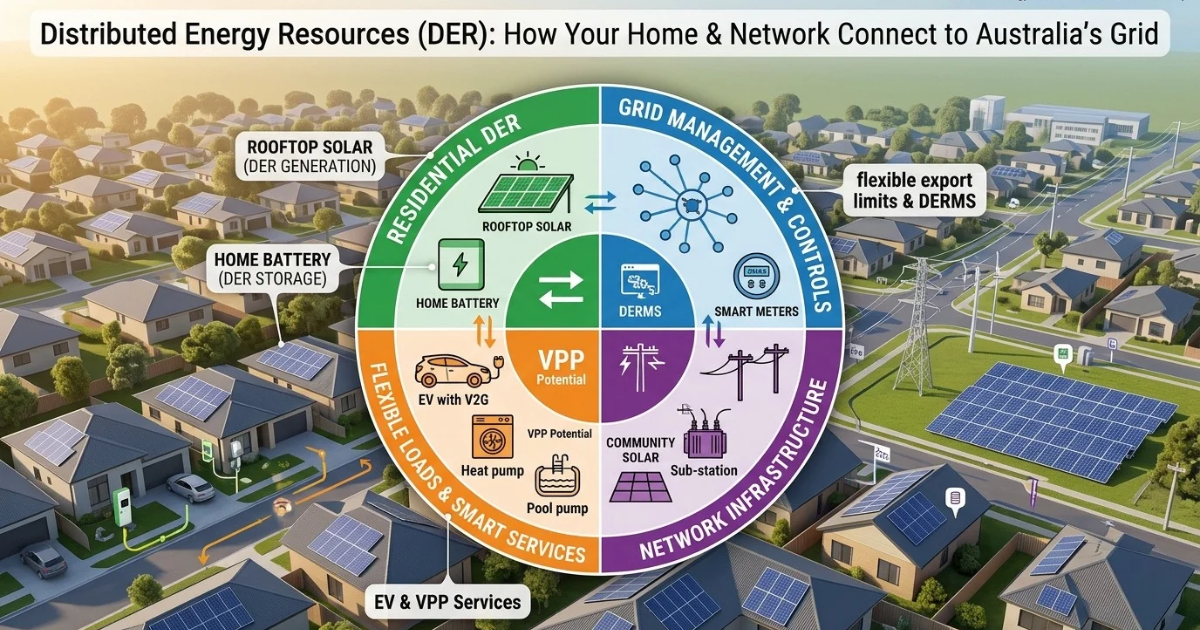
Distributed energy resources (DER) are small-scale devices that generate, store or manage electricity close to where it’s used, usually in homes and businesses. Instead of power flowing one way from a large power station, DER let energy flow both ways across the local network.
Common types of DER
| Type of DER | What it does | Examples |
| Distributed generation | Produces electricity on site | Rooftop solar, small commercial solar |
| Energy storage | Stores energy for later use | Home batteries, business batteries |
| Electric vehicles | Store energy and can sometimes export it | EVs with vehicle-to-home or vehicle-to-grid |
| Flexible loads | Shift when energy is used | Heat pump hot water, pool pumps, smart air conditioners |
Distributed generation explained
Distributed generation is the part of DER that produces power. In Australia, that’s mostly rooftop solar. Each system is tiny compared with a power station, but millions of them together form a huge, spread-out generator.
DER or CER: what’s the difference?
You may also see the term consumer energy resources (CER). Australian energy ministers and AEMO increasingly use CER for household and small business devices, as in the National CER Roadmap. The terms overlap heavily: CER focuses on devices owned by consumers, while DER can also include larger network-connected systems.
Every new solar, battery or EV charger installation should be recorded in AEMO’s national Distributed Energy Resources Register, which helps the market operator and networks see what’s connected and plan around it.
Expert tip
Ask your installer to confirm they’ve submitted your system to the DER Register. Accurate records help your network approve future upgrades, such as adding a battery or EV charger, more quickly.
How much DER is there in Australia?
Australia has one of the highest rates of household DER in the world, and it’s still growing at record pace. Rooftop solar alone now has more capacity than the country’s entire remaining coal fleet.
Australia’s DER by the numbers
| Measure | Latest figure |
| Homes and small businesses with rooftop solar | 4.5 million+ |
| Homes and businesses with a battery | 700,000+ |
| Rooftop solar capacity (end of 2025) | 28.3 GW |
| New rooftop solar installed, first half of 2026 | 1.89 GW (a record) |
| Coal-fired generation capacity, for comparison | ~22.5 GW |
Sources: Clean Energy Council Rooftop Solar and Storage Reports, 2025–2026.
The Clean Energy Regulator reported a record 1 GW of rooftop solar installed in the June 2026 quarter alone, with demand for batteries driving many households to install solar and storage together.
Still growing
At current installation rates, rooftop solar in the National Electricity Market is on track to reach about 40 GW by 2029–30, ahead of AEMO’s own forecasts. Home batteries are growing even faster, helped by the federal Cheaper Home Batteries Program.
Expert reference: The Clean Energy Council notes that rooftop solar has helped reduce daytime grid demand for years, and home batteries are now doing the same for the evening peak, improving reliability and easing evening price spikes.
Expert tip
If you’re adding a battery to an existing solar system, check whether your inverter needs upgrading. Older inverters may not support the smart functions networks now require, such as flexible exports.
How do solar and batteries help run the grid?
Your solar and battery do more than power your home. Together with millions of others, they provide “grid services” that help keep supply and demand balanced, voltage stable and costs down.
Five ways DER supports the grid
| Grid service | What it means | How households benefit |
| Energy supply | Rooftop solar meets a large share of daytime demand | Lower bills, feed-in credits |
| Peak reduction | Batteries discharge during the evening peak | Avoids expensive peak-time power |
| Frequency control | VPP batteries respond within seconds when a generator trips | VPP payments or credits |
| Voltage support | Smart inverters automatically adjust output to keep local voltage in range | Fewer solar trips and outages |
| Network support | Local batteries ease pressure on poles and wires at busy times | Can delay costly network upgrades, which flow into bills |
Energy and peak reduction
On sunny days, rooftop solar now supplies a large share of electricity across the National Electricity Market, and at times most of South Australia’s demand. Home batteries then shift that solar energy into the evening, when demand and prices peak.
Frequency and voltage control
The grid must stay at around 50 hertz. When a large generator suddenly drops out, batteries in a virtual power plant can respond within seconds through the frequency control ancillary services (FCAS) market.
Voltage support happens automatically. Inverters installed since late 2021 must meet the AS/NZS 4777.2:2020 standard, which includes response modes that reduce output when local voltage rises too high.
Solar battery grid services through VPPs
The biggest grid services from homes come through virtual power plants, which coordinate thousands of batteries to act like one power station. Learn more in our guide to virtual power plants and how VPPs are transforming energy consumption.
Expert tip
When comparing VPP offers, look beyond sign-up bonuses. Check how often your battery can be called on, the minimum charge kept for your home, and whether payments are per event or a fixed annual credit.
What challenges does DER create for the grid?
Millions of rooftop systems pushing power into local networks create three main challenges: very low midday demand, local voltage problems and limited visibility of what’s connected.
Minimum system load
On sunny, mild days, rooftop solar can supply so much power that demand on the main grid drops very low. The grid still needs a minimum level of demand to keep large generators running safely and the system secure.
AEMO introduced a Minimum System Load framework in 2021 to manage these periods. It first calls on the market to respond, for example by charging batteries or reducing large-scale generation, before taking stronger action.
The emergency backstop
As a last resort, networks can temporarily reduce rooftop solar exports during rare emergency conditions. This is called the emergency backstop.
South Australia, Western Australia, Queensland and Victoria already have backstop requirements for new solar. In NSW, the Emergency Backstop Mechanism applies from mid-2026: new and upgraded systems up to 200 kW must be backstop-enabled, while existing systems aren’t affected.
Voltage and export limits
When many homes on the same street export solar at once, local voltage can rise above safe limits. Networks have traditionally managed this with fixed export limits, often 5 kW per home, and sometimes zero in congested areas. That means wasted solar and lower feed-in credits for households.
Expert reference
The NSW Government describes the emergency backstop as a last resort for rare emergency conditions, and says households installing solar will see little impact. It is designed to protect the safe, continuous operation of rooftop solar rather than limit it.
Expert tip
If you’re told your export limit is 0 kW or very low, ask your installer whether a flexible export connection is available in your area. It could let you export far more of your solar on most days.
What is a DER management system?
A DER management system (DERMS) is software that electricity networks use to monitor and manage the solar, batteries and other DER connected to their poles and wires. It’s what makes flexible exports possible.
How a DERMS works
- It monitors the network. The DERMS tracks local conditions, such as voltage and how much capacity is available on each part of the network.
- It calculates a safe export limit. For each home, it works out a “dynamic operating envelope”: how much power can be safely exported at that moment, often updated every five minutes.
- It sends the limit to your inverter. The limit travels over the internet using a common language called CSIP-AUS, either directly to your inverter or through the manufacturer’s or retailer’s cloud platform.
- Your system adjusts automatically. Your inverter exports up to the limit and stores or uses the rest.
Flexible exports vs fixed limits
With a fixed limit, your system is capped at the same level all day, every day, based on the worst-case network conditions. With flexible exports, you can export much more on most days and are only limited when the local network is congested.
Where flexible exports are available
South Australia led the way, with SA Power Networks offering flexible exports for new solar since 2023. Victoria followed, and Powercor began offering flexible export connections from 1 July 2026 to customers who would otherwise receive a 0 kW export limit. Western Australia now requires CSIP-AUS capability for new and upgraded systems, while networks in Queensland and NSW are expanding trials and offers.
DERMS vs home energy management systems
A DERMS is run by your network. A home energy management system (HEMS) is an app or device in your home that decides when to charge your battery, run your hot water or charge your EV. The two work together: the DERMS sets the boundaries, and your HEMS makes the most of what’s available within them.
Expert tip
When buying a new inverter or battery, choose one that supports CSIP-AUS and has a reliable internet connection. Without it, you may be stuck on a lower fixed export limit, or miss out on flexible exports when your network offers them.

What does DER mean for your home?
As DER becomes central to how the grid runs, the value of your solar and battery increasingly depends on when you use, store and export energy. A few smart choices can help you get the most from your system.
Use more of your own solar
With midday feed-in tariffs falling, using your solar at home is usually worth more than exporting it. Run the dishwasher, washing machine, pool pump and heat pump hot water during the day, and charge your EV from solar where possible with a smart EV charger.
Store solar for the evening
A home battery shifts daytime solar into the evening peak, when power is most expensive. Make sure your tariff suits a battery: our guide to home batteries and time-of-use tariffs explains what to look for. If you have access to a free midday power offer, see why households are embracing free midday power.
Watch for two-way tariffs
Some networks now offer two-way tariffs that may charge a small fee for exports during the busiest solar hours, while rewarding exports in the evening. A battery helps you avoid the first and benefit from the second.
Join a VPP or flexible exports program
Joining a VPP can earn extra credits for letting your battery support the grid. Opting into flexible exports, where available, can let you export more solar on most days.
Choose future-ready equipment
Pick inverters and batteries that support CSIP-AUS, are emergency backstop compliant in your state, and are VPP-capable. If you’re adding a battery, check the latest rebate rules first: read our guide on fake battery rebate deadlines.
Expert tip
Ask installers for a written list of the grid functions your system will support: CSIP-AUS, emergency backstop, VPP compatibility and backup power. It makes quotes easier to compare and avoids costly upgrades later.
Make Your Home Solar and Battery System Future-Ready
Explore smart solar and battery solutions that work with Australia’s evolving energy grid. Compare quotes from trusted local installers and find a system designed for your home’s energy needs.
Frequently asked questions
What are distributed energy resources in Australia?
Distributed energy resources (DER) are small-scale devices that generate, store or manage electricity close to where it’s used. In Australia, they mainly include rooftop solar, home and business batteries, electric vehicles and flexible appliances such as heat pump hot water systems. More than 4.5 million homes and small businesses already have rooftop solar.
What is the difference between DER and CER?
DER stands for distributed energy resources, while CER stands for consumer energy resources. Australian energy ministers and AEMO increasingly use CER to describe devices owned by households and small businesses, such as rooftop solar, batteries and EVs. DER is a broader term that can also include larger systems connected to the distribution network.
How do solar and batteries provide grid services?
Rooftop solar supplies daytime electricity, while batteries shift that energy into the evening peak. Smart inverters automatically help control local voltage, and batteries in a virtual power plant can respond within seconds to support grid frequency. Households in a VPP are typically paid through credits, bonuses or per-event payments.
What is a DER management system?
A DER management system (DERMS) is software networks use to monitor and manage solar, batteries and other DER on their poles and wires. It calculates how much power each home can safely export, often every five minutes, and sends that limit to compatible inverters using the CSIP-AUS communication standard.
Will the emergency backstop switch off my solar?
Only in rare emergencies, and only temporarily. The emergency backstop lets networks reduce rooftop solar exports when grid demand falls dangerously low. It’s a last resort after other measures. In NSW, it applies from mid-2026 to new and upgraded systems up to 200 kW; existing systems aren’t affected.
Key takeaways
- Distributed energy resources include rooftop solar, batteries, EVs and smart appliances in homes and businesses.
- Australia’s rooftop solar capacity now exceeds its remaining coal fleet, with 4.5 million+ systems and 700,000+ batteries.
- DER provides grid services including daytime supply, evening peak reduction, frequency control and voltage support.
- DER management systems and flexible exports let more homes export safely, with the emergency backstop as a rare last resort.
- Choosing CSIP-AUS-ready, VPP-capable equipment and the right tariff helps you get the most value from your system.
Sources
- Clean Energy Regulator: Record solar and battery growth shows clean energy transition accelerating (August 2026)
- AEMO: Managing Minimum System Load
- NSW Government: Emergency Backstop Mechanism
- ARENA: Common Smart Inverter Profile – Australia (CSIP-AUS)
- Powercor: Flexible exports is coming
- pv magazine Australia: Rooftop solar, home battery installs hit record highs (CEC data)
- pv magazine: Australia’s rooftop solar hits 28.3 GW (CEC data)