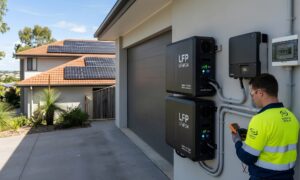




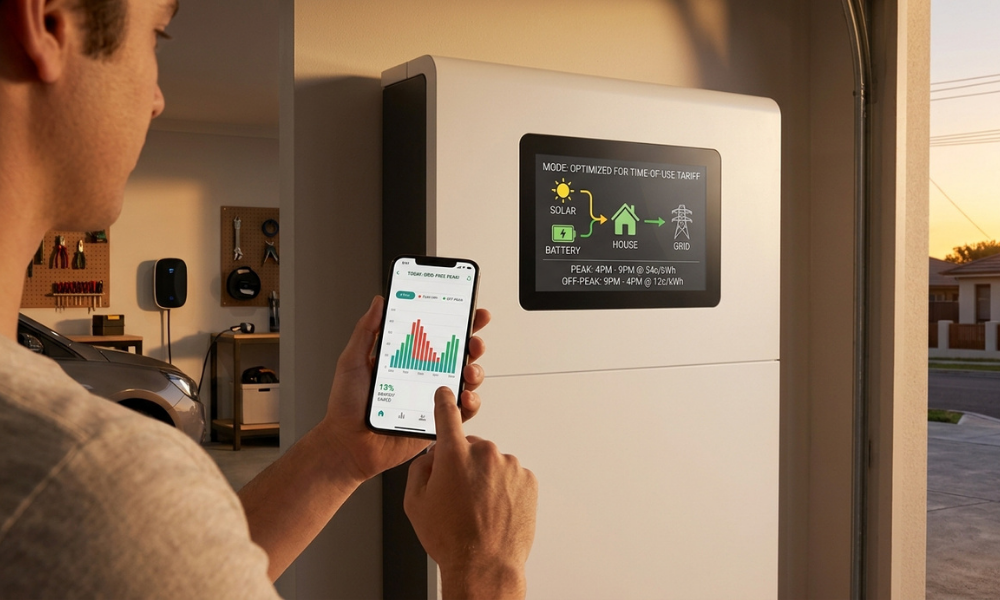
If you’ve installed a home battery under the Cheaper Home Batteries Program, the tariff you’re on could decide how much it does during peak times. New research from the Victorian Energy Policy Centre (VEPC) analysed half-hourly electricity data from 5,096 households across four states. Households with solar and a battery drew around 13% less grid power during peak hours than comparable households, but only when they were on a time-of-use tariff. On a flat tariff, their peak-time grid use was about the same as households with no solar at all.
That matters for the more than 540,000 households that have added batteries through the federal program. A battery follows instructions, and your tariff is a big part of those instructions. Here’s what the research found, why it happens, and how to check whether your tariff suits your battery.
Quick summary
- Battery owners on time-of-use tariffs used about 13% less grid power at peak times. Battery owners on flat tariffs showed no reduction.
- Most households don’t change their habits when peak prices rise, but a battery can respond to the tariff automatically.
- If you have a battery, check your tariff type and your battery’s charge and discharge settings.
Why higher peak prices don’t change most households’ habits
Widening the gap between peak and off-peak prices doesn’t make most households use less at peak times. That’s the VEPC’s first finding, and it held for households without solar, with solar only, and with solar and a battery.
Time-of-use tariffs charge more for electricity during peak hours, usually late afternoon and evening, and less at other times. The idea is that households will shift washing, cooking or heating to cheaper times, and shift more as the price gap grows. The researchers tracked households whose tariffs changed over three years and found no statistically significant sign of that response, even among households that saw the biggest price changes. It repeats what Mountain found in earlier research in 2021.
That doesn’t mean prices never matter. It means the gradual, price-driven shift that time-of-use pricing assumes isn’t showing up in the data. There are some likely reasons. Evening is when people cook, heat or cool their homes and get home from work, and bills arrive months after the usage that caused them.
Expert tip
Check your latest bill for separate peak, off-peak and shoulder rates. If you only see one usage rate, you’re on a flat tariff. If you see several, note the times each applies, because they vary by retailer and network.
Why a home battery changes the picture
A battery doesn’t need you to change your habits. It can be set to store solar energy during the day and use it during the expensive peak window, so the household cuts its peak grid use without anyone thinking about it.
The VEPC research found exactly that pattern, but only under a time-of-use tariff. To compare households fairly, the researchers measured everyone’s grid use during standard peak hours, whatever tariff they were on. Solar-and-battery households on time-of-use tariffs used around 13% less grid power in those hours than other households on the same type of tariff. Battery households on flat tariffs were statistically indistinguishable from households without solar, and solar-only households didn’t show the same clear pattern.
The research measures the pattern rather than the cause, but the likely explanation is simple. On a time-of-use tariff, there’s a clear reason to save stored energy for the evening peak, and battery systems are often set up to do that. On a flat tariff, every hour costs the same, so there’s no reason to hold energy back for a particular time.
Expert tip
Open your battery’s app and check its operating mode. Many systems offer a time-of-use or tariff-based setting that holds charge for the peak window. If you’re not sure which mode suits your tariff, ask your installer to check it.
How to check if your tariff suits your battery
You can check your tariff and battery settings in about half an hour with your latest bill and your battery app.
- Identify your tariff type. Your bill will show either a single usage rate (a flat or “single rate” tariff), separate peak, off-peak and sometimes shoulder rates (a time-of-use tariff), or a charge based on your highest usage in a set period (a demand tariff).
- Note your peak window. On a time-of-use or demand tariff, write down the hours your peak rate applies. Peak windows differ between retailers and networks.
- Check your battery’s settings. Make sure the battery is set to hold enough charge to cover your usage through the peak window, rather than running down earlier in the day.
- Compare plans using your real data. The Australian Energy Regulator’s Energy Made Easy website lets you compare single rate and time-of-use plans side by side, and estimates costs from your own usage history. In Victoria, use the state government’s Victorian Energy Compare website instead.
- Wait for a full year of data if you can. Your usage changes with the seasons, so a plan comparison is most reliable once you have 12 months of bills with your battery installed.
A time-of-use tariff isn’t automatically cheaper. If your battery is small relative to your evening use, or you can’t avoid heavy use during peak hours, a flat tariff may still cost less overall. Time-of-use plans also generally require a smart meter.
Expert tip
Before switching to a time-of-use plan, look at your battery app’s history for a typical winter evening. If the battery runs flat before the peak window ends, you’ll pay peak rates for the rest of it, so factor that into your comparison.
Make the Most of Your Solar and Battery Savings
Find the right solar and battery system for your home, compare quotes from trusted installers, and discover how much you could save on your electricity bills.
What this means for battery and tariff policy
The research suggests that battery incentives and tariff design work best when they’re planned together. If the goal is to cut household demand on the grid at peak times, pairing battery owners with suitable time-of-use tariffs may achieve more than trying to change the habits of every household.
There are some important limits to keep in mind:
- It’s one retailer’s customers. The data came from AGL, which gave the VEPC anonymous records for the study.
- It’s a working paper. The findings haven’t yet been through formal peer review.
- The data mostly predates the big battery boom. The three years of data ran to August 2025, shortly after the Cheaper Home Batteries Program began. AGL is due to share more data with the VEPC in January, which could show how today’s larger batteries behave.
- No virtual power plant customers were included. Households whose batteries are partly controlled by a VPP operator may behave differently.
Mountain has also suggested electric vehicles may follow a different pattern, because their large charging demand already gives owners a strong reason to charge at cheaper times.
Expert tip
If you’re about to buy a battery, ask your installer to model your savings on both a flat tariff and a time-of-use tariff. The tariff you choose can make a real difference to how quickly the battery pays for itself.




Frequently asked questions
Should I switch to a time-of-use tariff if I have a home battery?
Often, but not always. Research from the Victorian Energy Policy Centre found battery households on time-of-use tariffs used about 13% less grid power at peak times, while those on flat tariffs showed no reduction. Whether it saves you money depends on your battery size, your evening usage and the rates on offer.
What is a time-of-use tariff?
A time-of-use tariff charges different prices for electricity at different times of day. Peak rates, usually in the late afternoon and evening, cost the most. Off-peak rates cost the least, and some plans add a shoulder rate in between. Peak windows and prices vary between retailers and electricity networks.
Do time-of-use tariffs make households use less power at peak times?
Not on their own. The VEPC study found no statistically significant evidence that households cut peak use when the gap between peak and off-peak prices widened. The exception was households with solar and a battery on time-of-use tariffs, whose batteries could shift their grid use automatically.
How do I compare electricity plans if I have a battery?
Use the Australian Energy Regulator’s Energy Made Easy website, or Victorian Energy Compare if you live in Victoria. Both let you compare single rate and time-of-use plans using your real usage data. Comparisons are most reliable once you have 12 months of bills with your battery installed.
Do I need a smart meter for a time-of-use tariff?
Generally, yes. A time-of-use tariff needs a meter that records when you use electricity, not just how much. Energy Made Easy notes that a plan’s details show which meter type it needs. If you’re unsure, check your bill or ask your retailer before switching plans.
Key takeaways
- Battery households on time-of-use tariffs used about 13% less grid power at peak times than comparable households.
- Battery households on flat tariffs showed no peak-time reduction.
- Higher peak prices alone didn’t change household habits in the study.
- Check your tariff type, your peak window and your battery’s operating mode.
- Compare plans with your real usage data on Energy Made Easy or Victorian Energy Compare before switching.
Sources
- Bruce Mountain, Storage and Signals: Solar and Battery Storage, Time-of-Use Pricing, and Household Peak Demand in the Australian NEM, VEPC Working Paper 2609 (29 September 2026)
- Victorian Energy Policy Centre, full working paper (PDF) and non-technical companion report (PDF)
- Energy Made Easy (Australian Energy Regulator), Electricity tariffs
- Energy Made Easy, How the Energy Made Easy plan search works
- RenewEconomy, Home batteries and time-of-use tariffs may be best combination to steer households away from evening peaks (9 October 2026)