




Most EV buying advice treats a dedicated home charger as step one after picking up the keys: install it, then worry about everything else. For a lot of households, that’s the right call. For others, a standard power point genuinely covers what they need, and a dedicated EV charger in Australia can mean money spent on convenience they’ll barely use.
This isn’t about charger types or charging speeds; we’ve covered that ground already in our guide to the best home EV chargers in Australia. It’s about a more basic question: does your household actually need one at all?
Quick summary
- A standard powerpoint can fully cover daily charging needs for households driving under roughly 100km a day with an 8 to 10 hour overnight window.
- A dedicated charger earns its cost when daily driving exceeds what an overnight powerpoint session can replace, or when there’s no backup vehicle or public charging option nearby.
- A properly rated, undamaged powerpoint used with the vehicle’s factory-supplied cable is generally considered safe by the sources checked; the real risk comes from third-party adapters and extension leads, not the powerpoint itself.
The one number that actually decides this
Everything comes down to a simple comparison: how far you drive on a typical day, against how much charge a standard overnight session can realistically put back.
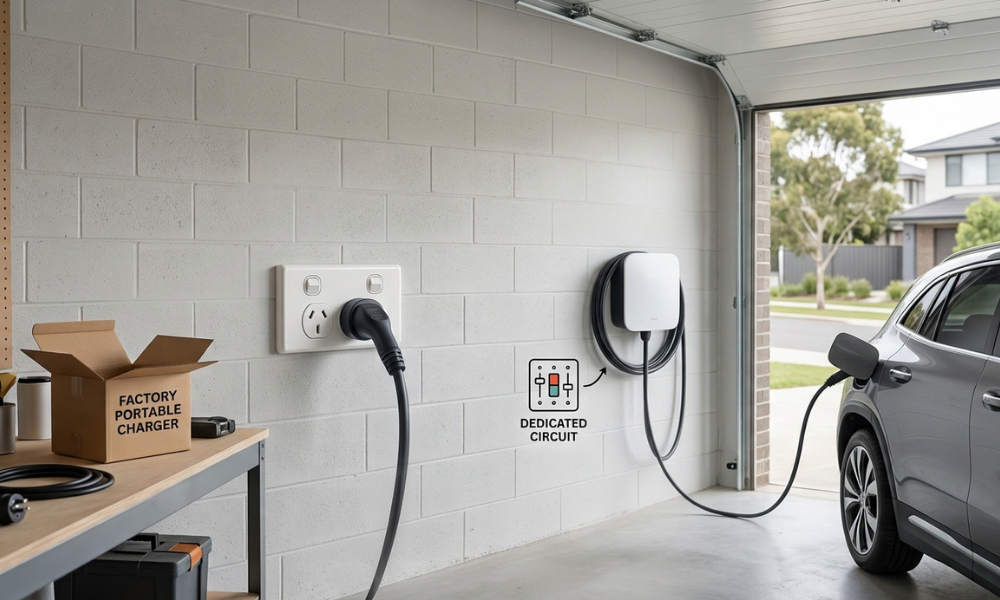
A regular household powerpoint delivers roughly 2 to 2.4kW, adding somewhere in the order of 10 to 15km of range per hour, depending on the vehicle. Over an 8 to 10 hour overnight window, that’s commonly enough to replace 80 to 150km of driving. If your daily distance sits comfortably under that, a standard powerpoint may already do the job, every single night, without ever needing an upgrade.
Drive further than that regularly, or have a shorter overnight window to work with, and the maths starts working against you.
Expert tip: Check your last few weeks of actual driving, not your worst-case day, against these numbers. Most households overestimate their typical daily distance when making this call.





What “good enough” looks like without a dedicated charger
A few real scenarios where a standard powerpoint is genuinely sufficient, not just a compromise:
- Short daily commutes or mostly local driving, well under 100km a day
- A second household car used mainly for school runs, groceries, or short trips
- Retirees or low-mileage drivers who rarely put big distances on the odometer in a single day
- Anyone with reliable access to workplace or public charging during the day, using home charging only as a top-up rather than the main source
In these cases, the “slow” charging speed of a standard powerpoint isn’t really a downside; it’s simply matched to how little charging the household actually needs each night.
When a dedicated charger genuinely earns its cost
The flip side is just as real. A dedicated charger stops being a luxury and starts being the sensible option when:
- Daily driving regularly exceeds what an overnight powerpoint session can replace
- It’s the household’s only EV, with no backup vehicle or reliable public charging nearby
- Multiple EVs need to share one home connection
- You’ve ever actually run short on charge because overnight topping up wasn’t enough
If any of these describe your household, the faster, more reliable charging a dedicated unit provides isn’t overkill; it’s solving a genuine problem you already have.
Expert tip: If you’re unsure which category you fall into, track your car’s charge level each morning for two weeks before deciding. A pattern of starting the day below where you’d like tells you more than any general rule of thumb.
Is charging from a standard powerpoint actually safe?
Worth addressing directly, since it comes up often. Some marketing content claims standard powerpoints “aren’t designed” for the sustained, near-continuous draw of EV charging. That specific claim is genuinely contested. Australian wiring standards don’t actually have a formal concept of derating a power point for continuous versus intermittent use; a point rated for a given current is rated for that current regardless of how long it’s drawn.
What’s well-supported instead is more specific: the real fire risk in home EV charging almost always comes from using extension leads, multi-plug adapters, or third-party travel adapters not rated for the current an EV draws, not from a properly rated, undamaged power point used with the vehicle’s factory-supplied portable charger. There’s a documented real case of exactly this going wrong: an incompatible adapter overheating and destroying a home garage and two vehicles. Worn, loose, or damaged sockets are a separate, genuine risk factor worth checking on regularly, especially if you’re relying on one nightly.
The practical takeaway: use the factory-supplied cable, plug directly into a sound, undamaged powerpoint, never an extension lead or third-party adapter, and have any older or suspect socket checked by an electrician before relying on it every night.
Expert tip: If your home’s powerpoints are original to a house built before the 1990s, get the specific one you plan to use checked by a licensed electrician before relying on it nightly, regardless of which side of the broader safety debate you find convincing.
What it actually costs to install a dedicated charger
For households where a dedicated charger does make sense, current Australian pricing for a standard single-phase 7kW unit typically runs $1,200 to $2,800 fully installed, including the charger, dedicated circuit, and labour, with most straightforward jobs landing around $1,500 to $2,200. If your switchboard needs upgrading first, commonly the case in older homes, add roughly $800 to $2,500 on top. Three-phase installs cost notably more.
Weighed against that upfront cost, it’s worth being honest about what you’re actually buying: faster charging and a larger safety margin against genuinely long driving days, not a necessity for every household, regardless of how it’s often presented.
Expert tip: Get your switchboard assessed before you commit to a charger model. A quote that assumes no switchboard upgrade can turn into a significantly higher final bill if your board turns out to need one.
A middle path worth considering
It doesn’t have to be all-or-nothing. Plenty of households get by charging from a standard powerpoint most nights and lean on public or workplace fast charging occasionally, for a longer trip, a busier week, or before a road trip. This isn’t a stopgap while you save up for a “proper” install, for the right driving pattern, it’s a perfectly legitimate long-term approach.
If you decide you do need one
Once daily driving distance, charging window, or a lack of backup options points toward a dedicated charger, the next decision is which one. We’ve covered Level 1, 2 and 3 options, speeds, and what to look for in our full guide to the best home EV chargers in Australia, worth reading once you’ve settled the “do I need one” question this piece is about.
FAQs
Can I charge my EV from a regular powerpoint every night? Yes, for many households. A standard powerpoint delivers roughly 2 to 2.4kW, enough to replace 80 to 150km of range over an 8 to 10 hour overnight charge. If your daily driving sits comfortably under that, a powerpoint can cover your needs indefinitely.
Is it dangerous to charge an EV from a normal powerpoint? Using a properly rated, undamaged powerpoint with your vehicle’s factory-supplied cable is generally considered safe. The real risk comes from third-party adapters, travel adapters, or extension leads not rated for EV charging current; never use these for EV charging.
How much does a dedicated home EV charger cost to install in Australia? A standard single-phase 7kW charger typically costs $1,200 to $2,800 fully installed, with most straightforward jobs around $1,500 to $2,200. Switchboard upgrades, needed in some older homes, add roughly $800 to $2,500 on top.
How do I know if I need a dedicated EV charger or can just use a powerpoint? Compare your typical daily driving distance to what an overnight powerpoint charge can replace (roughly 80 to 150km over 8 to 10 hours). If you regularly exceed that, have no backup vehicle, or share one connection between multiple EVs, a dedicated charger is worth the cost.
Can I use public charging instead of installing a dedicated home charger? Yes, for some households. A common middle path is charging from a standard powerpoint most nights and using public or workplace fast charging occasionally for longer trips or busier weeks, a legitimate long-term approach rather than a temporary compromise.
Key takeaways
- Whether you need a dedicated charger comes down to one comparison: daily driving distance versus what an overnight powerpoint charge can replace.
- Short commutes, second cars, low-mileage driving, and access to workplace or public charging are all scenarios where a standard powerpoint is genuinely enough.
- A dedicated charger earns its cost for long daily driving, single-EV households with no backup, or multiple EVs sharing one connection.
- A properly rated, undamaged powerpoint with the factory-supplied cable is generally considered safe; the real risk is third-party adapters and extension leads, not the powerpoint itself.
- A standard single-phase dedicated charger typically costs $1,200 to $2,800 installed in Australia; budget extra if your switchboard needs upgrading.
Sources: EVSE Australia, Cost to Install an EV Charger at Home; multiple licensed electrician installation pricing guides across Melbourne, Brisbane and Adelaide (2026); EV FireSafe incident reporting on EV charging fire risk; AS/NZS electrical wiring standards discussion. Charging times and costs vary by vehicle, battery size and charger specification; figures here are typical ranges as of September 2026. Confirm current pricing and your vehicle’s specific charging rate before deciding.