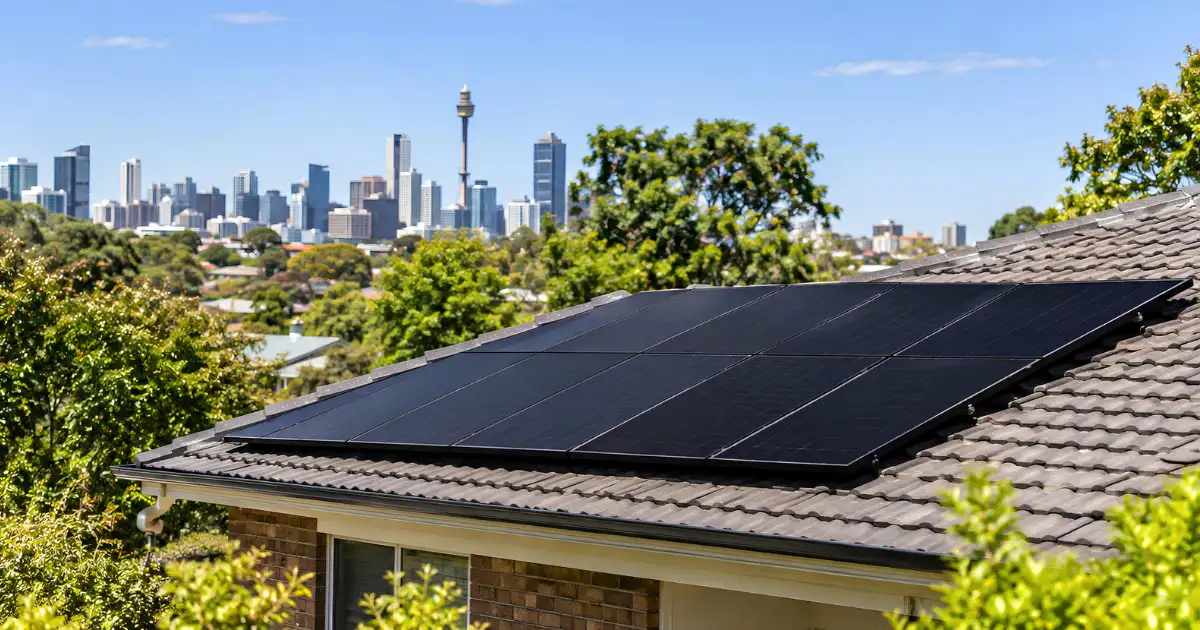
Australian cities are getting hotter, and the effects are becoming increasingly difficult for households to ignore. In September 2025, The Guardian Australia reported research identifying widespread vulnerability to extreme heat across major Australian cities, particularly western Sydney and Melbourne‘s outer suburbs.
For homeowners, understanding how the heat island effect affects solar panels in Australia and rooftop electricity generation is becoming increasingly important. While solar can help households manage rising cooling costs, excessive heat can also affect panel performance.
Understanding the benefits of residential solar systems is an important first step towards making informed energy decisions.
Quick answer: What urban Australians need to know
- Urban heat islands increase local temperatures: Concrete, asphalt, buildings and limited vegetation cause cities and densely developed suburbs to retain more heat than surrounding rural areas.
- Solar panels still work in hot cities: However, excessive panel temperatures can reduce electricity output, particularly when rooftop installations have insufficient airflow.
- Good solar design makes a difference: Quality panels, appropriate mounting, ventilation, shading management and battery storage can help urban households improve solar performance and manage rising electricity demand.



What is the heat island effect and why does it matter for Australian homes?
The urban heat island effect occurs when cities become significantly warmer than surrounding rural areas because buildings, roads and other artificial surfaces absorb and retain heat.
Unlike natural landscapes, which provide shade and release moisture through vegetation, urban environments contain large areas of concrete, asphalt, glass and roofing materials.
These surfaces absorb solar radiation during the day and gradually release stored heat, sometimes continuing well into the night.
Key terminology
Understanding several important terms helps explain the relationship between urban temperatures and solar energy.
- Urban heat island (UHI): A temperature difference between developed urban areas and surrounding rural environments.
- Solar photovoltaic (PV): Technology that converts sunlight directly into electricity.
- Temperature coefficient: A specification showing how much a solar panel’s power output changes with each degree increase in temperature.
- Building heat: Heat absorbed and retained by roofs, walls, windows and other building materials.
- Urban microclimate: Local temperature, humidity, wind, and sunlight conditions around a particular building or neighbourhood.
Why this matters right now in Australia
Australia’s urban population faces growing exposure to extreme temperatures.
A 2025 Western Sydney University study of the City of Willoughby found that temperatures during extreme heat events varied by as much as 17°C across different locations. The study recorded a maximum of 46°C in the local government area, compared with 40°C at the nearest official weather station.
This demonstrates why neighbourhood-level conditions matter when assessing building temperatures and energy requirements.
Expert insight: The Bureau of Meteorology identifies the urban heat island effect as one reason cities can experience temperatures several degrees higher than nearby rural locations. Urban planning, vegetation and building materials all influence local heat conditions.
How the heat island effect affects solar panels in Australia
Solar panels need sunlight to generate electricity, but excessive heat can reduce their operating efficiency. This is an important distinction. More sunshine generally creates more opportunities for solar generation, but higher panel temperatures do not automatically translate into more electricity.
Technical explanation: How temperature affects solar generation
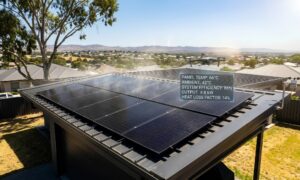
Solar panels are tested under standard conditions, including a cell temperature of 25°C. In actual Australian conditions, panels can become considerably hotter than the surrounding air.
According to CSIRO’s solar photovoltaic performance guidance, crystalline silicon panels typically have a temperature coefficient of approximately -0.4% per degree Celsius.
This means that for every degree above the reference temperature, the panel’s power output decreases by approximately 0.4%, assuming other conditions remain constant. For example, consider a solar panel operating at a cell temperature of 65°C.
- Reference cell temperature: 25°C
- Actual cell temperature: 65°C
- Temperature difference: 40°C
- Temperature-related output reduction: approximately 16%
This is an illustrative calculation, not a prediction of annual electricity generation. Actual performance also depends on sunlight intensity, wind, panel orientation, inverter characteristics and system design.
Australian examples and data
Research demonstrates how significantly local urban conditions can influence heat exposure. A 2025 Western Sydney University study identified substantial temperature differences between established and newly developed residential suburbs. Maximum temperatures reached 42.7°C in newer suburbs compared with 39.3°C in established suburbs.
The study highlighted the importance of mature trees, larger residential blocks and vegetation in moderating neighbourhood temperatures. For solar homeowners, this creates two considerations:
- Higher ambient temperatures can increase solar panel operating temperatures.
- Roof materials, building design and limited airflow can add further heat around rooftop installations.
Expert insight: CSIRO research highlights the importance of ventilation. Poorly ventilated solar installations can run significantly hotter than those with better airflow, potentially reducing electricity generation.
What does the heat island effect mean for your electricity bills?
The relationship between urban heat and electricity costs is more complicated than simply losing a percentage of solar generation. During heatwaves, households typically use more electricity for air conditioning, refrigeration and cooling appliances. This increases electricity consumption and can reduce solar panel efficiency.
Short-term impact
During particularly hot afternoons:
- Air conditioners operate for longer periods.
- Solar panels may lose efficiency due to heat.
- Household electricity consumption increases.
- Electricity demand across the wider network can rise.
- Solar exports may become less financially attractive during periods of high rooftop generation.
Long-term implications
As Australian cities experience more extreme heat, households may need more cooling. Solar panels can help offset daytime electricity consumption, particularly when air conditioning operates during peak sunlight hours.
However, households should consider battery storage, efficient cooling equipment and electricity tariffs rather than relying on solar panels alone.

Heat island effect solar panels Australia: Costs and savings
The financial benefits of installing solar in an urban environment depend on more than the local temperature. System size, installation quality, household consumption, electricity tariffs, export rates and available incentives all influence the financial outcome.
Upfront costs
There is no separate solar installation charge simply because a home is located within an urban heat island.
However, properties with difficult roof access, structural limitations, complex shading or specialised mounting requirements may incur additional installation costs. Potential expenses include:
- Solar panels and inverters.
- Mounting equipment and installation labour.
- Electrical upgrades where required.
- Additional monitoring or energy management equipment.
- Battery storage, if selected.
Use Energy Matters’ easy-to-use solar power and solar battery storage system calculator to determine the right size for your solar system with storage. Our solar calculator will generate performance information and potential savings.
We can send this information to 3 pre-vetted, trusted local installers in your area so they can provide obligation-free solar quotes and help you take the first step toward true energy independence!

Savings calculation
Consider an illustrative household generating 20 kWh of solar electricity daily. Assume a 10% temperature-related performance reduction during a particular period. The resulting generation would be:
| Measurement | Daily electricity |
| Expected generation | 20 kWh |
| Temperature-related reduction | 2 kWh |
| Actual generation | 18 kWh |
| Generation difference | 2 kWh |
If the household would otherwise purchase that electricity at an illustrative rate of $0.35 per kWh, the difference represents $0.70 in potential daily electricity savings.
This is not a guaranteed financial loss. The actual value depends on whether the missing generation would otherwise have been consumed at home or exported.
Payback period
A solar system’s payback period depends on its installed price and the value of electricity it produces. Include urban heat in realistic generation estimates rather than treating it as an additional fixed installation expense.
For accurate projections, request a site-specific assessment using local weather information and the manufacturer’s panel temperature specifications.
State-by-state considerations for urban solar panels in Australia
Australian states experience different combinations of heat, humidity, sunlight, urban density and electricity demand.
| State | Urban heat considerations | Solar considerations |
| Victoria (VIC) | Melbourne’s western and outer suburbs experience significant heat exposure. | Consider temperature coefficients, roof ventilation and the Solar Homes rebate. |
| New South Wales (NSW) | Western Sydney can experience substantially higher temperatures than coastal areas. | Prioritise ventilation, shading assessments and battery suitability. |
| Queensland (QLD) | High temperatures and humidity can affect equipment operating conditions. | Select suitable equipment and ensure adequate ventilation and weather protection. |
| South Australia (SA) | Adelaide experiences significant summer heat and urban heat island conditions. | Assess panel temperature ratings and daytime cooling requirements. |
| Western Australia (WA) | Perth experiences hot summers and substantial afternoon cooling demand. | Consider heat-tolerant equipment, self-consumption and export arrangements. |
Available government incentives
As of November 2026, households should investigate the following support arrangements:
- Federal Small-scale Renewable Energy Scheme: Eligible rooftop solar installations can receive an upfront discount through small-scale technology certificates.
- Cheaper Home Batteries Program: The Australian Government provides an approximately 30% discount on eligible battery installations, subject to program rules.
- Victoria: Solar Victoria offers eligible households a solar panel rebate of up to $1,400, with an optional interest-free loan.
- NSW, Queensland, South Australia and WA: Additional support varies by household circumstances, electricity provider and current state or local government programs.
Heat island effect solar panels Australia: Comparing cooling and energy solutions
Solar panels are one part of a broader approach to managing urban heat. Combining renewable energy with building improvements can help households reduce cooling requirements and improve comfort.
| Solution | Main benefit | Cost consideration | Solar compatibility |
| Rooftop solar | Generates renewable electricity | Moderate upfront investment | Excellent |
| Battery storage | Stores surplus solar electricity | Higher upfront investment | Excellent |
| Cool roofs | Reflect more sunlight and reduce roof heat absorption | Depends on roof condition and coating | Excellent |
| Shade trees | Provide natural shade and cooling | Maintenance and space requirements | Requires careful placement |
| Roof insulation | Reduces heat transfer into living spaces | Moderate upgrade cost | Excellent |
| Efficient air conditioning | Reduces electricity consumption | Equipment and installation costs | Excellent |
| Green roofs | Provides insulation and local cooling | Higher structural and installation costs | Requires specialist assessment |
Expert insight: Australia’s YourHome building guidance identifies insulation, shading, ventilation and appropriate building materials as important ways to improve thermal performance. Combining these measures with solar can deliver broader household benefits than installing panels alone.
What Australian homeowners can do right now?
Understanding local heat conditions is useful, but taking practical steps can make a bigger difference to household energy performance.
Actionable steps
- Choose panels with suitable temperature coefficients. Compare manufacturer specifications rather than selecting panels based on advertised wattage alone.
- Prioritise proper ventilation. Ask your installer about mounting clearance and airflow beneath the panels.
- Assess roof materials. Dark roofing materials can absorb considerable heat, so consider whether roof improvements are worthwhile.
- Manage shading carefully. Identify neighbouring buildings, trees and rooftop structures that may obstruct sunlight.
- Improve insulation. Insulation can reduce heat entering your home and lower cooling needs.
- Consider battery storage. A battery can store excess daytime generation for evening use.
- Monitor solar performance. Track daily generation and investigate unexpected changes.
- Use cooling appliances strategically. Where practical, run energy-intensive appliances during periods of strong solar generation.
Explore energy efficiency improvements to complement your solar investment. At Energy Matters, we believe informed energy decisions are essential to building more resilient Australian homes. Energy Matters recommends switching to energy-efficient appliances now to save money and live more sustainably.
Explore your solar options with Energy Matters today. Compare solutions, request competitive solar quotes and take the next step towards smarter, more sustainable energy.
Questions to ask your installer or electricity retailer
You can also compare solar panels and their specifications before deciding. Before committing to a solar installation, ask:
- What is the panel’s temperature coefficient?
- How will the mounting system provide adequate airflow?
- Have local summer temperatures been considered in the generation estimate?
- Will nearby buildings or trees create shading problems?
- Is the inverter appropriately sized?
- Would a battery improve my household’s energy savings?
- What rebates and export tariffs are currently available?
Common mistakes to avoid
Urban homeowners should avoid several common solar planning mistakes.
- Assuming hotter weather means more solar electricity: Higher sunlight levels can help, but excessive cell temperatures reduce panel output.
- Ignoring ventilation: Panels installed too close to roof surfaces can accumulate more heat.
- Choosing panels based only on price: Temperature coefficients, warranties and long-term performance matter.
- Overlooking shading: Nearby buildings and rooftop structures can reduce generation.
- Ignoring household cooling demand: Solar sizing should reflect actual electricity consumption, especially during summer.
- Assuming every property qualifies for rebates: Government incentives have specific eligibility requirements.
- Expecting identical generation across suburbs: Local weather, roof orientation and surrounding structures can produce different results.
State-by-state considerations for AI solar system design in Australia
AI can compare designs across locations, but a national model cannot assume every state has identical network rules, tariffs or incentives.
| State | What the design should consider |
| Victoria (VIC) | Check distributor connection requirements, applicable export limits and current Solar Victoria programs. |
| New South Wales (NSW) | Consider local network export arrangements, time-of-use tariffs and any current battery or virtual power plant incentives. |
| Queensland (QLD) | Account for high summer solar production, heat, storm exposure and distributor-specific connection requirements. |
| South Australia | Pay close attention to export limits, flexible export arrangements where available and the value of storing midday generation. |
| Western Australia | Check Western Power or Horizon Power requirements, depending on location, alongside local tariffs and battery incentives. |

Frequently asked questions
Does the urban heat island effect reduce solar panel efficiency?
Yes. Higher urban temperatures can increase solar panel operating temperatures, reducing electricity output. The actual reduction depends on the panel's temperature coefficient, airflow, sunlight intensity and installation conditions. Good system design can help minimise these losses.
Are solar panels still worthwhile in Australia's hottest cities?
Yes. Solar panels can remain highly beneficial in hot Australian cities because they generate electricity from sunlight, helping households offset daytime electricity consumption. Although high temperatures reduce efficiency, suitable equipment and ventilation can improve performance.
Can solar panels help reduce the urban heat island effect?
Solar panels can shade the roof surface beneath them, potentially reducing direct solar exposure. However, their overall impact on neighbourhood temperatures depends on installation design, surrounding surfaces and local conditions. Trees, vegetation and reflective materials remain important urban cooling measures.
What is the best solar panel temperature coefficient for Australian conditions?
A lower temperature coefficient is generally preferable in hot climates. For example, a panel rated at -0.30% per °C experiences a smaller temperature-related power reduction than one rated at -0.40% per °C, assuming comparable operating conditions.
Should urban Australian homeowners install solar batteries?
A battery may be worthwhile for households that generate excess daytime solar electricity and use more power during the evening. However, financial suitability depends on electricity tariffs, battery costs, usage patterns and available incentives. Compare the expected savings before investing.
Key takeaways
- Urban heat islands increase temperatures in built-up Australian neighbourhoods.
- Solar panels lose some efficiency when operating temperatures rise above standard testing conditions.
- Ventilation and appropriate panel selection can improve hot-weather performance.
- Combining solar with insulation, batteries and efficient cooling can reduce household electricity costs.
- Site-specific solar quotes and realistic generation estimates are essential for making informed investment decisions.
Is your home ready for hotter Australian summers?
Urban heat can affect solar performance and increase household electricity consumption. Find out how the right solar system can help you manage energy costs and prepare for rising temperatures.
Get expert solar advice and compare your options today.
Sources and References
- CSIRO: Solar photovoltaics: Optimising performance
- Bureau of Meteorology: What causes heatwaves?
- Western Sydney University (2025): Benchmarking Urban Heat in the City of Willoughby
- Clean Energy Council (2026): Rooftop solar and storage report, July to December 2025
- Australian Government: Government rebates and loans for solar
- ARENA: Module design for lower field operating temperature and improved yield
- YourHome: Rooftop solar
- ABC News: How Australian cities can cope with more record-breaking summer heat
- Guardian Australia (2025): How vulnerable are Australia's cities to extreme heat?