



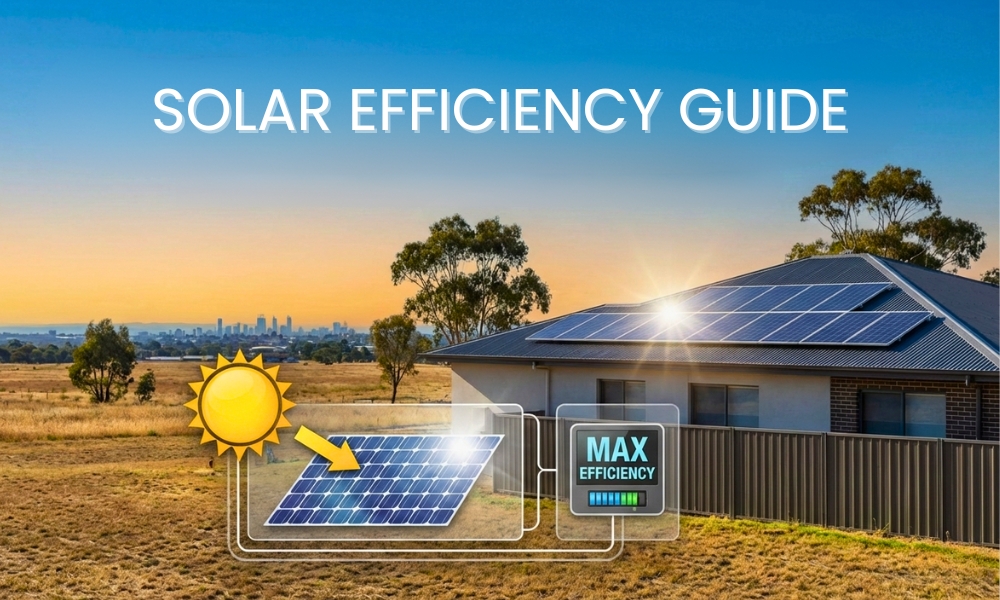
Understanding solar panel efficiency is critical for Australian homeowners and businesses investing in solar power. Solar panel efficiency measures how effectively sunlight is converted into usable electricity, directly affecting system performance, savings, and long-term returns. Given Australia’s high solar exposure, choosing the right high-efficiency system can make a major difference.
On this page



Did you know Energy Matters is Australia’s largest renewable news, blog and educational resource? Subscribe to Energy Matters’ weekly newsletter and keep updated even with incentives, rebates and recommended solar product offers.
Understanding the basics: What is solar panel efficiency?
When we talk about the complete guide to solar panel efficiency in Australia, we mean the percentage of solar energy (photons) that reaches the panel surface and is converted into electrical energy. Most residential solar panels have efficiency ratings between 20% and 24%.
While 24% might sound low, it is a significant technological feat. The remaining energy is lost as heat or reflected away. For an Australian homeowner, a higher efficiency rating means fewer panels are needed to meet daily energy needs. This is particularly crucial for smaller urban rooftops in cities such as Sydney and Melbourne.

How is solar panel efficiency measured?
Solar efficiency is expressed as a percentage. Most residential solar panels in Australia have an efficiency range of 18%-23%. Efficiency testing occurs under Standard Test Conditions (STC):
- Cell temperature of 25°C
- Solar irradiance of 1,000 W/m²
- Air mass of 1.5
While real-world conditions vary, these benchmarks allow accurate comparison between panels.
Why solar panel efficiency ratings matter for Australians
In the context of a complete guide to solar panel efficiency in Australia, efficiency is not just a laboratory number. It determines the physical footprint of your solar array. A 23% solar efficient panel produces more power per square metre than a 19% efficient model.
If you have a small roof, high-efficiency solar panels allow you to install a 6.6kW or 10kW system where standard panels wouldn’t fit. Furthermore, higher efficiency often correlates with better build quality and longer warranties. Australians need hardware that can withstand intense UV radiation and temperature fluctuations.
Higher solar panel efficiency panels are ideal for:
- Homes with limited roof space
- Urban properties with shading
- Commercial buildings aiming for maximum output
- Battery-connected solar systems
Improving solar panel efficiency at home
In the context of a complete guide to solar panel efficiency in Australia, efficiency is not just a laboratory number. It determines the physical footprint of your solar array. A 23% solar panel is more efficient and produces more power per square metre than a 19% efficient model.
If you have a small roof, high-efficiency solar panels allow you to install a 6.6kW or 10kW system where standard panels wouldn’t fit. Furthermore, higher efficiency often correlates with better build quality and longer warranties. Australians need hardware that can withstand intense UV radiation and temperature fluctuations.
Higher solar efficiency panels are ideal for:
- Homes with limited roof space
- Urban properties with shading
- Commercial buildings aiming for maximum output
- Battery-connected solar systems
Solar panel efficiency and battery storage
Solar batteries store excess electricity generated during the day. Pairing solar-efficient panels with lithium-ion batteries significantly increases energy independence.
High-efficiency systems:
- Charge batteries faster
- Reduce grid reliance at night
- Increase self-consumption rates
Use Energy Matters’ easy-to-use solar power and battery storage calculator to determine the size of your solar system with storage! Our solar calculator will generate performance information and potential savings.
We can send this information to 3 of our pre-vetted and trusted local installers in your area to receive obligation-free solar quotes and take the first step towards true energy independence!

Solar panel efficiency for businesses in Australia
Commercial solar efficiency is about ROI. High-efficiency commercial systems generate more energy per square metre—ideal for warehouses, offices, and retail centres.
Benefits include:
- Lower operating costs
- Reduced peak demand charges
- Faster system payback
- Improved ESG (Environmental, Social, and Governance) credentials
Energy Matters designs systems that optimise solar efficiency and is trusted by Australian homeowners and business owners. Energy Matters is the leading supplier of solar quotes in Australia, supported by a vast partnership network of high-quality installers. With Energy Matters, you can be sure you’re getting the best possible deal on solar energy.
The role of cell technology: Solar panel type
Monocrystalline solar panels
- Highest solar efficiency (20–23%)
- Sleek black appearance
- Ideal for Australian rooftops
Polycrystalline solar panels
- Moderate solar efficiency (15–18%)
- Lower cost
- Less common today
Thin-film solar panels
- Lightweight and flexible
- Lower solar efficiency (10–13%)
- Used mainly for large-scale installations
The Australian market has shifted away from older P-type silicon to advanced N-type cells.
- TOPCon (Tunnel Oxide Passivated Contact): Currently the industry standard, offering efficiencies around 22-23%.
- HJT (Heterojunction Technology): Combines crystalline and thin-film silicon for superior performance in heat.
- IBC (Interdigitated Back Contact): Moves all metal contacts to the rear, maximising the sunlight-catching surface area.
- Perovskite-silicon tandems: The “holy grail” of pushing efficiency records towards 30% in commercial testing.
Factors that influence solar performance in Australia
Many variables affect solar efficiency, and a complete guide to solar efficiency in Australia goes beyond the panel’s factory rating. Australia’s unique environment presents both opportunities and challenges for solar generation.
- Temperature coefficients: Solar panels actually lose efficiency as they get hotter.
- Orientation and tilt: North-facing panels at a 30-degree tilt are generally ideal for Australian latitudes.
- Shading: Even partial shading from a chimney or tree can significantly drop system output.
- Soiling: Dust, bird droppings, and salt spray in coastal areas can block sunlight.
Pro tip: Smart monitoring systems can alert you when “soiling” reduces your efficiency by more than 5%, indicating it’s time for a clean.
Comparing solar panel types
The following table provides a quick reference to a comprehensive solar efficiency guide for Australia, covering panel technologies.
Solar Panel Type | Solar Efficiency Range | Best Use Case |
20.0–23.0% | Homes, businesses | |
15.0–18.0% | Budget systems | |
10.0-13.0% | Utility-scale | |
N-type TOPCon | 22.0% – 23.5% | Standard residential |
N-type HJT | 22.5% – 24.5% | High-heat regions (QLD, WA) |
IBC (Premium) | 23.0% – 25.0% | Small roofs / Aesthetics |
Bifacial modules | +5% to 25% gain | Ground mounts / Flat roofs |
Maximising tour ROI through solar panel efficiency
Investing in a comprehensive solar efficiency guide in Australia is about more than green energy; it is a financial decision. While high-efficiency panels have a higher upfront cost, they often provide a better Return on Investment (ROI).
- Faster payback: More generation means lower bills and faster cost recovery.
- Future-proofing: High-efficiency systems are better suited for adding solar batteries or EV chargers later.
- Property value: Quality systems with high-efficiency ratings are more attractive to home buyers.
Measuring efficiency: STC vs. Real-world performance
In any solar efficiency guide in Australia, it is vital to distinguish between Standard Test Conditions (STC) and real-world results. STC assumes a temperature of 25°C and a sunlight intensity of 1,000 W/m².
Because real-world conditions vary, many experts look at NOCT (Nominal Operating Cell Temperature). This provides a more realistic expectation of how your panels will perform under the Australian sun. When comparing quotes, always ask for the expected annual yield in kilowatt-hours (kWh) rather than just the efficiency percentage.
The importance of professional solar installation
The best hardware will fail if not installed correctly. The complete guide to solar efficiency in Australia highlights that professional installation is key to maintaining high efficiency.
Poorly angled solar panels or incorrect wiring can lead to massive energy losses. Ensure your installer is accredited by Solar Accreditation Australia (SAA) and follows the latest Clean Energy Council guidelines. A well-installed system minimises “mismatch losses,” where an underperforming panel reduces the output of the entire string.
Maintenance: Keeping solar efficiency at its peak
To maintain the standards set in this complete guide to solar efficiency in Australia, regular maintenance is essential. While solar panels are “set and forget,” they aren’t “set and ignore.”
- Annual inspections: Check for micro-cracks or loose wiring.
- Regular cleaning: A simple rinse with water can remove dust and salt.
- Monitoring apps: Use your system’s app to track daily performance and spot anomalies early.
Frequently Asked Questions (FAQs)
1. Does solar panel efficiency degrade over time?
Yes, but slowly. Most panels degrade at 0.3–0.6% per year. After 25 years, solar panels still operate at 80–90% capacity.
Premium panels with strong warranties maintain the solar efficiency that Australian businesses depend on over the long term.
2. How to choose the most efficient solar system?
When comparing systems, focus on:
- Solar panel efficiency rating
- Temperature coefficient
- Solar inverter performance
- Solar installation quality
- Warranty coverage
3. What are the common solar panel efficiency myths?
Myth 1: Higher solar panel efficiency always means higher cost
Not always—prices have dropped significantly.
Myth 2: Solar panels don’t work on cloudy days
They still generate power, just at reduced levels.
Myth 3: Solar panel efficiency doesn’t matter in sunny Australia
It matters even more when roof space is limited.
4. Solar panel efficiency vs Solar output: What’s the difference?
These terms are often confused. A larger system with lower efficiency may outperform a smaller high-efficiency system. The best results come from balancing both.
- Solar efficiency = how well panels convert sunlight
- Solar output = total energy produced (kWh)
5. What are the solar panel efficiency ratings in Australia?
Australian solar panels are independently tested and certified. Always choose panels approved by the Clean Energy Council for guaranteed performance. Key standards include:
- Clean Energy Council (CEC) approval
- IEC 61215 and IEC 61730 certifications
- Manufacturer performance warranties
6. How does solar panel efficiency affect energy savings?
For Australian households, improved solar efficiency can reduce electricity bills by 50–80%.
- Generate more power per square metre
- Reduce reliance on grid electricity
- Improve battery charging performance
- Increase feed-in tariff earnings

Why choose Energy Matters for your solar journey?
Navigating the complete guide to solar efficiency in Australia can be complex. Energy Matters simplifies the process by connecting you with top-tier installers and providing the latest data on panel performance.
Whether you are looking for the most efficient N-type panels or a robust battery backup, our marketplace offers vetted solutions tailored to the Australian climate. Don’t settle for “average” when you can have “optimal.”
Energy Matters is here to guide you every step of the way. Energy Matters is one of Australia’s most trusted solar quote providers, thanks to our high customer satisfaction and industry recommendations. Our team of solar experts can help you get up to 3 FREE solar quotes from pre-qualified and vetted solar firms in your area.