






Around 12% of childhood asthma cases in Australia have been linked to cooking with gas, according to National Asthma Council research, a statistic quietly reshaping how families choose their kitchen appliances.
If you’re weighing up induction vs gas cooktop options in Australia for a renovation or new build, you’re not alone: gas connections are being phased out of new Victorian homes, and switching incentives are appearing in state and council programs nationwide.
This guide breaks down real induction cooktop running costs, efficiency, safety, and state-by-state rules so you can decide with confidence. We’ll also cover the wider gas vs electric cooking debate, what to look for in the best induction cooktop Australia has to offer, and exactly what’s involved in switching from gas to induction.
Quick summary
- Induction cooktops are 3x more energy-efficient than gas and typically cost less to run per year, especially when paired with home solar systems.
- Gas is still cheaper to install and remains the better fit for households on locked-in cheap gas tariffs or without spare electrical circuit capacity.
- Rebates and interest-free loans for switching are available in Victoria, NSW and several councils, with more states expected to follow through 2026–2027.
What is an induction cooktop vs a gas cooktop, and why does it matter for Australian homes?
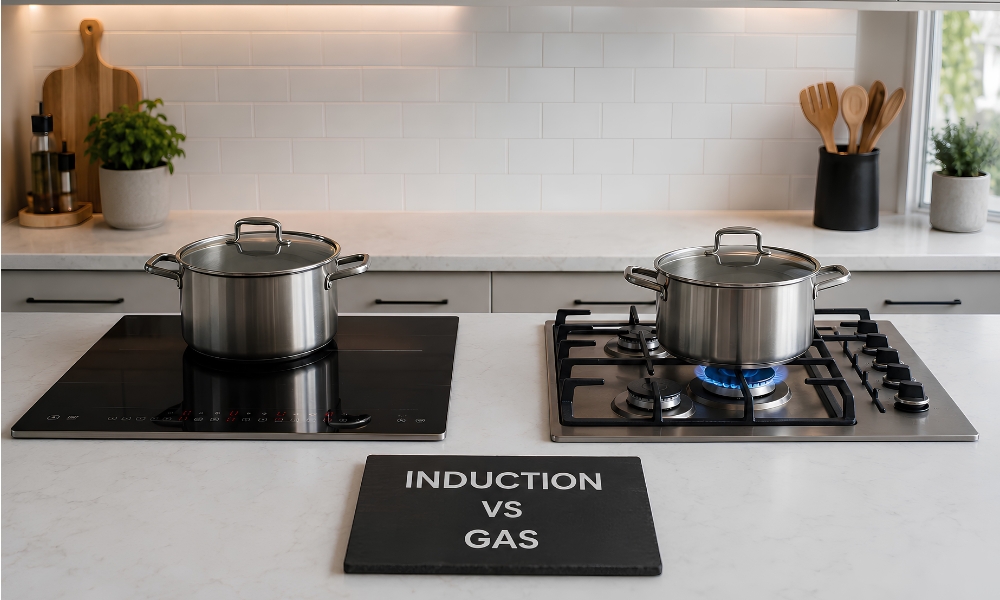
An induction cooktop uses an electromagnetic field beneath a ceramic-glass surface to heat magnetic cookware directly, while a gas cooktop burns natural gas or LPG in an open flame beneath the pot. The two technologies behave very differently in the kitchen and on your energy bill.




Key terminology
- Induction cooktop: An electric cooktop that heats cookware directly via electromagnetism, rather than heating a surface or flame.
- Gas cooktop: A cooktop connected to reticulated natural gas or bottled LPG, using an open flame for heat.
- Radiant/ceramic electric: An older electric cooktop style that heats a coil or element, then the cookware, slower and less efficient than induction.
- Magnet test: Hold a fridge magnet to the base of your cookware; if it sticks firmly, that pot or pan will work on induction.
- kW rating: The power draw of a cooktop zone; higher-kW induction zones boil water faster than an equivalent gas burner.
Why it matters in 2026
Australia’s east coast gas market is forecast to face a supply shortfall from around 2029–2030, according to the Australian Energy Market Operator’s 2026 Gas Statement of Opportunities, as demand outpaces new gas supply in the southern states.
At the same time, cooktop switching is increasingly part of a broader shift toward whole-home energy efficiency, alongside rooftop solar, solar hot water and EV charging, as households look to lock in lower running costs ahead of further gas price rises.
How induction and gas cooktops work in Australia
Step-by-step
- Induction: an alternating current runs through a coil under the glass surface, creating a magnetic field.
- The magnetic field induces an electric current directly in the base of ferrous (magnetic) cookware.
- That current generates heat inside the pot itself; the cooktop surface stays comparatively cool.
- Gas: a valve releases natural gas or LPG, which is ignited to produce an open flame.
- The flame heats the outside of the pot and the surrounding air, with a significant share of that heat escaping around the sides of the cookware.
Real-world examples
Independent efficiency testing shows gas cooktops are roughly 32–40% efficient, compared with 85–90%+ for induction, meaning induction wastes far less of the energy you pay for.
Households with rooftop solar report the biggest wins: running an induction cooktop during daylight hours can draw on self-generated electricity at close to zero marginal cost, something a gas flame can never do.
Ready to make the switch and maximise your energy savings? Get up to 3 free solar quotes from Energy Matters today and join thousands of Australian households paving the way toward an all-electric future!
Costs and savings
Upfront costs
- Basic induction cooktop: roughly $600–$1,500; premium models can run $2,000+.
- Gas cooktop: roughly $500–$1,800 depending on brand and burner count.
- A full switch from gas to induction, including disconnection, cabinetry and any switchboard work, typically costs $2,000–$8,000 for a whole-of-kitchen job.
- Budget-conscious households can often keep total conversion costs closer to $2,500 by choosing a mid-range cooktop and pairing it with available rebates.
Savings calculation
For an average household, switching from gas to electric appliances (not cooking alone) can save an estimated $400–$1,200 a year, largely driven by rising wholesale gas prices and the efficiency gap between the two fuel types.
On cooking specifically, the running-cost gap is smaller: most households see a difference of roughly $30–$150 a year between induction and gas, since a cooktop is a relatively small share of total household energy use.
Payback period
For a straightforward cooktop swap, expect a payback period of around 3–5 years once rebates and reduced running costs are factored in, faster for households that also retire their gas connection entirely and avoid the daily supply charge.
| Factor | Induction Cooktop | Gas Cooktop |
| Typical energy efficiency | 85–90%+ | 32–40% |
| Typical upfront cost | $600–$2,000+ | $500–$1,800 |
| Est. annual cooking running cost (avg. household) | $120–$250 | $150–$280 |
| Runs on rooftop solar during the day | Yes, near-zero marginal cost | No |
| Indoor air quality impact | No combustion by-products | Releases NOx, CO, and other pollutants |
| Works during a mains power outage | No (unless on battery backup) | Yes, if ignition doesn’t need electricity |
State-by-state considerations
Rules and rebates for switching from gas to induction vary significantly across Australia. Always check current offers with your state government or local council before buying, as programs are updated regularly.
- Victoria (VIC): New homes requiring a planning permit have been unable to connect to reticulated gas since 1 January 2024 under the state’s Gas Substitution Roadmap. Existing households can access a discount on approved induction cooktops through the Victorian Energy Upgrades (VEU) program.
- New South Wales (NSW): The Energy Savings Scheme and the newer Home Energy Saver program offer point-of-sale discounts and interest-free loans covering induction cooktops as part of a broader electrification upgrade, alongside a growing number of council-level rebates.
- Queensland (QLD): There’s no statewide cooktop-specific rebate at present, but induction upgrades can often be bundled with federal Small-scale Technology Certificates (STCs) when paired with a new solar installation.
- South Australia (SA): The Retailer Energy Productivity Scheme (REPS) supports household energy efficiency upgrades, and SA’s high rooftop solar uptake makes daytime induction cooking especially cost-effective.
- Western Australia (WA): WA has no statewide gas cooktop rebate at the time of writing, so the switch typically comes down to comparing your current gas tariff against electricity rates and any Synergy or Horizon Power offers.
Comparison table: Induction vs Gas vs Ceramic electric
| Feature | Induction | Gas | Ceramic Electric |
| Speed to boil | Fastest | Fast | Slowest |
| Temperature control | Precise, instant | Instant, visual flame | Slow to respond |
| Energy efficiency | 85–90%+ | 32–40% | 65–75% |
| Safety (cool-touch surface) | Yes | No — open flame | Partially |
| Cookware requirement | Magnetic base required | Any cookware | Any cookware |
| Best suited to | Solar households, safety-focused kitchens | Cheap locked-in gas tariffs | Budget renovations, rentals |
How to get started: Step-by-step guide
- Run the magnet test on your existing cookware to see what you can keep, and budget for replacements if needed.
- Book a switchboard and circuit assessment with a licensed electrician to confirm your home can support a full-power induction cooktop.
- Check the current state and council rebates, and keep your gas bill and any pre-approval documents on hand.
Compare multiple installer quotes. Energy Matters can connect you with accredited local providers via free solar quotes, which is a useful step if you’re bundling the cooktop switch with a new or expanded solar system.
If you’re planning a broader electrification project, consider pairing your new cooktop with home solar systems, a solar hot water system, and EV chargers, so your whole home works toward the same lower running costs.
When you’re ready to buy, take time to choose solar panels. If you haven’t already gone solar, it’s the single biggest lever for making induction cooking effectively free to run.
Common mistakes to avoid
- Buying an induction cooktop before checking your cookware: a full replacement of magnetic cookware can add hundreds of dollars to the cost of the switch.
- Skipping the electrical assessment, only to discover the switchboard needs an upgrade mid-installation.
- Missing rebate application windows: most schemes require pre-approval before purchase, not after.
- Comparing only sticker price and ignoring ongoing supply charges if you’re keeping a gas connection for just one appliance.
- Using an unlicensed installer: gas disconnection and cooktop wiring both require licensed trades in every Australian state.
Expert tips
- If you already have solar panels, shift more of your cooking to daylight hours. Batch-cooking dinner components at lunchtime on an induction cooktop can meaningfully reduce your grid electricity draw compared with cooking after sunset.
- Ask any installer whether they’re a Solar Accreditation Australia (SAA)-accredited provider before signing a solar or battery quote. Accreditation from the Clean Energy Council is a recognised industry benchmark and is often required to access state rebates.
- Before you commit to a switch, get your switchboard and circuit capacity checked. Many older Australian homes need a dedicated circuit for a full-power induction cooktop, and a CEC-accredited electrician or SAA-accredited solar installer can assess this at the same time as a quote for a solar or battery storage system.
Use Energy Matters’ easy-to-use solar power and battery storage calculator to determine the size of your solar system with storage! Our solar calculator will generate performance information and potential savings.
We can send this information to 3 of our pre-vetted, trusted local installers in your area so they can provide obligation-free solar quotes and take the first step toward true energy independence!

Frequently asked questions
Is induction cheaper to run than gas in Australia?
For cooking alone, induction is usually slightly cheaper to run than gas, saving most households roughly $30–$150 a year, mainly because induction converts over 85% of energy into heat, compared with around 32–40% for gas.
Do I need new cookware for induction?
Only if your current pots and pans aren’t magnetic. Run a fridge magnet over the base if it sticks firmly, it will work on induction. Copper, aluminium and glass cookware generally need an induction-compatible base or adapter disc.
Can I get a rebate for switching from gas to induction in Australia?
Yes, in several states. Victoria offers a Victorian Energy Upgrades discount, NSW has the Energy Savings Scheme and Home Energy Saver program, and many councils nationwide run their own electrification rebates — check eligibility before you buy.
Is induction cooking as fast as gas?
Induction is generally faster: a high-power induction zone can bring a litre of water to the boil in under two seconds once it reaches full power, while gas takes slightly longer because more heat escapes around the pot.
What’s the safety benefit of induction over gas?
Induction cooktops heat only the cookware, so the surrounding surface stays relatively cool, and there are no open flames or gas combustion by-products, reducing burn risk and improving indoor air quality, particularly for households with children.
Will induction cooktops work during a power outage?
No, standard induction cooktops need mains electricity and won’t work in a blackout unless you have a home battery or backup power system, whereas some gas cooktops with manual ignition can still be lit without power.

Key takeaways
- Induction cooktops are more energy-efficient than gas (85–90%+ vs 32–40%) and generally cheaper to run, especially with solar.
- Victoria has banned new gas connections for homes requiring a planning permit since 1 January 2024, with more states expected to tighten rules over time.
- Rebates for switching are available through VEU (VIC), the Energy Savings Scheme and Home Energy Saver (NSW), and numerous local councils.
- A full kitchen switch typically costs $2,000–$8,000 and pays for itself in about 3–5 years.
- Gas cooktops emit combustion by-products that contribute to indoor air quality concerns, including a measurable association with childhood asthma.
Ready to make the switch?
Choosing between induction and gas ultimately comes down to your household’s cooking habits, your home’s wiring, and how your overall energy setup is evolving.
Induction wins on running efficiency, indoor air quality and long-term running costs, especially when paired with rooftop solar, while gas still suits households with cheap, locked-in tariffs and no appetite for upfront change.
Energy Matters can help you look at the bigger picture, from home solar systems that power an induction cooktop for next to nothing, to solar hot water and EV charging that round out a fully electrified home.
Sources and References
- National Asthma Council Australia: Research on Gas Stoves and Childhood Asthma
- Victorian Energy Upgrades: Induction Cooktop Discounts
- Australian Energy Market Operator (AEMO): 2026 Gas Statement of Opportunities