






Australia still has a promising solar thermal technology future despite a major Concentrated Solar Power (CSP) project in South Australia failing because of financing issues.
Energy expert Simon Currie says the emerging CSP industry can overcome the collapse of SolarReserve’s $650 million Aurora project near Port Augusta.
Solar thermal technology is perfect for Australian conditions, according to Currie, former global head of energy at legal firm Norton Rose Fulbright. He says CSP can stabilise the grid in a similar way to the Snowy 2.0 pumped hydro project in NSW.
Industry reels from setback to solar thermal technology
The failure of the Aurora project is a blow to South Australia’s emerging solar thermal industry. It has also struggled to compete with the rapid growth and falling costs of residential and commercial solar panel systems.
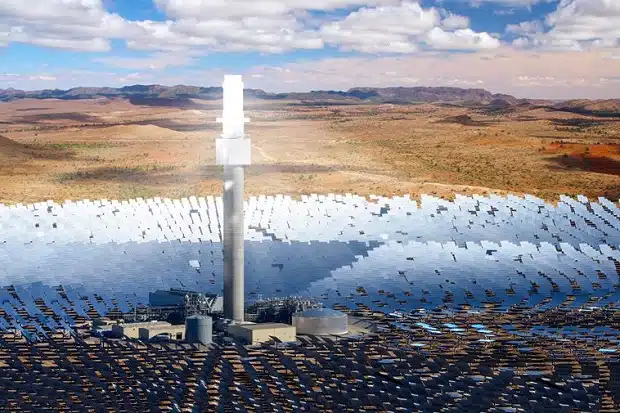
Aurora attracted $110 million in funding from the Turnbull Government. It also had 20-year supply contract with the SA government. However, it was unable to meet the deadline for final funding.
The project should have been online by 2020. It was supposed to supply clean energy to the state at $78 MWh, below the state’s average wholesale prices.
The Australian Solar Thermal Research Institute says CSP is the most cost-effective way to provide electricity after ageing coal generators close.
Smaller, more viable CSP projects still underway
As reported in the Australian Financial Review, the International Renewable Energy Agency (IRENA) says Concentrated Solar Power will attract $US1,900 billion of investment worldwide by 2050.
The 150 MW Aurora plant was trying to emulate large-scale overseas CSP developments. However, its sheer size proved “a step too far” for more conservative Australian investors, Currie adds.
A 220-metre solar thermal technology tower was planned for Aurora. However, three ongoing projects by Vast Solar (Forbes, NSW), RayGen (Newbridge, Victoria) and Solarstor (Lake Cargelligo, NSW) all feature smaller towers of 15-20 metres.
How solar thermal technology power works
CSP creates electricity using a different process to solar panels. Unlike solar PV, which uses the sun’s light, a CSP generator creates electricity by storing the sun’s heat in molten salt. Later, this heat can make steam to drive an electricity turbine.
Solar thermal technology thus overcomes the intermittency of solar power without using energy storage batteries or gas back up generators.