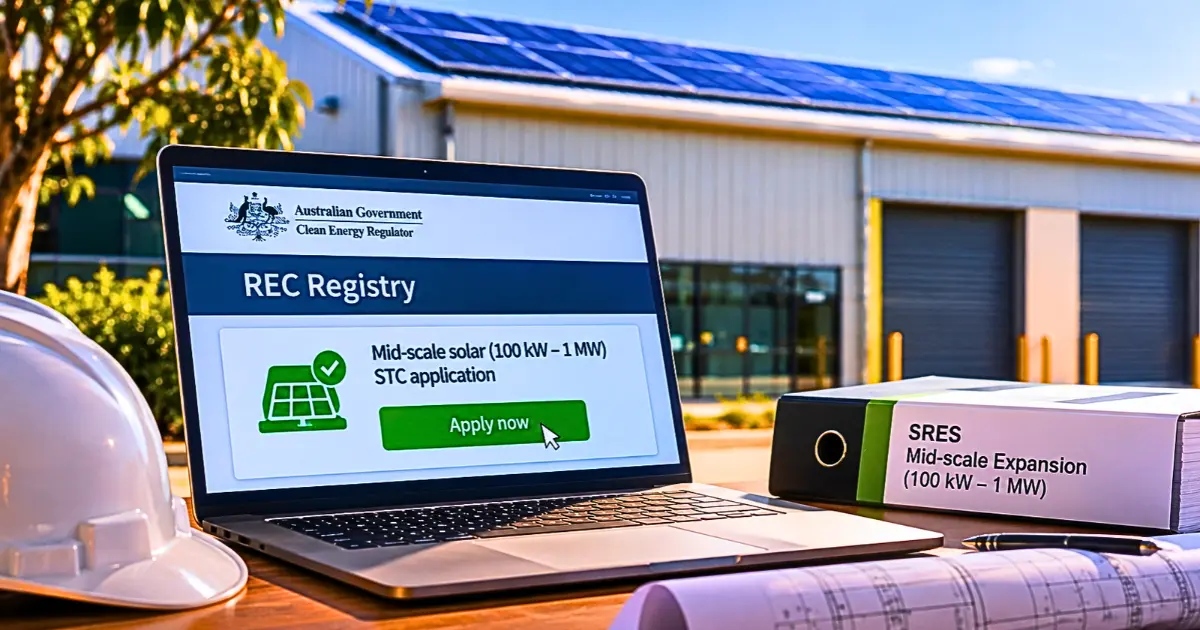
Businesses that installed solar systems between 100 kW and 1 MW since 1 October can now claim the federal solar rebate, after the Clean Energy Regulator opened mid-scale applications in the REC Registry on 17 November.
The expansion of the Small-scale Renewable Energy Scheme, legislated in October, brings systems ten times larger than the old 100 kW cap into the same upfront discount households have used for years. For a warehouse, shopping centre or factory roof, that can take a substantial share off the cost of the system.
With claims now flowing, the regulator has also put installers on notice that it will be auditing mid-scale work closely, and a few eligibility rules are catching projects that assumed they qualified.
Quick summary
- STC applications for solar systems from 100 kW to 1 MW opened in the REC Registry on 17 November 2026, for systems installed on or after 1 October 2026.
- Claiming STCs gives five years of certificates upfront, but may rule out creating LGCs or REGO certificates for that period.
- The 1 MW cap covers all solar on a site; extensions only earn STCs on the added capacity, and commissioning photos must be taken on the day.
What’s now open
The Renewable Energy (Electricity) Regulations were amended in October to expand eligibility under the SRES to solar systems above 100 kW and up to 1 MW. The changes apply to systems installed on or after 1 October 2026. The Clean Energy Regulator confirmed on 17 November that STC applications for these systems are now open.
As with household solar, the rebate is created as small-scale technology certificates. Your accredited installer or an agent usually creates and sells them, and the value comes off your quote. Mid-scale systems get a fixed five-year deeming period, so the certificates cover five years of expected generation upfront, regardless of when in the scheme’s life the system goes in.
The regulator’s mid-scale STC calculator estimates how many certificates a system will create, based on its size and postcode zone.
Expert tip
Ask installers to show the STC count and the certificate price they’ve assumed as separate lines on the quote. The count is set by the regulator’s formula, but the price you get per certificate varies between installers and agents.
The decision to make before you claim
Mid-scale systems can earn certificates under three different schemes, and the choice affects more than the upfront price:
- STCs under the SRES, for an upfront discount.
- Large-scale generation certificates (LGCs), by operating as an accredited power station under the Large-scale Renewable Energy Target.
- Renewable Electricity Guarantee of Origin (REGO) certificates, which track and verify renewable generation.
The regulator warns that if you claim STCs, you may not be able to create LGCs or REGO certificates for the deeming period. For most businesses chasing a lower upfront cost, STCs will be the obvious choice. For those that need to report renewable electricity use to investors, customers or under climate disclosure rules, giving up REGO certificates for five years could be a real cost.
Expert tip
Talk to whoever handles your sustainability or emissions reporting before you sign. If the business has made public renewable energy commitments, check how the system’s output will be counted if you take STCs.
The eligibility rules catching projects out
The 1 MW cap covers the whole site
The limit applies to all the solar at a site, not each system. According to the regulator’s transitional guidance, if existing solar plus the new installation exceeds 1 MW, the new system won’t be eligible as a mid-scale system. The regulator gives the example of a new 500 kW system alongside an existing 100 kW system and a 600 kW accredited power station, which is ineligible because the total passes 1 MW.
Extensions only earn STCs on the new capacity
Adding panels to an existing system only creates STCs for the capacity added on or after 1 October 2026. The combined system has to be above 100 kW and no more than 1 MW. In the regulator’s example, an 80 kW system expanded by 40 kW earns five-year deeming on the 40 kW only.
Installation date decides eligibility
Eligibility depends on when the system is installed, not when design, procurement or construction began. A project planned and partly built before 1 October can still qualify if it’s installed after that date. Existing accredited power stations stay in the large-scale scheme.

The paperwork
Each mid-scale claim needs a full evidence pack, and your installer will need input from you, your builder or engineer, and your network. The regulator’s guidance lists:
- planning and building approvals
- structural engineering reports, where applicable
- network connection approvals, such as a connection agreement
- system design documentation
- electrical compliance certificates, testing and commissioning records and metering information
- geotagged, time-stamped photos showing the installer’s face and the system during testing and commissioning.
All panels, inverters and batteries must be on the Clean Energy Council’s approved list, and the installation must meet Solar Accreditation Australia’s guidelines.
Expert reference
The Clean Energy Regulator says it will closely monitor installation quality, safety and compliance outcomes for mid-scale systems, including targeted audits and on-site inspections.
Expert tip
The photo rule is the easiest to fail. The regulator says photos taken after the work is finished to recreate evidence may not be accepted, so make sure your installer captures them on commissioning day.
Planning a 100 kW to 1 MW system?
Compare quotes from accredited commercial installers who’ll show the STC value as a line item and handle the mid-scale paperwork properly.
Frequently asked questions
Are commercial solar rebate applications open for systems over 100 kW?
Yes. The Clean Energy Regulator opened STC applications for mid-scale solar systems, from above 100 kW up to 1 MW, in the REC Registry on 17 November 2026. The rebate applies to eligible systems installed on or after 1 October 2026. Your accredited installer or an agent usually lodges the claim and passes the value on as a discount.
How is the mid-scale solar rebate calculated?
The rebate is paid as small-scale technology certificates. The number depends on the system’s size and its postcode zone, multiplied by a fixed five-year deeming period for mid-scale systems. The dollar value then depends on the certificate price your installer or agent achieves. The Clean Energy Regulator publishes a mid-scale STC calculator for estimates.
Can I claim STCs if I already have solar on site?
Possibly. The 1 MW limit applies to all solar at the site, so existing systems count towards it. If you add capacity to an existing system, only the new capacity installed on or after 1 October 2026 earns STCs, and the combined system must be above 100 kW and no more than 1 MW.
What do I give up by claiming STCs?
The Clean Energy Regulator says you may not be able to create large-scale generation certificates or Renewable Electricity Guarantee of Origin certificates for the deeming period if you claim STCs. That matters most for businesses that report renewable electricity use or have public emissions commitments, so check with your reporting team first.
What paperwork do mid-scale solar claims need?
Claims need planning and building approvals, structural engineering reports where applicable, network connection approvals, system design documents, electrical compliance and commissioning records, and metering information. Photos must be geotagged, time-stamped, show the installer, and be taken during testing and commissioning. Products must be on the Clean Energy Council approved list.
Key takeaways
- STC applications for solar systems from 100 kW to 1 MW are open, for systems installed on or after 1 October 2026.
- Mid-scale systems get a fixed five-year deeming period, so the certificates are paid upfront.
- Claiming STCs may mean giving up LGCs or REGO certificates for that period.
- The 1 MW cap covers all solar on a site, and extensions only earn STCs on the new capacity.
- The regulator is auditing mid-scale work, so commissioning-day photos and full documentation are essential.
Sources
- Mid-scale applications are open in the REC Registry (Clean Energy Regulator, 17 November 2026)
- Mid-scale solar (Clean Energy Regulator)
- Transitional guidance for mid-scale solar PV systems (Clean Energy Regulator)
- Commercial solar rebate: 1 MW SRES expansion (Energy Matters)