



Commercial solar exports in Australia typically earn just 2 to 3 cents per kWh. With a commercial solar feed-in tariff that low, most businesses install only enough panels to cover their own daytime use and leave the rest of the roof empty. Across warehouses, shopping centres and industrial estates, that adds up to a lot of unused space.
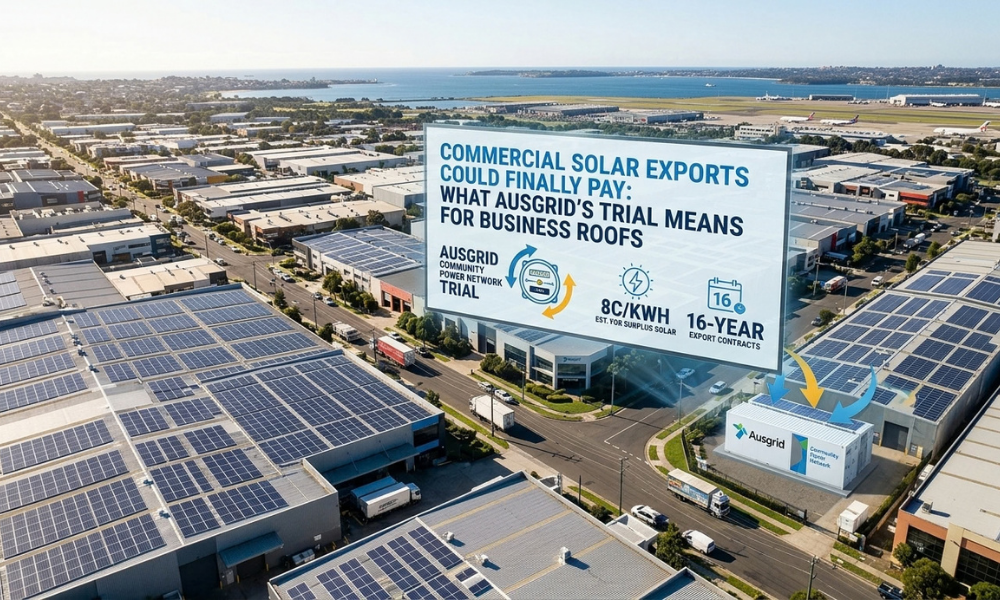
Ausgrid is now testing a way to change that. Its Community Power Network trial, launched in September 2026, will offer long-term contracts for surplus commercial rooftop solar in parts of Sydney and the Central Coast, backed by a network of community batteries.
It’s a small trial with some open questions. But it’s the first serious attempt in Australia to make filling a business roof with solar pay off. Here’s how it works, who can take part, and what it means for businesses outside the trial areas.
Quick summary
- Ausgrid will pay commercial roof owners for surplus solar under 16-year contracts, at prices set by reverse auction, with around 8c/kWh expected.
- The trial covers Botany–Mascot in Sydney and Charmhaven on the Central Coast, with a separate competitive area in Caringbah.
- Businesses elsewhere should still size solar mainly around their own use, but design systems that can grow if export value improves.
Why most business roofs are only half full
Commercial solar economics are built on self-consumption. Every kWh a business uses directly from its panels replaces power bought from the grid at retail rates. Every kWh it exports earns a feed-in tariff that, for commercial customers, is close to nothing.
That creates a ceiling. A business sizes its system to its daytime load, and the rest of the roof stays bare.
Commercial leases add a second problem. A landlord might install solar for a tenant with high energy use, then find the next tenant uses much less. Without a reliable buyer for the surplus, the extra panels become a stranded investment.
The effect shows up in the numbers. In its application to the Australian Energy Regulator (AER), Ausgrid cited solar uptake of only 9% in the Botany–Mascot area.
Expert tip: Check your inverter data to see how much of your solar you use on-site and how much you export. If a large share goes to the grid, your system may be oversized for your current load, or you may have loads you could shift into daylight hours.
How Ausgrid’s Community Power Network works
The trial runs for five years under an AER regulatory “sandbox” waiver. According to the AER, it’s the first trial approved under the sandboxing approach it launched in 2025.
Long-term contracts for surplus solar
Commercial roof owners in the trial areas will be offered 16-year power purchase agreements (PPAs) for any solar their buildings don’t use. Prices will be set through reverse auctions, where solar owners bid the price they’re willing to accept. Ausgrid expects around 8c/kWh to be viable.
Crucially, the contract stays with the building. If a tenant leaves and the new one uses less power, the owner can sell more of the output to the Community Power Network.
Community batteries
The trial includes up to 130MWh of community-scale battery storage and support for up to 70MW of additional rooftop solar. The batteries store cheap daytime solar and release it locally during the evening peak.
They are also positioned to ease pressure on the local network. Ausgrid forecasts a reduction of about 20% in peak demand at participating zone substations, freeing room for EV chargers and electrified businesses without new network infrastructure.
Who shares the value
Around 32,000 local customers are expected to benefit. Solar owners get higher payments for their exports. Other households and businesses in the trial areas, including renters and apartment residents, receive an annual share of the profits, forecast at up to $150 to $200 for customers without solar.
Expert tip: Don’t judge an 8c/kWh contract against retail electricity prices. Compare it with the 2 to 3 cents you’d earn exporting today. For commercial landlords, the main value is a guaranteed buyer for 16 years, which removes the tenant risk.
Is it worth filling your roof? The business case
Ausgrid estimates that 1MW of extra commercial solar could generate up to $440,000 in profit over the 16-year contract. That’s a modest but predictable return, which suits some property owners better than others.
The trial is likely to appeal most to:
- Warehouse and industrial landlords with large roofs and tenants who change regularly.
- Shopping centre owners with big roof areas and fluctuating tenant loads.
- Schools and community buildings that use little power during holidays and weekends.
Before committing, weigh the contract income against the full installation cost, your roof’s condition and its remaining lifespan. A commercial solar installer can model self-consumption and export separately so you can see where the returns come from.
If upfront cost is a hurdle, solar PPAs and leasing can let you install with little or no capital, although you’ll need to check how any existing finance arrangement interacts with an export contract.
Expert tip: Check the roof before signing a 16-year contract. If the roof needs replacing halfway through, the panels must be removed and reinstalled, which can erase years of export income. Older roofs may be worth repairing first.




The catches and open questions
The Community Power Network is promising, but it’s a trial, and there are limits to keep in mind.
It’s limited in time and place
The trial runs for five years in a handful of areas. Only property owners in Botany–Mascot and Charmhaven can join Ausgrid’s scheme. In Caringbah, the AER required a separate competitive zone, where Ausgrid will share network data so retailers, aggregators and battery companies can test their own models instead.
Retailers still control the bill
Retailers manage billing and solar export payments. Ausgrid wants the full export price passed through to customers but cannot guarantee it. The annual dividend can be paid through retailers or directly.
Competition concerns
Industry groups have questioned whether a regulated network monopoly should own batteries and trade electricity. In its submission, Master Electricians Australia strongly opposed any waiver allowing Ausgrid to install solar systems itself, because Ausgrid can act as “solar owner of last resort” if private uptake falls short.
Who carries the risk?
Ausgrid originally planned to recover $72.8 million of the trial’s cost from its wider customer base. After the AER declined that request, Ausgrid now says it will invest around $120 million, backed by $13.2 million from ARENA, with its shareholders carrying the financial risk. The AER has noted Ausgrid could still seek funding for the trial at its next regulatory reset.
Expert tip: If you’re in a trial area, ask your electricity retailer in writing how it will handle Community Power Network export payments before you sign a contract. The headline price only matters if it reaches you.
What it means if you’re outside the trial area
For most Australian businesses, the core advice on commercial solar hasn’t changed yet: size your system mainly around what you’ll use on-site. But a few things are worth planning for now.
Size for future loads, not just today’s. If you plan to electrify hot water, heating or vehicles, your daytime electricity use will rise, and a larger system becomes worthwhile. See our [business electrification guide].
Use more of your own solar. Commercial battery storage can shift daytime solar into the evening and help manage electricity demand charges. The federal Cheaper Home Batteries Program is also open to businesses for eligible systems up to 100kWh, and NSW offers commercial battery incentives.
Watch for network capacity data. Ausgrid plans to publish a map showing where the local network has room for more solar and batteries, potentially down to street level. Similar data from other networks would make it easier to plan larger systems.
Expert tip: Design your system so it can grow. Choosing an inverter and switchboard with spare capacity costs little upfront and makes adding panels much easier if export contracts like Ausgrid’s become more common.
Frequently asked questions
What is Ausgrid’s Community Power Network?
It’s a five-year trial approved by the Australian Energy Regulator in which Ausgrid pays for surplus rooftop solar, mainly from commercial buildings, and stores it in community batteries. The stored energy is released during evening peaks, and profits are shared with local customers through higher export payments and annual dividends.
How much will businesses be paid for surplus solar?
Prices will be set through reverse auctions, where solar owners bid the price they’re willing to accept. Ausgrid expects around 8c/kWh to be viable, compared with typical commercial feed-in tariffs of 2 to 3 cents. Contracts run for 16 years, giving roof owners a guaranteed buyer for surplus output.
Who can take part in the trial?
The trial is open to property owners in the Botany–Mascot area of Sydney and Charmhaven on the Central Coast. Around 32,000 customers in those areas, including renters and apartment residents, can share in the benefits. A third area, Caringbah, will host competing models from retailers and other companies.
Why are commercial solar feed-in tariffs so low?
Commercial solar exports mostly occur in the middle of the day, when solar floods the grid and wholesale electricity prices are very low or negative. Retailers have little reason to pay much for that power, so commercial feed-in tariffs are typically only a few cents per kWh, or nothing at all.
Should I install more solar than my business uses?
Outside the trial areas, generally not yet, as exported power earns little. Instead, size your system for current and planned electricity use, including future electrification. Choosing equipment with room to expand lets you add panels later if export contracts like Ausgrid’s become available in your area.
Key takeaways
- Low commercial feed-in tariffs have kept many business roofs only partly covered with solar.
- Ausgrid’s trial offers 16-year contracts for surplus solar, with around 8c/kWh expected through reverse auctions.
- Only property owners in Botany–Mascot and Charmhaven can join Ausgrid’s scheme during the five-year trial.
- Retailer pass-through, competition concerns and cost recovery remain open questions.
- Businesses outside the trial should size solar for future electrification and choose expandable systems.