



Australia’s rooftop solar revolution has largely been a residential success story. Now, the focus is beginning to shift. For more than a decade, government incentives helped millions of Australian households put solar panels on their roofs. Residential solar has become mainstream, with Australia achieving one of the highest rooftop solar penetration rates in the world. Commercial solar has followed a very different trajectory.
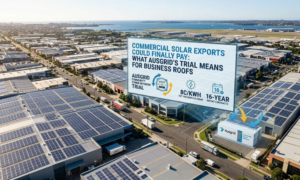
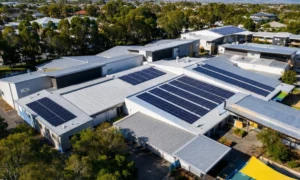
Drive through almost any Australian industrial estate, and the contrast becomes obvious. Homes surrounding these areas often have roofs covered in solar panels. Meanwhile, enormous warehouses, factories, shopping centres, agricultural buildings, and commercial facilities can have thousands of square metres of unused roof space.
That represents an enormous untapped energy resource.
From 1 October 2026, changes to the Australian Government’s Small-scale Renewable Energy Scheme (SRES) will significantly change the commercial solar equation. The solar system eligibility threshold will increase from 100 kW to 1 MW. Eligible businesses could receive an upfront discount of around 20% on medium-scale solar installations.
For some larger projects, the Federal Government estimates the changes could reduce upfront costs by almost $200,000.
Combined with new commercial battery incentives in New South Wales and existing Victorian incentives, the direction is becoming clear.
Commercial solar is moving towards the centre of Australia’s energy transition.
Quick summary: What businesses need to know
- From 1 October 2026, solar systems up to 1 MW will become eligible under the expanded SRES.
- NSW will introduce new BESS3, BESS4, and BESS5 battery activities from 1 September 2026.
- Victoria already offers additional incentives for eligible 30 kW to 200 kW commercial and industrial solar systems through Victorian Energy Upgrades.
For businesses with high daytime electricity consumption and suitable roof space, these changes could substantially improve commercial solar project economics.
Why is the Federal Government turning towards commercial solar?
Residential rooftop solar is arguably entering a more mature stage of its development. Australia passed four million small-scale renewable energy installations in late 2024. More than 300,000 solar systems had been installed annually under the SRES since 2020.
Residential solar installations continue to grow, so the market certainly has not stopped. However, there is a practical limit to residential expansion. Millions of suitable homes already have solar. Other households rent, live in apartments, have unsuitable roofs, face shading, or cannot justify an installation.
Australia is gradually approaching the point where much of the easiest residential rooftop solar opportunity has already been captured. Commercial buildings tell another story.
Factories, warehouses, farms, logistics centres, offices, schools, hospitals, and shopping centres collectively offer vast areas of potentially usable roof space. The Federal Government estimates the technical solar potential across commercial, industrial, and agricultural rooftops could exceed 80 GW. That is a lot of sunshine currently landing on corrugated iron.
Climate Change and Energy Minister Chris Bowen has described mid-scale solar as the “missing middle” of Australia’s renewable energy transition. Utility-scale renewable energy has grown rapidly. Residential rooftop solar has been extraordinarily successful. Commercial and industrial rooftops sit between them.
Why hasn’t commercial solar grown as quickly?
Commercial solar sounds straightforward. Businesses often have large roofs. Many consume substantial electricity during daylight hours. Solar generates electricity during those same daylight hours.
Perfect match, right? Sometimes. However, commercial energy projects can become considerably more complicated than residential installations.
Commercial solar requires greater capital
A household might consider a 6.6 kW, 10 kW, or 15 kW solar system.
A commercial customer could be assessing 100 kW, 300 kW, 500 kW, or significantly more.
Even where the return on investment is attractive, the initial capital requirement can become a major obstacle. Businesses must compare solar against competing investment priorities. A manufacturer might choose between solar, new machinery, additional staff, expanding premises, or increasing inventory.
The question therefore isn’t simply whether solar saves money. It is whether investing capital into solar delivers sufficient value compared with every other place that business could invest its money.
Commercial electricity use is more complicated
Commercial solar also requires more careful system design. Businesses can have highly variable load profiles. Demand charges, seasonal consumption, operating hours, production schedules, refrigeration, HVAC, machinery, and EV charging can completely change the economics.
Exporting excess solar electricity may also deliver considerably less value than consuming it on site. The Australian Government’s own commercial solar guidance recommends examining when electricity is consumed, rather than simply installing the largest system a roof can accommodate.
For commercial customers, self-consumption is king.
A well-designed commercial solar system should therefore reflect how that particular site consumes electricity.
Network connections can become difficult
Larger systems can also face more complicated network connection requirements. This can involve export limits, network studies, additional protection equipment, engineering requirements, and lengthy approval processes.
The Federal Government has acknowledged these issues alongside its SRES changes. It plans to pursue reforms aimed at improving network connection processes for mid-scale solar.
That matters because cheaper panels achieve little if a viable project becomes stuck in connection limbo.
The biggest commercial solar change: STCs expanding to 1 MW
The headline change arrives on 1 October 2026.
Until now, solar PV systems could only qualify for Small-scale Technology Certificates if their rated capacity did not exceed 100 kW. Larger installations generally entered the Large-scale Renewable Energy Target framework and could create Large-scale Generation Certificates. That 100 kW boundary created an awkward divide.
A business considering a 90 kW system could access an upfront STC incentive. A business needing several hundred kilowatts faced a substantially different incentive structure.
The Federal Government’s announced changes increase the SRES solar eligibility threshold from 100 kW to 1 MW. That is a tenfold increase. Eligible commercial, industrial, agricultural, community, education, and other organisations installing systems within the expanded threshold will gain access to upfront certificate-based support.
The Government expects the expanded scheme to reduce eligible project costs by approximately 20%.
Indicative examples released alongside the announcement suggest potential discounts of around:
- $68,000 for a 250 kW commercial solar system
- $136,000 for a 500 kW commercial solar system
- Potentially close to $200,000 for some larger eligible installations
Actual incentives will depend on final scheme rules, system characteristics, certificate values, installation dates, and eligibility.
Why the 1 MW STC threshold matters
This isn’t simply a bigger solar rebate. It changes the investment calculation.
Commercial solar projects frequently live or die on payback periods and internal rates of return. Reducing upfront expenditure can shorten payback periods. It can also reduce financing requirements and improve project cash flow. For some businesses, the change could make a previously marginal project commercially viable. It could also encourage businesses to install a system that better reflects their actual electricity demand.
Previously, some businesses had an incentive to design around the 100 kW STC threshold. From October, businesses with substantially larger loads can potentially consider hundreds of kilowatts without crossing that same incentive cliff. That could be particularly important for manufacturing, cold storage, logistics, agriculture, shopping centres, schools, hospitals, and other energy-intensive facilities.
Commercial solar and batteries are becoming a package deal
Solar solves one part of the commercial energy equation. Batteries can solve another.
A commercial battery can store excess solar generation for later use. Depending on the site, it may also help reduce peak demand, manage demand charges, shift consumption between tariff periods, provide backup capability, or participate in demand response programs.
That doesn’t mean every commercial solar system needs a battery.
For businesses with strong daytime electricity demand, direct solar self-consumption can already provide excellent economics. However, batteries become increasingly interesting where consumption continues after sunset, peak demand costs are significant, or energy flexibility has additional value.
This is where NSW’s new commercial battery incentives become particularly important.
NSW BESS3, BESS4, and BESS5 explained
From 1 September 2026, three new battery activities will commence under the NSW Peak Demand Reduction Scheme.
They are BESS3, BESS4, and BESS5.
Together, they significantly expand the types and sizes of battery installations that can receive support in NSW.
What is BESS3?
BESS3 targets apartment buildings.
Eligible installations must be located at a BCA Class 2 apartment building containing at least four individual dwellings.
Battery capacity must be greater than 20 kWh and no more than 200 kWh usable capacity. Other requirements include approved battery equipment, appropriately accredited installation, relevant planning and network approvals, and compliance with applicable installation standards.
BESS3 therefore opens another previously difficult market: shared and multi-residential energy storage.
What is BESS4?
BESS4 is particularly important for small and medium businesses (SMEs). It supports eligible battery installations with combined usable capacity greater than 20 kWh and up to 200 kWh.
The battery cannot be installed in a residential building or data centre.
Eligible systems must meet requirements covering battery capacity, inverter output, warranties, network connections, approved equipment, installation standards, and relevant approvals. BESS4 installations also require a minimum customer payment of $5,000 per implementation.
For SMEs, BESS4 could fill an important gap. Many businesses consume far more electricity than a typical household but are nowhere near utility scale. A workshop, supermarket, office, warehouse, restaurant, medical facility, or small manufacturer might sit squarely within this category.
What is BESS5?
BESS5 steps into genuine commercial and industrial battery territory.
It applies to eligible batteries with combined usable capacity greater than 200 kWh and up to 30,000 kWh, or 30 MWh.
However, incentives apply only to the first 10,000 kWh, or 10 MWh, of eligible battery capacity.
BESS5 installations cannot be located in residential buildings or data centres. The scheme also introduces requirements relating to new solar capacity, inverter output, network connections, internet connectivity, demand response capability, safety testing, and appropriately licensed installation.
This makes BESS5 fundamentally different from a residential battery rebate. It recognises batteries as flexible commercial energy infrastructure. Businesses can use storage to manage when they import electricity, reduce peak demand, increase solar utilisation, and respond to electricity market conditions.
Why NSW’s commercial battery incentives matter
Less than 2% of batteries installed under the Federal Cheaper Home Batteries Program in NSW had been installed by businesses when the NSW Government assessed the market. The Government identified several commercial battery use cases, including reducing demand charges, increasing solar self-consumption, responding to electricity prices, and participating in aggregated demand response.
That highlights the same problem seen with commercial solar. Businesses may have a compelling use case, but upfront capital remains a barrier. BESS4 and BESS5 are designed to help close that gap.
For NSW businesses considering solar and storage together, the timing is particularly interesting. From September, commercial batteries gain new state support. From October, substantially larger commercial solar systems gain access to the expanded federal SRES.
Those policies could work together.
Victoria already has a commercial solar incentive
NSW isn’t the only state specifically targeting commercial renewable energy. Victoria introduced a dedicated commercial and industrial solar activity under the Victorian Energy Upgrades program in September 2025.
The program provides upfront incentives for eligible 30 kW to 200 kW commercial solar installations.
Eligible sites include businesses and other non-residential premises, such as schools, hospitals, and community buildings. Systems must meet technical, product, connection, monitoring, and installation requirements. They must also be delivered through an appropriately accredited VEU provider.
Indicative VEU discounts published by the Victorian Government include approximately $9,100 for a 100 kW installation and $34,300 for a 200 kW installation. These examples assume a VEEC price of $70, so actual discounts can vary.
Importantly, eligible businesses may also claim federal renewable energy incentives alongside the VEU incentive. The October SRES expansion could therefore make Victoria particularly attractive for qualifying commercial solar projects.
What commercial solar incentives are available elsewhere?
The incentive landscape outside NSW and Victoria is less uniform. At present, there is no equivalent broad commercial solar incentive across every Australian state and territory. That does not mean businesses elsewhere are left empty-handed.
The Federal SRES applies nationally, and the October expansion will therefore be relevant across Australia.
Small businesses may also access the Federal Cheaper Home Batteries Program for eligible solar-connected batteries. Eligible battery systems can have nominal capacities between 5 kWh and 100 kWh, although program rules determine the capacity receiving STCs.
Businesses should also investigate state energy-efficiency schemes, industry-specific grants, local council programs, financing programs, and funding for EV charging or electrification.
These programs change regularly and may target specific industries, locations, technologies, or business sizes. For larger commercial projects, incentive stacking should form part of the feasibility assessment.
Commercial solar is not simply residential solar made bigger
This may be the most important point for businesses considering solar. A commercial energy system needs to be designed around the business. Two neighbouring warehouses with identical roofs could require completely different systems. One might operate from 7 am until 4 pm and consume enormous amounts of electricity during solar production hours. The other might operate refrigeration equipment around the clock. The first could achieve extremely high solar self-consumption without significant battery storage. The second might benefit from combining solar with a commercial battery.
Another business might face substantial demand charges, while another may have EV fleets arriving each afternoon.
Commercial solar design therefore requires analysis of interval consumption data, tariffs, maximum demand, operating hours, future electrification, network constraints, roof space, solar production, and potential battery operation.
The biggest system is not automatically the best system. The right system is the one that produces the strongest long-term outcome for the business.
Is commercial solar worth considering in 2026?
For many Australian businesses, the answer is increasingly yes. Solar power is already one of the most accessible ways for businesses to reduce grid electricity consumption and exposure to future electricity prices. The policy environment is now catching up with the opportunity.
Australia spent years successfully encouraging households to use their roofs as miniature power stations. The next obvious question is what we do with the enormous roofs above our factories, warehouses, farms, offices, schools, and commercial buildings. From October 2026, the Federal Government is putting significantly more weight behind the answer.
Commercial solar systems up to 1 MW entering the SRES could remove a major financial barrier. NSW’s new commercial battery incentives could improve the economics of energy storage. Victoria’s existing C&I solar incentive adds another layer of support.
For businesses, this means commercial solar should no longer be viewed solely as a sustainability project. It is increasingly an energy cost, productivity, resilience, and capital investment decision.
Commercial solar FAQs
What is commercial solar?
Commercial solar refers to solar PV systems installed on businesses, warehouses, factories, farms, schools, offices, and other non-residential properties. These systems are usually larger than residential installations and are designed around the site’s electricity demand, operating hours, available roof space, tariffs, and future energy requirements.
Is there a commercial solar rebate in Australia?
Yes. Eligible commercial solar systems can receive support through the Federal Government’s Small-scale Renewable Energy Scheme. From 1 October 2026, the eligibility threshold is set to increase from 100 kW to 1 MW. Some states also offer additional incentives for eligible commercial solar or battery installations.
How will the 1 MW STC change benefit businesses?
Expanding STC eligibility to systems up to 1 MW can significantly reduce the upfront cost of larger commercial solar installations. This could improve project payback periods and make solar viable for businesses previously sitting above the 100 kW threshold. Actual savings will depend on system size, certificate values, and final eligibility requirements.
Is commercial solar worth it for businesses?
Commercial solar can deliver strong returns where businesses consume significant electricity during daylight hours. The best results usually come from matching solar generation with on-site electricity demand. Electricity tariffs, demand charges, operating hours, export limits, financing costs, and future energy use should all form part of the feasibility assessment.
Can businesses receive incentives for commercial battery storage?
Yes, depending on location and eligibility. In NSW, new BESS3, BESS4, and BESS5 activities commence from 1 September 2026. BESS4 supports eligible small and medium commercial battery systems, while BESS5 targets larger commercial and industrial installations. Other federal and state incentives may also apply.
Can commercial solar and battery incentives be combined?
Potentially. Businesses may be able to access more than one incentive where program rules allow it. This could include federal solar incentives, state-based schemes, and eligible battery support. However, incentive stacking rules vary, so businesses should confirm eligibility before signing contracts or commencing installation.
Key takeaways for Australian businesses
- Commercial solar is becoming a major policy focus. The Federal Government has identified mid-scale solar as a missing part of Australia’s renewable energy transition.
- The SRES threshold will increase from 100 kW to 1 MW from 1 October 2026. This could substantially reduce upfront costs for eligible commercial solar projects.
- NSW commercial battery incentives commence on 1 September 2026. BESS4 targets SMEs, while BESS5 supports much larger commercial and industrial batteries.
- Victorian businesses may already qualify for additional C&I solar incentives. The VEU program supports eligible 30 kW to 200 kW installations.
- Commercial solar requires proper feasibility analysis. Electricity load, operating hours, tariffs, demand charges, network constraints, batteries, and future electrification should all influence system design.
Australia’s residential rooftop solar boom showed what can happen when good technology, strong economics, and government incentives align.
Commercial rooftops could be next.
And with thousands of square kilometres of Australian commercial roof space spending every sunny afternoon doing little more than getting hot, the opportunity is difficult to ignore.