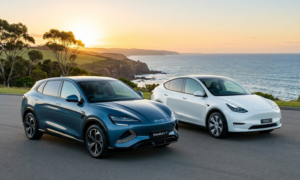





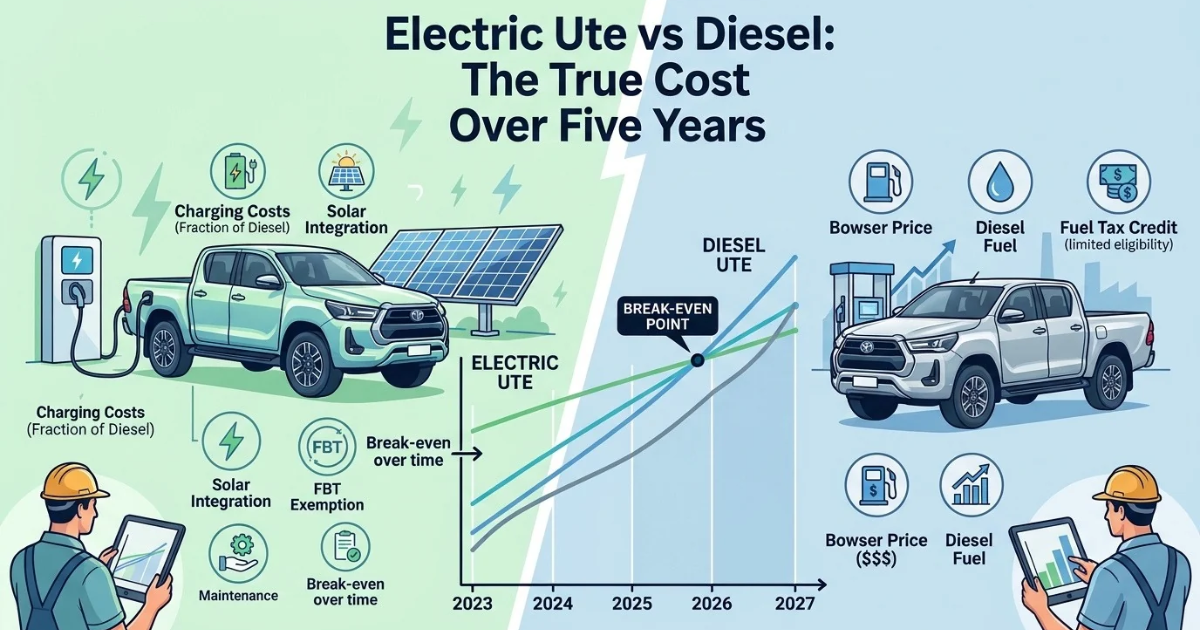
Toyota sold more than 51,000 HiLuxes in Australia last year, yet it expects to sell just 500 of its new HiLux BEV in 2026. That gap says a lot about how Australians weigh up an electric ute vs diesel: the fuel savings are obvious, but the full cost of ownership is not.
With diesel prices climbing sharply through 2026, tradies and small business owners are asking whether an electric ute is cheaper to own, not just cheaper to fuel. The answer depends on more than the bowser. The upfront premium, a proposed per-kilometre road user charge from 2027, depreciation, insurance and tax treatment all shape the true cost of an electric ute.
This guide breaks down each cost, then runs three worked break-even examples so you can see how quickly an electric ute might pay for itself, and how to run your own numbers before you visit a dealer.
Quick summary:
- Usually, over time. Charging costs a fraction of diesel, but most electric utes cost $5,000 to $15,500 more upfront, so savings take years to pay back the premium.
- Kilometres and charging decide it. High-kilometre drivers who charge at home on solar or off-peak power break even fastest, often in three to five years.
- Factor in 2027 changes. Proposed state road user charges of 2 to 3 cents per km will trim annual savings, while tax and lease incentives can offset part of the upfront cost.
How much more does an electric ute cost upfront?
The purchase premium is the single biggest factor in whether an electric ute saves you money. It varies widely by brand, so the same fuel savings can pay back in three years or take nearly a decade.
Toyota priced the HiLux BEV $15,500 above a comparably specified diesel HiLux. Even the entry SR cab-chassis costs more than the top-spec diesel Rugged X. Chinese-built options sit much lower, with the KGM Musso EV launching from around $60,000 drive-away.
Electrified ute prices in Australia (October 2026)
| Model | Type | Starting price | Braked towing |
| Toyota HiLux BEV SR (cab-chassis) | Full electric | $74,990 + on-roads | 2,000 kg |
| Toyota HiLux BEV SR5 (pick-up) | Full electric | $82,990 + on-roads | 2,000 kg |
| KGM Musso EV | Full electric | ~$60,000 drive-away | Check variant |
| BYD Shark 6 | Plug-in hybrid | ~$62,000 drive-away (Sydney) | 2,500–3,500 kg |
Prices change often and vary by state. Always compare drive-away quotes, not list prices.
Why the premium matters more than fuel prices
A $15,500 premium on a ute that saves $3,000 a year takes about five years to recover. Halve the premium and payback halves too. That makes negotiating the purchase price, or choosing a lower-cost model, as important as how you charge.
Compare like with like. A diesel top-spec with leather and tech is not a fair match for a base-spec electric ute. Line up equivalent cab styles, drivetrains and towing needs before you calculate the gap.
See our guide to electric vehicles in Australia for the latest models.
Expert tip
Ask dealers about novated lease bundles. Toyota includes a 7 kW wall charger (installation extra) with HiLux BEVs bought or novated-leased by private customers, which can shave $1,000 or more off your setup costs.
How much can you save on running costs?
An electric ute’s energy bill depends far more on where you charge than on the ute itself. Your blended cost per kWh, across home, solar and public charging, is the number to know.
Your blended charging rate
Most owners charge from a mix of sources. Here’s how we estimate the cost of each in this guide:
| Charging source | Assumed cost per kWh |
| Free midday power plan | $0.00 |
| Own rooftop solar (feed-in tariff forgone) | ~$0.05 |
| Off-peak or EV grid tariff | ~$0.25 |
| Public DC fast charger | ~$0.60 |
Multiply each rate by the share of your charging it covers, then add them up. A driver who charges 70% off-peak, 20% on solar and 10% at fast chargers pays roughly 24 cents per kWh overall.
Why kilometres matter most
Savings scale with distance. A ute doing 40,000 km a year saves more than three times as much as one doing 12,000 km, even with the same charging habits. Low-kilometre drivers need a small premium, or a lot of cheap solar, to come out ahead.
Free midday power is a game-changer if your ute is home or at a depot in the middle of the day. Under the federal Solar Sharer offer, eligible households get at least three hours of free power. Read why Australian households are embracing free midday power.
Expert tip
If your ute is on site all day, consider charging at your workshop or depot instead of at home. A business site with rooftop solar and a commercial EV charger can deliver near-free charging during working hours.
Will a road user charge wipe out the savings?
No, but it will trim them. Several states plan to charge EV and plug-in hybrid owners per kilometre from July 2027, which could cost a high-kilometre tradie $700 to $1,200 a year.
Proposed charges by state
| State | Full EV | Plug-in hybrid | Proposed start |
| New South Wales | 2.974c/km | 2.379c/km | 1 July 2027 (under inquiry) |
| South Australia | 2.5c/km (indexed) | 2.0c/km (indexed) | July 2027 or 30% EV sales, whichever is first |
| Western Australia | Proposed | Proposed | July 2027 |
| Tasmania | Flagged | Flagged | From 2027 |
South Australia’s rates and trigger are set out in the Motor Vehicles (Electric Vehicle Levy) Amendment Bill. The charge is billed in arrears with your registration, based on distance travelled.
What it adds to your costs
At NSW’s proposed EV rate, 25,000 km a year adds about $744. At 40,000 km, it’s closer to $1,190. That’s real money, but it’s still well below the fuel savings for most high-kilometre drivers.
The charge is not certain. Victoria’s earlier EV charge was struck down by the High Court in 2023, and NSW is still finalising how it would collect payments.
Expert reference
At the NSW inquiry into the charge, the Electric Vehicle Council’s chief executive, Julie Delvecchio, argued it should wait until EVs make up 30% of the national fleet, warning an early charge could slow sales. The NRMA supported the charge as designed.
Expert tip
Build the road user charge into your sums now, even if you live in a state that hasn’t confirmed one. Most utes are kept for five years or more, so a 2027 start will apply for most of your ownership.





What about depreciation, servicing and insurance?
These costs are harder to pin down than fuel, and resale value is the biggest unknown. Treat them as a range, not a fixed number, in your calculations.
Depreciation and resale value
There’s little resale data for electric utes yet because so few have been sold. Fast-improving battery range and falling prices can push down the value of earlier models, as they have with some electric cars.
On the other hand, electric drivetrains have far fewer moving parts, and long battery warranties transfer to the next owner. The BYD Shark 6, for example, carries a six-year, 150,000 km vehicle warranty. Check the separate battery warranty, which is often longer.
Servicing and tyres
No oil changes, fuel filters, timing belts or exhaust systems usually means lower scheduled servicing costs. Regenerative braking also reduces brake wear.
However, electric utes are heavy, which can wear tyres faster. Regional owners should also check how far the nearest qualified service centre is.
Insurance
Premiums on newer electric models can be higher, reflecting repair costs and limited parts supply. Get real quotes for both vehicles before you buy, as this can add or remove several hundred dollars a year.
Expert tip
Plan to keep an electric ute longer than you would a diesel. Lower servicing costs and fewer wear parts mean ownership costs stay flat for longer, which spreads the upfront premium over more years.
How do tax and business rules change the numbers?
Tax treatment can swing the comparison by thousands of dollars for business owners. Three rules matter most: fringe benefits tax, fuel tax credits and how you finance the vehicle.
Fringe benefits tax (FBT)
Eligible zero-emission cars provided to employees can be exempt from FBT under the ATO’s electric cars exemption. For FBT purposes, a ute designed to carry less than one tonne is generally treated as a car, so a fully electric ute may qualify if it meets the other conditions.
Plug-in hybrids no longer qualify for new arrangements from 1 April 2025. That shifts the tax case towards fully electric utes for businesses offering vehicles to staff.
Fuel tax credits: the discount diesel utes don’t get
Many tradies assume they can claim back fuel tax on their work ute. In most cases, they can’t. The ATO lists fuel used in light vehicles of 4.5 tonnes GVM or less on public roads as ineligible.
The exception is business use off public roads, such as on mine or construction sites. If your diesel ute spends most of its time on site, fuel tax credits narrow the gap with an electric ute.
Financing and novated leases
Novated leasing an FBT-exempt electric ute lets employees pay for the vehicle and running costs from pre-tax income. For eligible buyers, this can offset much of the upfront premium.
Business owners should also check current instant asset write-off thresholds and car depreciation limits, as these change between financial years.
Expert reference
The ATO notes that fuel tax credit rates change regularly and advises businesses to check eligibility each time they lodge a BAS. Speak with your accountant before electrifying a fleet.
Expert tip
If you run a small fleet, start by replacing the utes with the most predictable, highest-kilometre routes. They deliver the fastest payback and the cleanest FBT case.
How long until an electric ute pays for itself?
In our three examples, payback ranges from about 3.5 years for a high-kilometre builder to nearly 8 years for a weekend user. The size of the upfront premium is what separates a quick win from a slow one.
Each example assumes diesel at $2.60 per litre, a NSW road user charge of 2.974c/km and a $15,500 premium, matching the HiLux BEV gap. Servicing and insurance are left out because they vary too much between owners.
| Profile | Km/year | Diesel cost | Charging cost | Road user charge | Net annual saving | Payback |
| Regional builder | 40,000 | $11,440 | $5,780 | $1,190 | ~$4,470 | ~3.5 years |
| Suburban electrician | 25,000 | $5,525 | $1,627 | $744 | ~$3,150 | ~4.9 years |
| Weekend user | 12,000 | $2,652 | $292 | $357 | ~$2,000 | ~7.7 years |
The regional builder
Drives 40,000 km a year, often with a trailer. We assume 11 L/100 km on diesel versus 34 kWh/100 km electric, with half the charging at home off-peak and half at public fast chargers. Heavy public charging raises costs, but sheer distance still delivers the biggest saving. Check towing needs first: the HiLux BEV is rated to tow 2,000 kg.
The suburban electrician
Drives 25,000 km a year around town. We assume 8.5 L/100 km on diesel versus 27 kWh/100 km electric, charging 70% off-peak at home, 20% on solar or free midday power and 10% at fast chargers. Predictable routes and home charging make this a strong fit.
The weekend user
Drives 12,000 km a year and charges mostly from rooftop solar. Running costs are tiny, but low distance means the $15,500 premium takes almost eight years to recover. Choose a model with a $5,000 premium and payback drops to around 2.5 years.
Expert tip
If you’re a low-kilometre driver, chase the smallest premium, not the cheapest charging. Your fuel savings are capped by distance, so the purchase price decides whether you come out ahead.

How do you work out your own break-even point?
Five numbers will tell you whether an electric ute makes financial sense for you. Gather them before you talk to a dealer.
- The real price gap. Get drive-away quotes for the electric ute and its closest diesel equivalent, then subtract any lease or dealer incentives.
- Your annual kilometres. Check your last two years of logbook or service records rather than guessing.
- Your blended charging rate. Estimate how much charging you’ll do at home, on solar, during free midday hours and at public chargers.
- Your state’s road user charge. Add the proposed per-km rate for your state from July 2027.
- Insurance and tax. Get insurance quotes for both vehicles and ask your accountant about FBT, fuel tax credits and depreciation.
Divide the price gap by your net annual saving to get your payback period in years. If it’s shorter than you plan to keep the ute, an electric ute is likely to save you money.
Cheap home charging is the lever you control most. Pairing solar with a home battery lets you store daytime solar for overnight charging. Learn how time-of-use tariffs affect home batteries and what the federal battery rebate changes on 1 January 2027 mean for you.
Expert tip
Sort out home charging before you buy the ute. A solar system and correctly sized EV charger can cut your charging cost per kWh by 80% or more, which shortens payback more than any other single step.
Cut your electric ute running costs with solar
Get up to 3 free quotes from trusted local installers for solar, batteries and EV chargers.
Frequently asked questions
Is an electric ute cheaper to run than a diesel ute?
Yes. Charging at home on an off-peak tariff costs roughly a third of diesel per kilometre, and charging from rooftop solar costs even less. Savings shrink if you rely heavily on public fast chargers, but most drivers who charge at home spend thousands of dollars less on energy each year than they would on diesel.
How long does it take for an electric ute to pay for itself?
It depends on the upfront premium and how far you drive. In our examples, payback ranged from about 3.5 years for a driver covering 40,000 km a year to nearly 8 years for a 12,000 km weekend user, based on a $15,500 premium. A smaller premium shortens payback dramatically.
Will electric ute owners pay a road user charge?
Probably, from July 2027. NSW has proposed 2.974 cents per km for EVs and 2.379 cents for plug-in hybrids, while South Australia has legislated 2.5 and 2.0 cents (indexed). Western Australia and Tasmania have flagged similar charges. Rates and timing could still change, so check your state’s latest position.
Can I claim fuel tax credits on a diesel ute?
Generally not if it’s used on public roads. The ATO treats fuel used in light vehicles of 4.5 tonnes GVM or less on public roads as ineligible. You can claim for business use off public roads, such as on mine or construction sites, which can narrow the cost gap with an electric ute.
Are electric utes exempt from fringe benefits tax?
Fully electric utes can be, if they meet the ATO’s electric cars exemption conditions. A ute designed to carry less than one tonne is generally treated as a car for FBT. Plug-in hybrids lost eligibility for new arrangements from 1 April 2025. Check with your accountant before relying on the exemption.
Key takeaways
- The upfront premium, which ranges widely by brand, matters more to payback than fuel prices do.
- High-kilometre drivers who charge at home on solar or off-peak power recover the premium fastest.
- Proposed road user charges from July 2027 could cost $700 to $1,200 a year for heavy users, so include them now.
- Most light diesel utes on public roads can’t claim fuel tax credits, while fully electric utes may be FBT-exempt.
- Sorting out solar, a battery and a home EV charger first is the most effective way to cut ownership costs.
Sources
- ATO: Electric cars exemption
- ATO: Ineligible fuels and activities for fuel tax credits
- Australian Government energy.gov.au: Solar Sharer offer
- Parliament of South Australia Hansard: EV road user charge
- GoAuto: Toyota prices HiLux BEV
- Chasing Cars: HiLux BEV pricing and sales target
- WhichCar: NSW road user charge proposal
- The Driven: NSW road user charge inquiry
- CarExpert: 2026 BYD Shark 6 pricing