
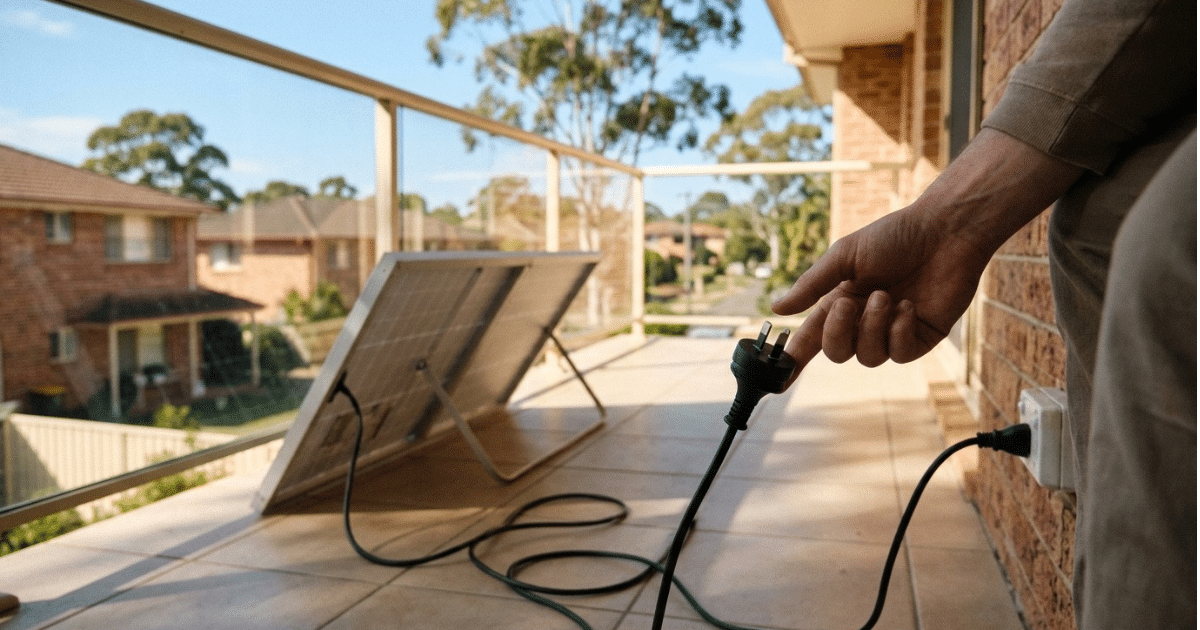
One of the stated goals of Western Australia’s new plug-in solar consultation is to steer people away from uncertified kits bought through online marketplaces. That tells you something: those kits are already finding their way into Australian homes.
WA wants to be the first state to legalise plug-in solar in Australia, and national energy ministers are working on rules too. But right now, plugging a solar panel or battery into a standard power point to feed your home’s wiring isn’t legal anywhere in the country, and no certified products exist yet.
If you’re a renter or apartment dweller keen to cut your bills, the wait is frustrating. This guide explains why buying a kit now is risky, covering plug-in solar safety, insurance, warranty and landlord issues, and what to look for once approved products reach the shelves.
Quick summary
- Plug-in solar and batteries that feed power through a wall socket aren’t legal to use in Australia, and no certified products are available.
- Uncertified kits can stop safety switches from working properly, endanger electricians and could void your insurance.
- WA expects to finalise its standard and certification pathway by around February 2027, with national work under way.
The legal status of plug-in solar in Australia
No. Plug-in solar panels and batteries that feed electricity back into your home’s wiring through a standard power point aren’t legal to use anywhere in Australia yet.
Why it isn’t legal yet
Australia’s inverter installation standard, AS/NZS 4777.1:2024, requires inverters to be permanently wired into a switchboard. WA’s own consultation paper acknowledges that this hard-wiring rule currently blocks any certification pathway for plug-in generators. Without a standard to test against, no product can be certified, and without certification, no product can legally be sold for this use.
What is legal
A portable power station is a different product. You can charge it from a power point and run appliances directly from its own outlets, because it never pushes electricity back into your home’s wiring. Our guide to battery storage for apartment dwellers explains the difference in detail.
Where things stand
| Jurisdiction | Status (October 2026) |
| Western Australia | Consulting on a proposed standard and certification pathway; submissions close 9 December 2026 |
| National | Energy ministers agreed in September 2026 to explore pathways for safe plug-in devices |
| Other states | No changes announced yet |
| Germany, UK | Already legal, with approved products on sale |
For the latest on the national process, see our update on plug-in solar moving one step closer to legal.
Expert tip
If a seller claims a plug-in solar kit is “approved” or “legal” in Australia, ask for proof. Until standards and certification are in place, no plug-in generator can genuinely carry that approval here.
Why plug-in solar kits are already sold online
Because buying something and legally connecting it are two different things. Global online marketplaces make it easy to order electrical products that were never designed or approved for Australian homes.
Two kinds of kits
Most kits available to Australians fall into one of two groups:
- Kits approved overseas. Products certified for Germany or the UK meet those countries’ rules, but Australian wiring, plugs and safety switches differ. Overseas approval doesn’t make them legal or safe to connect here.
- Uncertified kits. Cheaper products sold through online marketplaces may not meet any recognised safety standard at all.
The Regulatory Compliance Mark
In Australia, nearly all electrical appliances supplied to consumers must carry the Regulatory Compliance Mark (RCM). A product without it hasn’t been shown to meet Australian electrical safety requirements.
Regulators do act on non-compliant gear. In 2024, WA’s Building and Energy issued $10,000 in infringements to sellers of unapproved power supplies and chargers, and warned consumers to confirm an appliance is certified before buying.
Expert tip
Check for the RCM tick logo on the product and its packaging, and ask the seller where the product is certified. If it’s only approved overseas, or the seller can’t say, treat it as not approved for use in Australia.
The safety risks of uncertified plug-in solar
The main risks come from pushing electricity into wiring that was designed only to receive it. Certified products and proper standards are built to manage these risks. Uncertified kits may not be.
Five risks to know
| Risk | What can happen |
| “Blinded” safety switches | Some safety switches (RCDs) may not reliably detect faults when DC current leaks into the circuit, raising the risk of electric shock |
| Live plug pins | If the inverter doesn’t shut down instantly when unplugged, the exposed pins of the plug could be live |
| Danger to electricians | Someone may switch off the switchboard believing a circuit is dead, while a plugged-in device is still feeding power into it |
| Overloaded wiring | Power fed in at the socket isn’t seen by the circuit breaker, so a large system or several units on one circuit could overheat the cabling |
| Battery fire | Uncertified lithium batteries may lack proper cell protection and battery management |
Why size matters
A small system is far less risky than a large one. Glen Morris, who sits on the Standards Australia committees for solar and battery installation, has noted that an 800 W system draws only around 3 amps, well within the 10 amp rating of a standard Australian power point. Many kits sold online are larger than that.
WA’s proposed technical standard would cap a plug-in system’s AC output at 800 VA and its solar panels at 2 kW, based on rules already used in Germany.
Expert reference
Morris says safe plug-in solar needs three things: a product standard that makes the inverter shut down instantly when unplugged, an output cap of around 800 W, and simple registration with the network. Uncertified kits offer none of these guarantees.
Expert tip
Never plug a solar or battery device into a power board or extension lead, and never into a circuit you can’t identify on your switchboard. If you already own a kit, unplug it and have a licensed electrician check your home’s safety switches.


Insurance, warranty and landlord risks
Even if nothing goes wrong electrically, an uncertified kit can leave you exposed financially. These risks often matter most to renters, the very people plug-in solar is meant to help.
Insurance
Home and contents policies commonly exclude or limit cover for damage caused by illegal or non-compliant electrical equipment. If a fire or electrical fault is traced back to an unapproved plug-in kit, your insurer may refuse the claim, and you could be liable for damage to neighbouring apartments.
Warranty and consumer protection
Products bought from overseas marketplaces can be hard to return or repair, and there’s usually no local support if something fails. One of WA’s stated aims is for approved plug-in systems to be sold by retailers with clear warranty obligations, like other household appliances. Until then, you may have little recourse.
Your lease and strata rules
If you rent, connecting generating equipment to the property’s wiring without permission could breach your lease. In apartments, strata by-laws may also restrict what you can attach to balconies or common property. Any damage could come out of your bond, or worse.
Federal energy minister Chris Bowen has flagged tenancy and strata rules as among the hardest parts of legalising plug-in solar, so these issues may take time to resolve even after products are certified.
Expert tip
Read your insurance policy’s exclusions for electrical work and unapproved equipment, and call your insurer if you’re unsure. A five-minute call can tell you whether a future plug-in system would be covered.
What to look for once approved products arrive
When plug-in solar becomes legal, certified products will look a lot like the kits sold online today. The difference will be in the testing, labelling and paperwork. Use this checklist before you buy.
Your plug-in solar buying checklist
- Certified to the Australian standard. Look for confirmation that the product meets the applicable plug-in standard, such as WA’s proposed technical bridging standard or a future national standard.
- The RCM mark. The Regulatory Compliance Mark should appear on the product and packaging.
- Independent testing. WA proposes that products be tested by a laboratory accredited by the National Association of Testing Authorities (NATA).
- Output within the limit. Under WA’s proposal, that’s no more than 800 VA of AC output and 2 kW of solar panels.
- Instant shutdown when unplugged. The product documentation should confirm the inverter stops supplying power the moment it’s disconnected.
- A local seller and warranty. Buy from an Australian retailer that offers clear warranty terms and local support.
- Network notification. Expect to complete a simple form telling your network the system exists. WA proposes this for Western Power and Horizon Power customers.
When to expect approved products
WA’s consultation closes at 5 pm on 9 December 2026. The state then plans to publish an updated standard and certification route, which it expects to complete by around February 2027, before making the regulatory changes needed to legalise plug-in systems. Products will then need to be tested and certified, so they may take longer to reach shops.
You can read the full WA consultation paper and make a submission before it closes.
Expert tip
Before buying any plug-in system, ask a licensed electrician to check what type of safety switches your home has. If they need upgrading to work safely with plug-in generation, it’s better to know before you spend money on a kit.
Legal ways renters and apartment dwellers can save now
You don’t have to wait for plug-in solar to start saving. Several legal options can cut your bills today.
Switch to a free midday power plan
The federal Solar Sharer offer and Victoria’s Midday Power Saver give eligible households free electricity for a few hours in the middle of the day, with no panels required. Run your washing machine, dishwasher and other appliances during those hours. Find out why households are embracing free midday power.
Use a portable power station
A portable power station is legal to use because it doesn’t feed power back into your home’s wiring. Charge it during free or cheap hours, then run appliances directly from it in the evening.
Explore shared solar for your building
Some apartment buildings can share one rooftop solar system, and sometimes a battery, across multiple units. It needs owners corporation approval, but it’s a legal, permanent option. Our guide to battery storage for apartment dwellers covers the options.
Ask your landlord about rooftop solar
Solar and batteries can add value to a rental property, and government rebates reduce the upfront cost. A landlord may be more open to the idea than you expect.
Have your say
If you live in WA, or simply want plug-in solar done safely, you can make a submission to WA’s consultation before 9 December 2026.
Expert tip
Compare your current plan with free midday power offers in your area before buying any device. For many renters, simply shifting appliance use to free hours delivers savings similar to a small plug-in solar system, with zero upfront cost.
Own your home or a rental property?
Rooftop solar and batteries deliver bigger savings than any plug-in kit. Compare up to 3 free quotes from trusted local installers.
Frequently asked questions
Is plug-in solar legal in Australia?
Not yet. Plug-in solar panels and batteries that feed power into your home’s wiring through a standard power point aren’t legal anywhere in Australia, because the inverter standard requires permanent wiring. WA is consulting on a legal pathway, and national energy ministers are exploring rules for safe plug-in devices.
When will plug-in solar be legal in WA?
WA hasn’t set a final date. Its consultation closes on 9 December 2026, and the state expects to publish an updated standard and certification route by around February 2027. It will then prepare regulatory changes to legalise plug-in systems, and certified products will need to be tested before reaching shops.
Is it dangerous to use a plug-in solar kit bought online?
It can be. Uncertified kits may stop safety switches from detecting faults, leave plug pins live when unplugged, overload wiring, or put electricians at risk. Products approved in Germany or the UK aren’t certified for Australian homes. Using one could also void your insurance or breach your lease.
Can I legally use a portable power station in my apartment?
Yes. A portable power station is legal because it doesn’t feed electricity back into your home’s wiring. You charge it from a power point, ideally during free or cheap hours, and run appliances directly from its own outlets. Check that it carries the RCM mark before buying.
What should I look for in a plug-in solar system once it’s legal?
Look for certification to the applicable Australian plug-in standard, the RCM mark, independent NATA-accredited testing and output within the legal limit, proposed at 800 VA in WA. The inverter should shut down instantly when unplugged. Buy from a local retailer with a clear warranty and notify your network.
Key takeaways
- Plug-in solar and batteries that feed power through a wall socket aren’t legal anywhere in Australia yet.
- Kits sold online, including those approved overseas, aren’t certified for Australian homes and carry real safety risks.
- Using an uncertified kit could void your insurance, leave you without warranty support and breach your lease.
- WA expects to finalise its standard and certification route by around February 2027, with national work under way.
- In the meantime, free midday power plans and portable power stations offer legal ways to cut your bills.
Sources
- WA Government: Plug in to power up – Consultation on plug-in solar and battery systems (October 2026)
- WA Building and Energy: Safety warning and infringements for power packs and chargers
- UNSW: Balcony solar and plug-in systems could help cut your energy costs, but only if rules change
- ABC News: Western Australia set to lift ban on balcony solar in national first