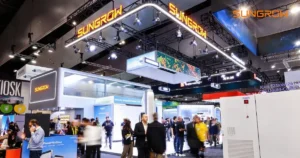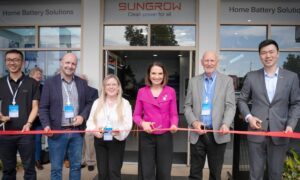
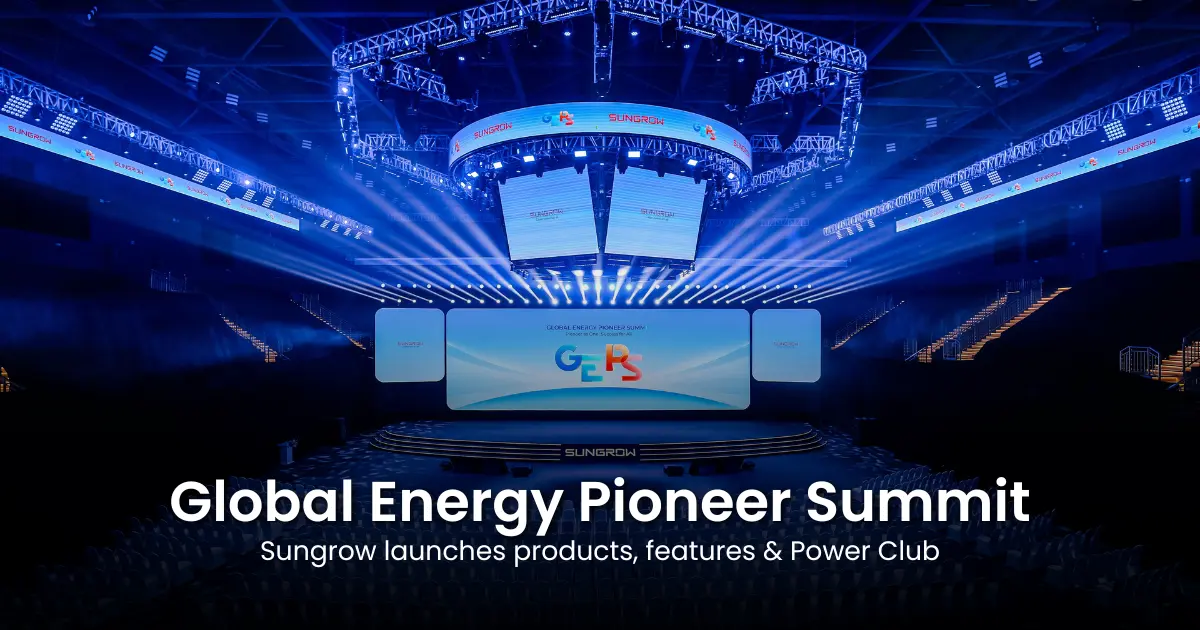
Sungrow rolled out the red carpet for more than 1,200 guests from over 80 countries at its inaugural Global Energy Pioneer Summit. Held in Hefei, China, from 10 to 13 November, the summit brought installers, distributors, project partners, and media together. Sungrow launched its PowerStack 3.0 commercial battery system, expanded its PowerKeeper range, and unveiled Sungrow Power Club for installers.
I joined the Australian media entourage for a week that took me from a 300 km/h maglev to a factory floor. Somewhere in between, there were lasers, dancing robots, an electric saxophone, and a three-day hunt for deodorant. I came home utterly exhausted, with a better sense of what Sungrow wants to do next.
Key points
- Commercial batteries: Sungrow launched PowerStack 3.0 for standalone storage, solar, EV charging, and microgrids. It also unveiled PowerKeeper Lite, a compact indoor battery system.
- Plug-in batteries: Sungrow showcased the MiniCube A Series with 5, 6, and 10 kWh options. Australian availability remains open.
- The Australian debate: Sungrow told us it’s staying neutral on legalising plug-in solar and batteries, citing safety concerns about poorly made products.
- Smarter solar panels: Sungrow’s Pulson panels can track performance and isolate a faulty panel while the rest of the array keeps generating.
- Installer support: Sungrow launched Power Club for training, technical support, and rewards. I’m keen to see how that support works in Australia.
- Beyond the launches: I toured Sungrow’s commercial and utility-scale production lines and discovered that the chairman plays a mean electric sax.
Author’s note: Sungrow covered the full cost of my trip to China. Neither Energy Matters nor I received payment for this article. The views expressed are my own.
A country light years ahead, except for one thing
I was childless and newly married the last time I visited China. More than 15 years later, the change was obvious from the moment I left the airport. Electric cars and plug-in hybrids were everywhere I looked, and construction sites dotted the landscape.
As a Melburnian, I already live with the pang of disappointment that there’s no train to our airport. So catching the maglev from Shanghai’s airport and watching it hit 300 km/h stung a little. The trains I caught were cheap, too. At one point, I waited all of 90 seconds. From Shanghai to Hefei and on to Guangzhou, I kept thinking about how easily you could get around without a car.
The fruitless quest for deodorant
My trusty Rexona made it through two seven-hour flights. It met its match at security screening at Shanghai railway station. The can was confiscated, which set me off on a three-day hunt for something I’d never thought twice about packing.
I eventually settled for a product for excessive sweating. I’m sure my fellow travellers were grateful for my persistence. Free travel tip: pack roll-on.
What I already thought about Sungrow
I knew the Sungrow name well before I joined Energy Matters. If you asked me for three words I associate with the brand, I’d say consistency, quality, and longevity.
I’ve long thought of Sungrow as sitting in that useful middle ground between price and features. When I think about quality, I think about how a system will be installed, monitored, and serviced. The longer a system is expected to work, the more those practical details matter. I went to Hefei curious to see whether that thinking would carry across to the company’s newer products.
What Sungrow launched in Hefei
Sungrow calls its product philosophy “Simplicity, Evolved”. It wants to make systems easier to choose, install, operate, and keep safe. That sounds straightforward until you consider how differently a suburban home, a factory, and a remote site use power.
PowerStack 3.0 brings more options to commercial batteries
PowerStack 3.0 was the headline commercial and industrial (C&I) launch. The system uses a modular dock that allows project teams to configure it for different jobs. It can run as a standalone battery, pair with solar, integrate solar and EV charging, or form part of a microgrid.
The idea makes sense when you look at how businesses use electricity. A factory might need to keep critical equipment running through an outage. A depot might want to use rooftop solar and stored energy to charge its fleet. Those sites have different priorities, even if both come to the table asking for a battery.
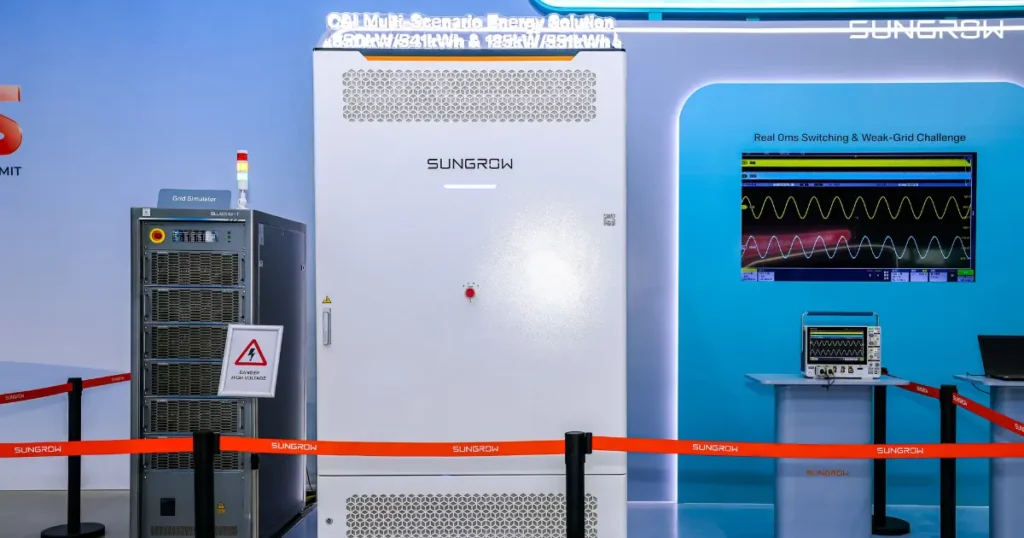
The standalone configuration supports two-hour or four-hour discharge durations. In the solar configuration, panels can connect on the DC side without a separate solar inverter. A charging module can link solar, storage, and EV charging on the same DC system. Sungrow says the microgrid module can switch to off-grid operation in 0 milliseconds without a separate static transfer switch cabinet. It has yet to be confirmed whether the modular dock can be changed before or after commissioning.
Space is another consideration. Sungrow says a 5 MWh installation can take up 43% less space than with the previous generation. It also reports round-trip efficiency above 92%. For a site with limited room or frequent battery cycling, those are figures I’d want to see modelled against the actual project.
Bubbly puts AI to work behind the scenes
I didn’t expect to be writing about an AI assistant called Bubbly in a story about industrial batteries. The name is playful, but the proposed uses are practical.
Sungrow says Bubbly can use satellite images and 3D modelling to generate a preliminary design, site layout, and financial estimate in 30 seconds. It can also help configure systems, forecast solar generation and site demand, and diagnose faults. Those forecasts can inform when a business should store energy or draw from the battery to cut peak demand.
The question I’d ask is how much time it saves on a real job. A fast first pass could help installers and engineers work through options earlier. The quality of the inputs and the checks that follow will still shape the result. I put Bubbly to the test when requesting to change the LED light on the PowerHarbour Pro. It took its time, but it did exactly as I asked.
PowerKeeper Lite gives installers more room to work
Sungrow also introduced the PowerKeeper family, bringing its existing PowerKeeper system together with the new PowerKeeper Lite. Sungrow lists configurations of 50 to 125 kW and 50 to 1,000 kWh for PowerKeeper with compatible hybrid inverters. The kW figure tells you how much power the system can deliver at once. The kWh figure tells you how much energy it can store.
PowerKeeper Lite is designed for indoor installations. It can be arranged in a narrow, tall layout or a lower, wider one. It also uses plug-in connections, wall-side cabling, and battery-level indicators to help installers pinpoint faults. The upgraded iSolarCloud platform supports remote monitoring and diagnostics.
I got a taste of the build process in a PowerKeeper Lite speed-building challenge and put the slide-in functionality to the test. On an actual job, I can see why flexible layouts would matter as much as ease of installation. The space a business has available for a battery rarely looks like the space in a product brochure.
The PowerKeeper Lite is not yet slated for an Australian release, which is a shame. The system looks like it would slot in well into the Australian ecosystem.
Where residential storage fits
I’d already spoken with Sungrow about PowerHarbour at All Energy Australia. In Hefei, I got to see where it sits in the wider line-up. Sungrow says its flagship residential system offers up to 30 kW of output and 10 to 120 kWh of modular storage. It pairs with EnergyBridge for backup and uses Bubbly to assist with installation and commissioning. The PowerHarbour Pro is undeniably the more exciting of the two, with integrated AC coupled EV charging which is V2X ready.
I couldn't help but wonder if Sungrow's entry into the all-in-one market is perhaps a little late in the game. With rebates dwindling and possibly ending early, will the Pro's integrated EV charger be enough to get it over the line? Time will tell once it is CEC approved and available for Aussie homes.
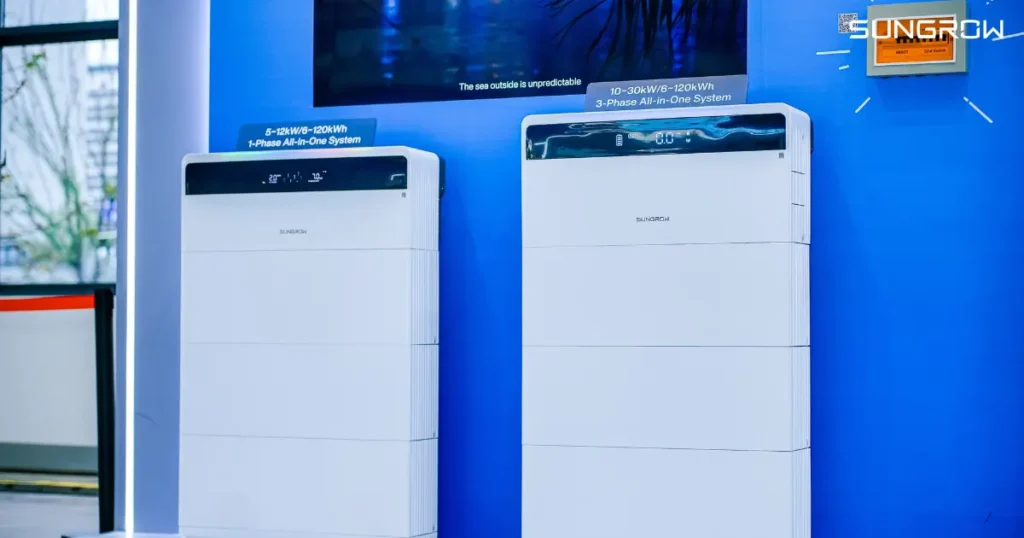
Sungrow also presented its low-voltage MG and MBL series for weak-grid and off-grid sites. These systems can integrate with diesel generators, an option that could interest some regional and remote customers.
The summit was a global showcase. For Australian households and businesses, the details I’ll be watching are local availability, approved configurations, and which features make it into the versions sold here.
Why MiniCube caught my attention
The residential product that caught my eye in Hefei was the MiniCube A Series. Sungrow showed it alongside balcony solar panels and pitched it as a plug-in battery. The range on display had power ratings from 800 W to 3.68 kW and battery capacities of 5, 6, or 10 kWh.
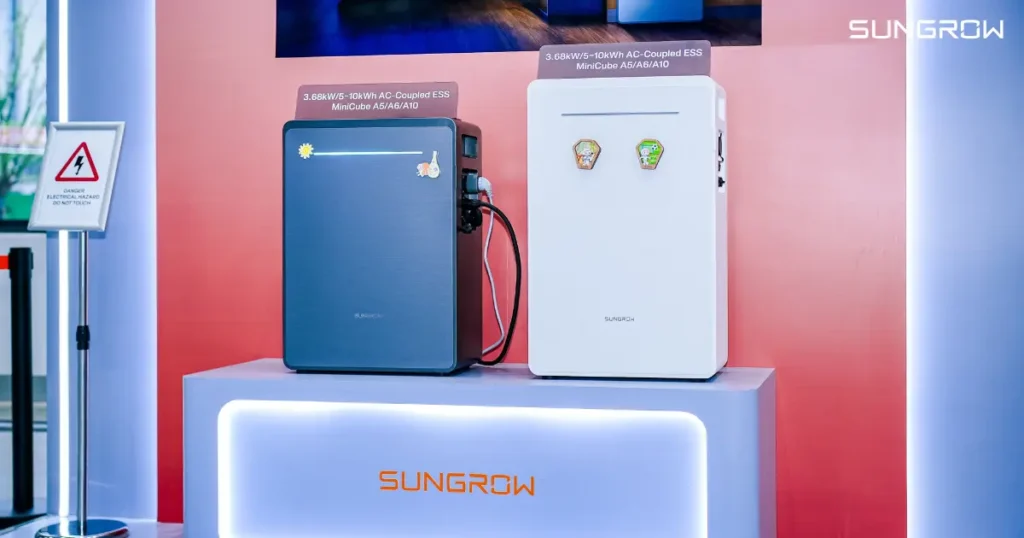
Sungrow highlighted 3.68 kW of AC output for the MiniCube A5 configuration. That figure tells you how much power the unit can supply at once. Sungrow also quoted 100% depth of discharge, showing 5 kWh of usable storage from the 5 kWh unit. Sungrow claims more than 11,000 cycles and identified the cells as lithium iron phosphate (LFP).
Plenty of Australian households already have solar panels and are weighing up how to add storage. What I’d like to know is which A Series models will become available here and how they would connect alongside existing rooftop solar - or even standalone and charge from the grid.
The Australian debate over plug-in solar and batteries
In Hefei, Sungrow informed us that it wants to stay neutral in Australia’s push to legalise plug-in solar and batteries. Its concern is that poorly made, low-cost products could enter the market and create safety problems. I can see why Sungrow is taking that seriously, especially if people are buying a system online and connecting it themselves.
Plug-in solar is already widely used in parts of Europe. Germany has seen widespread uptake and uses a simplified registration process for small plug-in solar systems. Western Australia is consulting on a pathway modelled on Germany’s technical standard, with additional provisions to allow battery storage.
As a renter, I can see the appeal. If you can’t put panels on the roof, a smaller system you can take with you when you move could open up an option you’ve never had. For me, the question is what it would take to make that option accessible and safe. I’d like to see clear testing and approval requirements, and a simple way for shoppers to tell which products meet them.
Sungrow’s Pulson solar panels had a few tricks of their own
MiniCube got me thinking about how we store solar energy. Sungrow’s Pulson Smart Modules had me thinking about what happens up on the roof. The L2 Series includes the SG-48TG4D-BX residential panel at 455 to 480 W and the larger SG-66TG4D-X at 630 to 655 W per panel.
What caught my eye in Hefei was the small Smart Control Box on the back of the panel. It lets you track each panel’s performance, log its data, and pinpoint faults. Sungrow showed how the system can automatically isolate a faulty panel while the rest of the array keeps generating.
The coating on the front was just as interesting. Sungrow says its nano-coating helps water spread across the glass and carry dirt away. The presentation also highlighted a self-cooling feature still in development.
The feature I’d most like to see in action is the fault detection. If output drops on a roof with hundreds of panels, knowing exactly where to look could save quite a bit of legwork.
Sungrow Power Club gives installers a seat at the table
Power Club was the other major launch. It’s a global installer membership program that brings together technical support, training, certification, networking, and points-based rewards. Sungrow also outlined its POWER⁵ strategy, which covers product design by application, marketing, partnerships, service, and the wider partner network.
The rewards might grab attention, but I’m more interested in what happens when an installer needs help on a job. Can they reach someone who understands the equipment? Can they get a fault diagnosed without another site visit? Sungrow also announced upgraded iSolarCloud tools and 24/7 AI-powered multilingual support. How that works alongside local technical support is something I’ll be looking out for in Australia.
What I saw on the factory floor
The media group saw Sungrow’s utility-scale and C&I production lines. After hearing about the products on stage, seeing the manufacturing operation gave me a better sense of the scale behind them. Every nut and bolt had its place, and every step had its own stringent standards and testing.
The residential production line remained behind the curtain for our group. I have it on good authority that the installers and retailers got a look. Yes, I’m envious.
Lasers, slow-flailing robots, and a chairman on sax
The laser show genuinely caught me off guard. Given the scale of everything else Sungrow had organised, I probably should have seen it coming.
The dancing robot, on the other hand, was somewhat underwhelming, but great for a chuckle. I’d pictured flips and a bit of attitude mixed with hip-hop. What I got was a lot of slow arm-flailing. I’m giving that round to the humans.
The Sungrow team can dance, they can sing, and even the chairman can play the electric saxophone. I sincerely hope Energy Matters doesn’t take this as an invitation to put my 'talents' to the test.
The gala dinner was a highlight in its own right. Between the food, the dancing, the company, and the Chinese liquor aptly named ‘Hot’, it was a fantastic night.
Sungrow packed plenty into the week away from the presentations, too. We made traditional fans, received personalised calligraphy, and tried our hand at ink calligraphy at the Anhui Art Museum. We also ventured into Ancient Anhui Town. I’m glad we had time to see some of Anhui beyond the summit venue and the factory.
What stayed with me after Hefei
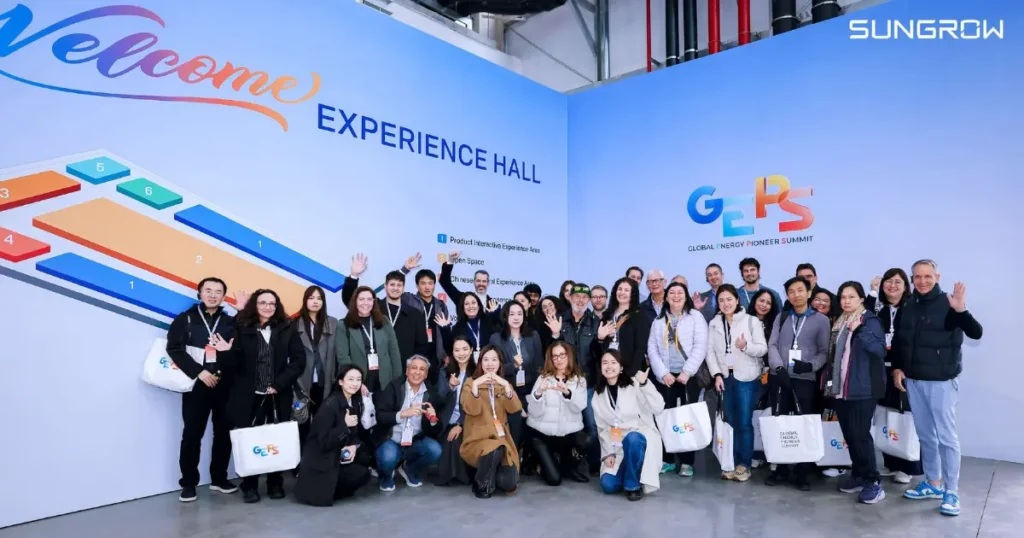
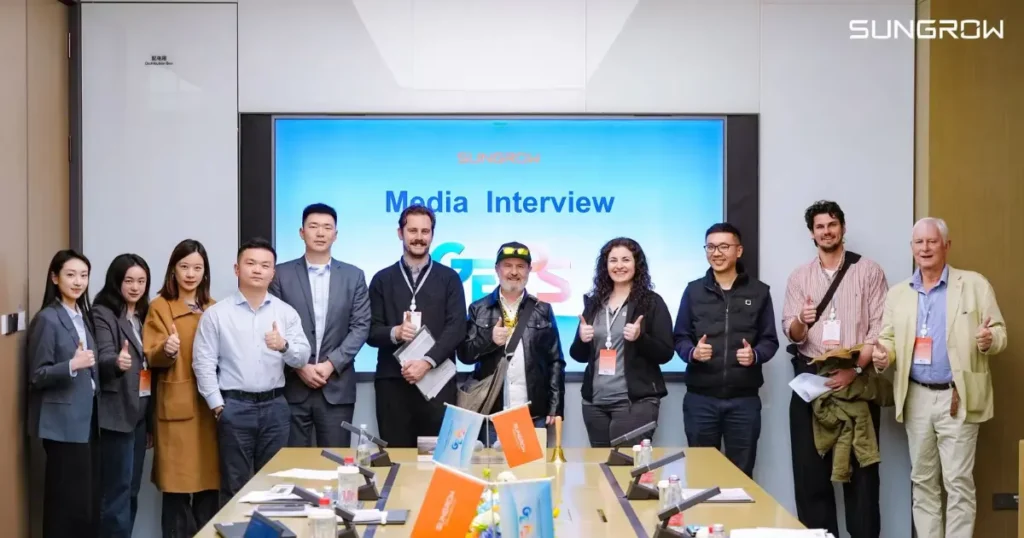
The people were the highlight. The Sungrow team I spent time with were warm, witty, and genuine. I made fast friends among the hosts and the other attendees. Some of the best conversations happened away from the stage, when there was time to get to know one another.
I also came home with a clearer picture of where Sungrow sits and where it wants to go. Across the launches, I kept coming back to the same practical questions. What role will plug-in storage and solar play in Australia? Is the all-in-one PowerHarbour too late to the game? Will Power Club achieve its goal of connecting the company to installers?
Those are the details I’ll be most interested in following as Sungrow brings its plans to Australia. The company put on a fantastic show in Hefei. I’m looking forward to seeing how the gear and the support hold up on the ground.
Thank you to the Sungrow team for a week of fun and insight! Definitely one I will cherish.
Oh, and I was very happy to be reunited with my deodorant, ahem, family.