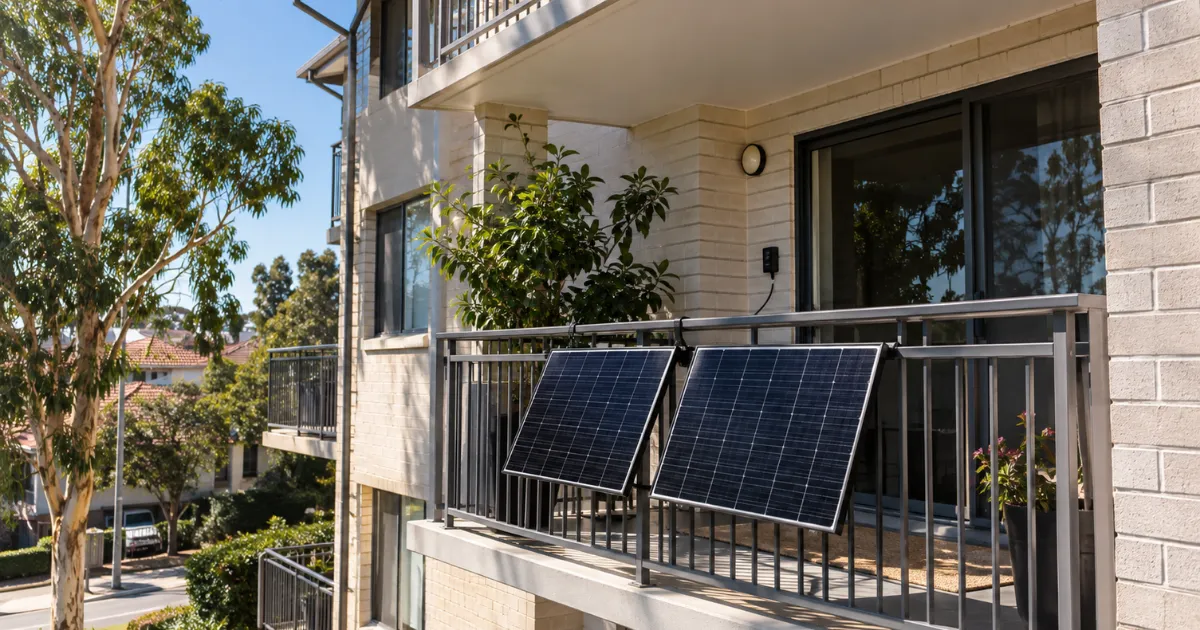
If you live in a WA apartment with a sunny balcony, you’ve probably had the thought already. Clip a couple of panels to the railing, plug them into the power point by the door, and let the sun run your fridge.
It’s a good idea. The catch, if you live in strata, is that the railing you’d clip them to may not actually be yours.
Western Australia is set to become the first state to legalise plug-in solar and batteries, and the WA Government estimates a north-facing system could take around $240 a year off the average Perth power bill, or about $500 with a battery. That’s real money, and the people who stand to gain most are the ones who’ve been locked out of rooftop solar for years: apartment owners and renters.
But between the balcony and the power point sit a strata plan, a set of by-laws and, quite possibly, a council of owners with opinions. Here’s how plug-in solar in WA strata is likely to play out, and what to do before the rules are locked in.
Quick summary
- WA’s draft rules would allow plug-in solar of up to 2 kW of panels and an 800 W inverter, but systems aren’t legal yet. Consultation closes on 9 December 2026.
- In strata, whether you need approval depends on whether the system sits on your lot or on common property, and on your scheme’s by-laws.
- Councils of owners can get ahead by reviewing their by-laws and having their say in the consultation.
What is WA proposing?
When national energy ministers agreed in September to explore a legal pathway for plug-in solar, state strata laws were quietly listed among the things that needed reviewing. WA hasn’t waited. It’s now consulting on a draft standard, and the government’s Balcony Solar FAQs spell out what it would allow:
- Solar panels of up to 2 kW, connected through an inverter of up to 800 W.
- Batteries with no capacity limit, as long as they connect on the solar side of the inverter (DC-coupled) and use safer chemistries such as lithium iron phosphate (LFP) or sodium.
- Plug-in installation into an existing power point, with an “install, then notify” process for your network operator.
Before anyone heads to the shops, there are a few catches. Plug-in systems aren’t legal yet, and using an imported kit is still against the rules. You won’t get paid for power you send to the grid either, because the whole idea is to use it yourself. And renters aren’t covered by this round of consultation, although the government says it’s working on that.
Expert tip
That cheap balcony kit in your online shopping cart? Leave it there. Only products certified to the final standard will be allowed, and the requirements could still change. Energy Matters’ guide on why you should wait for approved products explains what to look for.
Is your balcony part of your lot or common property?
Most owners assume their balcony is theirs. It’s attached to the unit, nobody else uses it, and they’re the one who sweeps it. But in strata, what counts as yours is decided by a document most people have never read.
Every WA strata scheme has a strata plan that draws the line between each lot and the common property. Balconies, balustrades, railings, external walls and courtyards can land on either side of that line, depending on how the scheme was set up. That’s why Landgate tells owners to work out what kind of scheme they’re in, and where their lot boundaries sit, before making any changes.
So the railing that seems perfect for two solar panels might be common property, owned by every owner in the building.
Expert tip
Ask your strata manager for a copy of the strata plan and registered by-laws, or order them from Landgate. Ten minutes with these two documents will tell you more than any amount of guessing.
What approvals might you need?
Here’s the honest answer: nobody knows exactly yet. The rules for plug-in solar in strata haven’t been written. But existing WA strata law gives a pretty good idea of where the hurdles are likely to be.
If the system sits within your lot
If the balcony is part of your lot and the panel simply stands on it, you may not need strata approval at all. Think of it like a barbecue or a pot plant. But your scheme’s by-laws can still have a say in what goes on a balcony, especially anything visible from the street. And if the job involves drilling, fixing or any other structural alteration to the lot, strata approval is generally needed, on top of any council approvals.
If it attaches to common property
This is where it gets more interesting. If the railing or wall is common property, clipping a panel to it is likely to need strata company approval. The good news is that this is easier than it used to be. Before WA’s 2020 strata reforms, one stubborn owner could block solar on a shared roof. Now a strata company can approve sustainability infrastructure, such as solar panels, on common property by ordinary resolution, a simple majority vote. Whether that process will suit a pair of panels on a balcony railing is one of the questions still to be answered.
Conduct by-laws
Even if no approval is needed, the usual by-laws on appearance, noise, safety and nuisance still apply. A panel that rattles in the wind or reflects glare into a neighbour’s living room is going to cause trouble, approved or not.
Expert reference
The WA Government says installing plug-in solar in an apartment will often be possible, subject to a strata company’s or owners’ rules, and that it’s working across government on changes to make access easier for people in strata.
Expert tip
Talk to your council of owners before you buy, not after. A one-page proposal with the product’s certification, how it mounts and where it’ll sit is much easier to say yes to than a panel that’s already on the railing.


What should councils of owners do now?
Now flip it around. You’re on the council of owners, and the email arrives: “Can I put solar panels on my balcony?”
The rules aren’t final, so you can’t give a definitive answer yet. But you can avoid being caught flat-footed by thinking through the questions that are bound to come up:
- Where can panels go? Can they be seen from the street? Are some balconies too exposed or too shaded to bother?
- How are they held on? The draft standard covers wind loading for mounts, and that matters a lot on the eighth floor. A panel falling from a balcony is a far bigger worry than any by-law breach.
- Where do batteries live? The draft limits batteries to safer chemistries and requires fire and abuse-safety testing. Even so, most councils will want them kept clear of exits, stairwells and common areas.
- Who needs to know? Owners will have to notify their network operator. It makes sense to ask them to tell the strata company too.
- What does the insurer think? A quick call to the building insurer now can save an awkward conversation later.
- Is the building on an embedded network? Many apartment blocks have a single grid connection and resell power to residents. The WA Government has flagged metering issues for embedded networks, so check how plug-in systems would work in yours.
Expert tip
Resist the urge to ban it outright. A blanket ban is the easiest by-law to write and the hardest to defend, especially once the final rules and any strata reforms land. Clear guidelines on placement and safety will serve the building better.
What about renters in strata?
If you rent, there’s an extra layer. You need permission from your landlord and, through them, potentially the strata company.
This is the group the reforms are meant to help most, but renter access isn’t part of the current consultation. The WA Government says it’s working across government on the changes needed. Until those land, renters should talk to their landlord or property manager before spending a cent, and expect the landlord to check the by-laws first.
Expert tip
Landlords, think about your answer now. A plug-in system is designed to be unplugged and packed up when the tenant moves out. It’s a much smaller ask than a permanent rooftop install, and a happy tenant on lower bills tends to stay longer.
Have your say before 9 December
Here’s the thing about consultations: the people who turn up shape the outcome. If strata owners and councils don’t speak up now, the rules will be written without them.
Submissions close at 5pm AWST on 9 December 2026, through the WA Government’s consultation page. From a strata point of view, the questions worth raising include:
- How should common property approvals work for small plug-in systems?
- What mounting standards are needed for balconies on multi-storey buildings?
- Should owners have to notify the strata company, as well as the network?
- How will plug-in systems work in buildings with embedded networks?
So if you’ve been eyeing your balcony, there’s no need to rush out and buy panels. But a look at your strata plan, a chat with your council of owners and a submission before 9 December could mean that, once plug-in solar is legal, your panels go up without a fight.
Stay ahead of plug-in solar
Plug-in solar isn’t legal yet, but the rules are moving fast. Get the latest updates, and compare quotes for rooftop solar and batteries if your building has room for a shared system.
Frequently asked questions
Can I install plug-in solar on my apartment balcony in WA?
Not yet. WA is consulting on a draft standard that would legalise certified plug-in solar and batteries, and the systems remain illegal until it’s finalised. Once they’re legal, apartment installs will often be possible, but they’ll be subject to your strata scheme’s by-laws and, if you rent, your landlord’s permission.
Do I need strata approval for plug-in solar?
It depends on where the system goes. A freestanding panel on a balcony that’s part of your lot may not need approval, although by-laws may still apply. Fixing a panel to a railing or wall that’s common property is likely to need strata company approval. Check your strata plan and by-laws first.
Can a strata company ban plug-in solar?
The final rules haven’t been set. Strata companies can make by-laws about the use and appearance of common property, and the WA Government says apartment installs will be subject to strata rules. It’s also working on changes to make access easier for people in strata, so any restrictions may need reviewing once those are known.
Will plug-in solar earn feed-in credits?
No. The WA Government says upgrading meters for export payments would likely cost households more than they’d earn, so it’s focusing on systems that power your own home. That makes plug-in solar best suited to running always-on appliances, such as a fridge and internet router, during the day.
How much could plug-in solar save in a WA apartment?
The WA Government estimates a north-facing plug-in system could save the average Perth household around $240 a year, or about $500 with a battery. Apartments with shaded or south-facing balconies, or limited space for panels, are likely to save less than these estimates.
Key takeaways
- WA plans to legalise plug-in solar of up to 2 kW of panels and an 800 W inverter, but systems aren’t legal yet.
- In strata, approval depends on whether the system sits on your lot or common property, and on your by-laws.
- WA’s 2020 strata reforms already let strata companies approve solar on common property by ordinary resolution.
- Councils of owners should start thinking about placement, mounting, battery safety and insurance now.
- Owners, councils and landlords can shape the rules through the consultation, which closes on 9 December 2026.
Sources
- Plug in to power up: Consultation on legalising plug-in solar and batteries (WA Government)
- FAQs: Balcony solar consultation (WA Government)
- Getting things done: Renovations in a strata titles scheme (Landgate)
- Solar for strata (City of Vincent)
- Strata Titles Act 1985 (WA Legislation)
- Thinking of buying plug-in solar? Why you should wait for approved products (Energy Matters)