





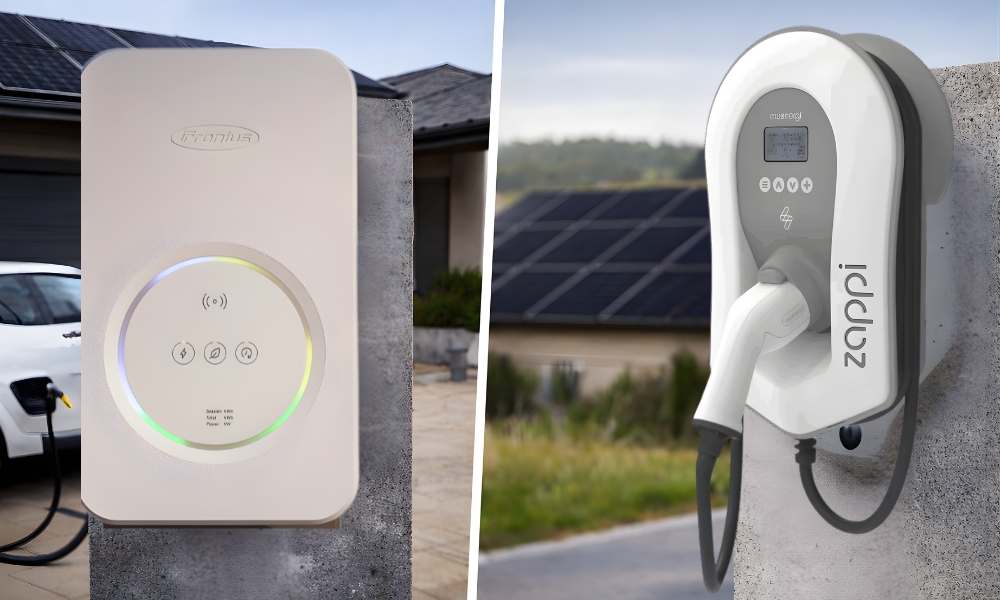
Choosing the right electric vehicle (EV) charger in Australia can feel like navigating a high-voltage maze. With solar energy adoption at an all-time high, most homeowners are looking for a “smart” solution. This brings us to the ultimate showdown: Zappi vs Fronius Wattpilot.
Both units are heavy hitters in the Australian market, designed to squeeze every drop of value from your rooftop solar. However, when comparing the myenergi Zappi V2.1 and the Fronius Wattpilot Flex, there are distinct differences in performance and integration.
Watch the Global Energy Revolution on Channel Nine with Energy Matters
Catch the Global Energy Revolution on Channel Nine, proudly presented by Energy Matters. Join our CEO, Roshan Ramnarain and co-host James Treble on Channel NINE (and streaming on 9Now) as we explore the disruptive technologies and visionary pioneers reshaping our world.
This inspiring TV series highlights the latest in solar energy, battery storage, electric vehicles, and smart energy solutions, transforming homes and businesses across Australia. Each episode features insights from solar experts, real-world installations, and practical advice to help homeowners and businesses lower energy costs and reduce their carbon footprint.
Watch the show. Join the revolution. Power your future with Energy Matters.
Understanding the contenders
To provide a fair comparison, we are looking at the latest iterations available in 2026. The myenergi Zappi V2.1 is the UK-born pioneer of solar-aware charging. It is famous for its independent “brain” that doesn’t always require a specific inverter to function.
On the other side, we have the Fronius Wattpilot Flex. Built with Austrian precision, this charger is the crown jewel of a Fronius solar system. It offers a sleek, compact design and some of the most advanced software logic seen in the industry today.
| Feature | myenergi Zappi V2.1 | Fronius Wattpilot Flex |
| Max power output | 7kW (1-Phase) / 22kW (3-Phase) | 7.36kW (1-Phase) / 22kW (3-Phase) |
| Solar integration | Universal (via CT Clamps) | Seamless (best with Fronius inverters) |
| Installation | Fixed wall unit | Plug-in or fixed |
| Warranty | 3 Years | 2 Years (extendable) |
| Ecosystem integration | Limited | Full Fronius system integration |
| Best for | Basic solar EV charging | Integrated solar smart homes |
Solar integration: The battle of excess energy
The main reason Australians search for Zappi vs Fronius Wattpilot is solar optimisation. Both chargers allow you to charge your car using 100% “free” energy from your roof. This reduces your reliance on the grid and slashes your carbon footprint. Use Energy Matters’ carbon footprint calculator to calculate your household and business’s direct emissions.
The Zappi V2.1 uses Current Transformer (CT) clamps to monitor your home’s energy flow. It detects when you are exporting power to the grid and diverts that energy into your car instead. This makes it a “universal” choice because it works with any solar inverter brand. Check our page for our recommended solar inverter products.
However, the Fronius Wattpilot Flex takes integration to a professional level. If you already have a Fronius inverter, the Wattpilot Flex communicates directly with it via the local network. This eliminates the need for complex extra wiring or third-party clamps in many scenarios.
Pro tip: For homeowners with a Fronius GEN24 Plus inverter, the Wattpilot Flex is the preferred option. It provides a “single pane of glass” view that lets you see your solar production, home usage, and EV charging all in one app.
Charging modes and smart features
When comparing these two, the software’s “intelligence” is often the deciding factor. A good Zappi EV charger review must mention its three iconic modes: Eco, Eco+, and Fast. Eco+ is the most popular because it only charges when there is surplus solar power.
The Fronius Wattpilot Flex counters this with its “Next Trip Mode” and “Eco Mode.” Next Trip Mode is a game-changer for busy Australians. You simply tell the app how many kilometres you need and by what time you are leaving.




Design and durability in Aussie conditions
Australia is a land of extremes, from scorching heat to coastal salt spray. Both units carry an IP65 rating, meaning they are dust-tight and protected against water. However, their physical designs differ significantly.
The Zappi V2.1 is a larger, more robust-looking unit. It comes in black or white and features a 6.5-metre tethered cable or an untethered socket. Its size is mainly due to the internal components required to handle various earthing systems without extra hardware.
The Fronius Wattpilot Flex is significantly more compact. Its minimalist design features a beautiful LED ring that changes colour based on the charging status. It looks more like a high-end tech gadget than a piece of electrical switchgear.
Because the Wattpilot Flex is smaller, it is often easier to install in tight garage spaces. It also features an anti-theft locking mechanism for the charging cable, providing peace of mind if your charger is installed in a carport.
The Wattpilot then calculates the cheapest way to get you there. It will use solar first, and if that isn’t enough, it will only draw from the grid during off-peak hours. This level of automated financial logic is why many experts consider it the smarter pick for 2026.
- Zappi V2.1: Great for manual control and visibility via its built-in LCD screen.
- Wattpilot Flex: Superior for “set and forget” automation and sleek aesthetics.
- RFID access: The Wattpilot includes RFID support as standard, allowing you to secure the charger or track usage for different drivers.
Installation and compatibility
Installation costs can vary significantly between Zappi and Fronius Wattpilot. The Zappi V2.1 is famous for its “PEN fault” protection. This is a technical way of saying it doesn’t require an expensive earth rod to be driven into the ground, which can save you money on labour.
The Fronius Wattpilot Flex is designed for simplicity. While it requires a Fronius Smart Meter to unlock its full solar potential, the commissioning process is incredibly fast. Most sparkies can have the Wattpilot up and running via the Solar.wattpilot app in minutes.
If you are building a new home or upgrading your solar, the Wattpilot is the preferred option. It fits perfectly into a broader energy management ecosystem. You can even pair it with a Fronius Ohmpilot to manage your hot water simultaneously!

Which one should you choose?
So, in the battle of Zappi vs Fronius Wattpilot, which one is the right fit for your Australian home? The answer depends on your current solar setup and your style preferences.
Who should choose Zappi?
Zappi remains a strong competitor. Many positive Zappi EV charger review results highlight reliability and solar compatibility. Zappi may suit you if:
- You want basic solar diversion
- You prefer a simple eco mode system
- You are not tied to a specific inverter brand
- Budget is your main priority
Who should choose Fronius Wattpilot Flex?
In almost every major performance category, Zappi vs. Fronius Wattpilot, the Wattpilot Flex leads. Choose Fronius Wattpilot Flex if:
- You want full solar integration
- You use a Fronius inverter
- You want dynamic load management
- You plan future energy upgrades
- You value smart tariff optimisation
While both brands are reputable, the Fronius Wattpilot Flex is often the preferred option for those seeking a premium, integrated experience. Check out our blog post on the Fronius Wattpilot Flex: Smarter, Solar‑Optimised EV Charging Arrives in Australia.
Power your EV the smart way with Energy Matters
Ready to choose between Zappi vs Fronius Wattpilot? Speak to the solar energy experts at Energy Matters today.
Get tailored advice, professional installation, and competitive pricing on solar and EV charging solutions.
- Contact Energy Matters now and future-proof your home energy system.
- Request a free quote and start saving with smarter solar EV charging.

Why buy through Energy Matters?
The best EV charger depends on your setup and goals. For tailored advice and seamless installation, trust Energy Matters to power your EV future.
Choosing the right EV charger is only half the decision. Professional installation and system design matter just as much. At Energy Matters, we help Australian homeowners:
- Compare EV chargers
- Integrate solar and EV charging
- Optimise energy savings
- Access expert installers
Explore our guides on solar EV charging and energy storage solutions to maximise your investment