




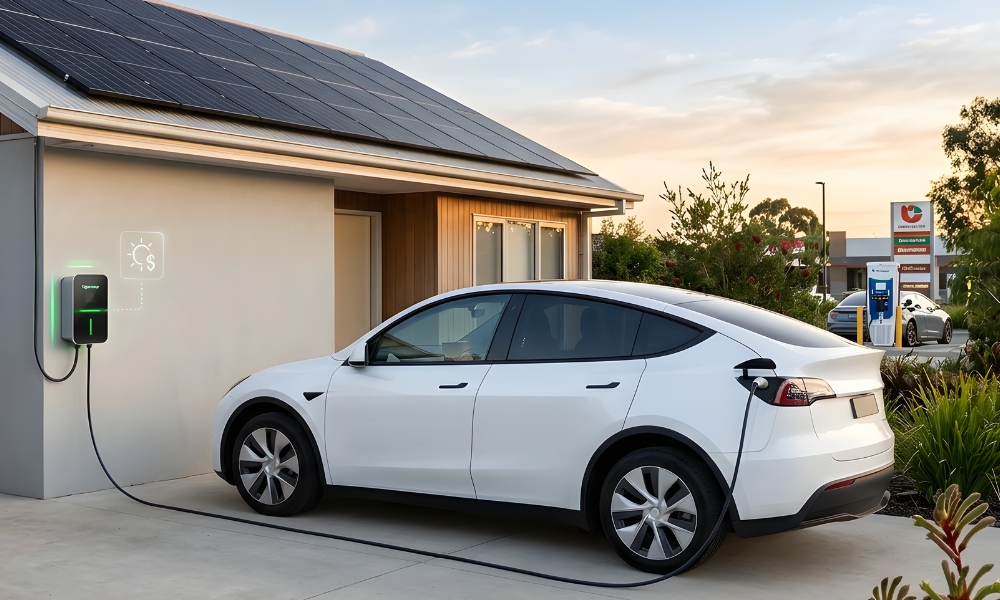
Making the switch to an electric vehicle is an exciting milestone for any Australian household. One of the first big decisions you will face is choosing between installing a home EV charger and relying on public electric car charging stations. While public infrastructure is growing fast, the long-term financial benefits of charging at home are hard to ignore.
Home EV charger vs Public charging: The cost gap
The primary difference between these two methods is the price per kilowatt-hour (kWh). Public fast chargers often charge a premium for the speed and convenience they provide. In contrast, charging at home allows you to take advantage of off-peak electricity rates or even free power from the sun.
Understanding public charging costs
Public networks like Chargefox, Evie, and Tesla Superchargers are essential for long trips. However, using them daily can get expensive quickly. Most ultra-rapid DC chargers in Australia now cost between $0.60 and $0.70 per kWh. While some providers, like Jolt, offer a small amount of free energy daily, the costs of a full battery top-up add up over time.
The value of home charging
Charging at home is significantly cheaper, especially with a dedicated EV plan. Many Australian energy retailers offer off-peak rates as low as $0.08-$0.15 per kWh. For a standard 60kWh battery, a full charge at home could cost under $10, compared to over $40 at a public station.



Evaluating the EV charger installation cost
Investing in a dedicated wallbox requires an upfront cost for EV charger installation. While a standard power point can work, it is extremely slow and not recommended for daily use. A professional Level 2 charger provides faster, safer, and more intelligent charging.
Typical installation prices in 2026
In Australia, the average cost of installing an EV charger ranges from $1,200 to $3,300. This includes the price of the hardware and the labour from a licensed electrician. Prices vary depending on your location and the complexity of your home’s wiring.
- NSW/VIC: Approximately $2,200 – $2,300.
- QLD: Approximately $2,350.
- ACT/SA: Often slightly lower, around $1,800 – $1,900 due to local incentives.
Why professional installation matters
A licensed installer ensures your home’s electrical switchboard can handle the added load. They also ensure the unit meets Australian safety standards (AS3000). Proper installation protects your car’s battery and your home’s electrical system.
Take control of your energy future! Get solar quotes from Energy Matters today for professional EV charger installation.
Maximising value with an EV charger solar setup
The smartest way to power your vehicle is with a solar EV charger system. By linking your charger to your rooftop solar panels, you can effectively “fuel” your car for free. This is the ultimate goal for sustainable transport in Australia.
How solar charging works
A smart EV charger solar unit monitors your home’s energy production. When your solar panels produce more electricity than your house needs, the charger diverts that excess energy into your car. Instead of sending power back to the grid for a low feed-in tariff, you use it to power your commute.
Ready to upgrade your solar systems and take your energy savings to the next level? Embrace the energy efficiency revolution by upgrading your solar systems and adding a battery or solar inverters with Energy Matters.
Long-term solar savings
Households using solar energy to charge their EVs can save an additional $1,000 per year compared to grid charging. Over the vehicle’s lifespan, these savings can completely offset the initial purchase price. It turns your home into a private green petrol station.
Finding the best home EV Charger for You
Not all chargers are created equal, and the best home EV charger for your neighbour might not be the best for you. You need to consider your vehicle type, your home’s power supply (single-phase vs. three-phase), and whether you want smart features. Check our page for our recommended EV charger products.
Key features to look for
- Solar integration: Does it talk to your solar inverter?
- App control: Can you schedule charging for off-peak times?
- Weather resistance: Is it rated for outdoor installation in the Australian sun?
- Tethered vs. Untethered: Do you want a built-in cable or a socket?

Convenience: Home vs Public
Convenience is subjective, but for most, nothing beats waking up to a full battery every morning. Public charging requires you to plan your day around a station’s location and availability. Sometimes, you might even have to wait in a queue.
The “Fill while you sleep” advantage
With a home unit, plugging in takes ten seconds. Your car charges while you sleep, eat, or spend time with family. This eliminates “range anxiety” because you start every day with maximum range.
When public stations are better
Public stations are unbeatable for long-distance travel. Ultra-rapid DC chargers can add 300km of range in just 15 to 30 minutes. They are also vital for apartment dwellers who may not have access to private parking with power.
Future-proofing your Australian home
As Australia moves toward a renewable future, having an electric car charging station at home increases property value. More homebuyers are looking for “EV-ready” properties. Installing a charger now is a smart move for your lifestyle and your home’s equity.
Smart charging and the grid
Modern chargers are “grid-smart.” This means they can help balance the Australian energy grid by charging when demand is low. Some newer models are even V2G (Vehicle-to-Grid) ready, meaning your car could one day power your home during a blackout.
Ongoing maintenance
Unlike petrol pumps, home EV chargers require very little maintenance. Keeping the unit clean and checking the cable for wear is usually all that is needed. Choosing a reputable brand ensures you have access to local support if a software update is required.

Home EV charger vs Public charging in Australia: Final verdict
When comparing home EV charger vs public charging in Australia, the winner is clear for most drivers. A home EV charger delivers the best value for everyday use.
Choose a home EV charger if you want:
- Lower long-term costs
- Maximum convenience
- Solar savings (EV charger solar)
- Daily charging reliability
Use public charging if you need:
- Long-distance flexibility
- Occasional top-ups
- No installation option
Investing in a home EV charger is the most cost-effective way to run an electric vehicle in Australia. While the EV charger installation cost is an upfront expense, the long-term savings from off-peak rates and solar integration with the EV charger are substantial.
Public charging remains a vital tool for travel, but for daily life, the best home EV charger offers unmatched freedom. Start your journey toward energy independence today by choosing a setup that fits your home and driving habits.
Powering up your EV with solar
If you’re thinking of buying an EV, adding an EV charger to your solar system is a smart way to “fuel” your car with clean, renewable energy.