





Extreme summer temperatures across Australia regularly push the National Electricity Market to its limits, causing sudden power spikes and unexpected grid blackouts. Preparing your home with robust heatwave solar battery storage in Australia helps ensure uninterrupted cooling, protects against severe price spikes, and provides total peace of mind when extreme weather hits.
Energy Matters’ solar battery systems guide provides a useful starting point for understanding how storage can increase self-consumption and improve household resilience.
Quick answer
- Solar can be a major advantage during a heatwave because rooftop generation often peaks when air conditioners and other cooling appliances are working hardest.
- A home battery extends that advantage into the evening by storing excess daytime solar for cooling, refrigeration, lighting, and other essential loads after sunset.
- For genuine blackout protection, homeowners need a battery system specifically configured for backup, an appropriate backup gateway or islanding capability, and a system designed around essential household loads.
What is a heatwave solar battery strategy and why should Australian homeowners care?
A heatwave solar battery strategy is not simply about installing more panels or buying the biggest battery available. It means designing the home’s energy system around the way electricity is consumed during extreme heat.
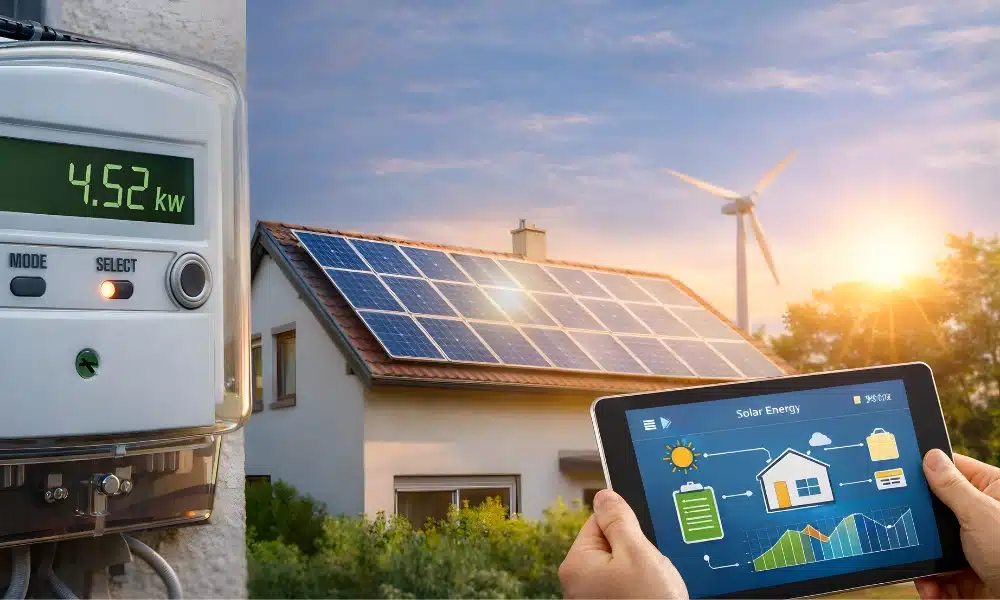
That usually means producing electricity with rooftop solar during the day, using some of it immediately for cooling and appliances, storing surplus energy in a battery, then using the stored energy later when solar production falls.
The key facts
A heatwave solar battery Australia configuration integrates high-efficiency photovoltaic panels with home battery storage to deliver continuous domestic power. This setup actively captures abundant summer sunlight to run household appliances while charging local energy storage reserves.
When ambient temperatures soar above 40 degrees Celsius, standard electricity grids experience extreme operational stress. Dedicated battery backup during a heatwave keeps your climate control systems fully functional even if regional infrastructure fails.


Use Energy Matters’ easy-to-use solar power and solar battery storage system calculator to determine the right size for your solar system with storage. Our solar calculator will generate performance information and potential savings.
We can send this information to 3 pre-vetted, trusted local installers in your area so they can provide obligation-free solar quotes and help you take the first step toward true energy independence!

Why this matters right now in Australia
Australia’s energy landscape is shifting rapidly as global temperatures break historical records. Recent ABC News reporting highlights that summer demand peaks consistently threaten grid stability across Eastern states.
According to data published by the Australian Energy Market Operator (AEMO), residential air conditioning accounts for over 70 per cent of peak demand during severe heat events. Without localised storage, households rely entirely on an increasingly strained grid.
Expert insight: A resilient home energy system needs to consider both sides of the heatwave curve: abundant daytime solar generation and potentially heavy evening demand. For households assessing heatwave solar battery Australia options, the objective should be resilience first, followed by energy savings.
From Energy Matters’ perspective, based on its long-standing focus on Australian residential solar and storage, homeowners should design around how their household actually uses electricity rather than selecting equipment based solely on headline system size.
How heatwave solar and battery systems work in Australia
The basic concept is simple, although the technology behind it is increasingly sophisticated.
Solar panels convert sunlight into DC electricity. An inverter converts that electricity into AC power that household appliances can use.
When solar production exceeds household demand, the surplus can either be exported to the grid or directed into a battery.
After sunset, the battery can discharge stored electricity to the home. Depending on the system configuration, it can also provide backup power during a grid outage.
Technical explanation
Think of solar panels as the home’s daytime electricity generator and the battery as an energy reservoir. During a hot summer afternoon:
- Solar panels generate electricity.
- Air conditioning uses some of that electricity immediately.
- Other appliances consume more solar power.
- Excess electricity charges the battery.
- The battery reaches its programmed state of charge.
- After sunset, the system discharges stored energy.
- The home buys less electricity from the grid.
The battery’s capacity, measured in kWh, determines how much energy it can store. Its power output, measured in kW, determines how much electricity it can deliver at one time. That distinction is important.
A battery with plenty of capacity may still struggle to run multiple high-powered appliances simultaneously if its inverter cannot supply sufficient instantaneous power.
Solar air conditioning during a heatwave
Air conditioning is often the largest controllable electricity load in a hot Australian home.
Running a high-efficiency reverse-cycle air conditioner while solar generation is strong can make practical sense because the household uses electricity when it is generated.
Energy Matters’ guide to reverse-cycle air conditioning can help homeowners compare cooling technologies and efficiency considerations.
The most effective approach is usually not to turn the air conditioner on at maximum output only once the house becomes extremely hot. Pre-cooling parts of the home earlier, closing blinds and curtains, reducing heat entering through windows and using fans to circulate cooled air can reduce the workload.
Expert insight: Solar is particularly valuable when it directly powers cooling. A battery becomes more valuable when the home still needs substantial cooling after solar production declines.
Australian examples and data
The national picture is changing quickly.
The Clean Energy Council reported that more than 180,878 rooftop solar systems were installed in the first half of 2026, a 35% increase from the same period in 2025.
Battery uptake has also accelerated. More than 183,000 battery units were sold in the second half of 2025 alone, bringing household battery installations to more than 450,000 by the end of that year.
The federal Cheaper Home Batteries Program, introduced on 1 July 2025, has helped accelerate this trend by providing around a 30% discount on eligible small-scale battery systems.
What does this mean for your electricity bills?
A heatwave can create an uncomfortable combination: households need more electricity precisely when demand across the wider system is also increasing.
Solar and batteries can change the timing of that consumption.
Short-term impact
Without solar, a household may buy large amounts of electricity from the grid during a heatwave.
With solar, much of the daytime cooling load can potentially be supplied directly from rooftop generation.
With solar plus a battery, households can store excess daytime electricity for later use.
| Household setup | Daytime heatwave | Evening heatwave | Blackout capability |
| Grid electricity only | Buys electricity from grid | Buys electricity from grid | Usually no power |
| Solar only | Solar can supply cooling | Grid generally supplies demand | Usually no power |
| Solar + battery | Solar supplies loads and charges battery | Battery can reduce grid use | Possible if backup is configured |
| Solar + islandable battery | Solar supplies loads and charges battery | Battery supplies stored energy | Can continue operating when designed correctly |
The financial outcome depends on electricity tariffs, solar generation, battery size, household consumption and export arrangements.
A battery is not automatically the cheapest option for every household. The Australian Government notes that the financial case depends on factors including electricity consumption patterns, electricity prices, solar-system size and battery cost.
Long-term implications
A properly designed system can increase solar self-consumption and reduce reliance on grid electricity.
It can also provide an additional form of household resilience, particularly where power interruptions occur during storms, bushfires, heatwaves or infrastructure failures.
However, homeowners should not assume that every battery provides whole-home backup.
The Australian Government explains that some battery systems only supply selected essential circuits, while others can be configured to operate an islanded home during a grid outage.
Expert insight: Ask an installer to show exactly which circuits remain powered during an outage. “Battery backup” should never be treated as synonymous with “the whole house stays on.
Reduce your home carbon footprint with solar
Using rooftop solar for cooling can reduce the electricity you buy from the grid during sunny periods.
For homeowners considering a broader electrification strategy, solar can also work alongside heat-pump hot water, EV charging and other electric appliances.
Embrace the energy-efficiency revolution by upgrading your solar system with Energy Matters, adding a battery, solar inverters, and more.
Energy Matters recommends switching to energy-efficient appliances now for smarter savings and a more environmentally friendly lifestyle.
Powering up your EV with solar
If you’re thinking of buying an EV, adding an EV charger to your solar system is a smart way to “fuel” your car with clean, renewable energy.
What Australian homeowners can do right now?
The best time to discover a battery system’s limitations is before the heatwave, not during a blackout.
Actionable steps
1. Check your solar monitoring
Look at your system on a clear day. Confirm that solar generation rises in the morning, peaks around midday, and declines in the afternoon. Unexpectedly low production can indicate shading, equipment faults or other issues.
2. Check your battery’s state of charge
If you already have a battery, learn how its operating modes work. Some systems have settings designed around self-consumption, time-of-use tariffs, backup reserve or participation in a virtual power plant.
3. Set a sensible backup reserve
If severe weather is forecast, consider whether your system allows a larger backup reserve. A battery at a high state of charge provides more energy during an outage than one deliberately emptied beforehand.
4. Identify essential loads
Decide what actually needs electricity during a blackout. Typical priorities may include:
- Refrigerator and freezer
- Essential lighting
- Internet equipment
- Medical equipment
- Security systems
- Garage doors
- Water pumps
- Selected air-conditioning circuits
5. Reduce heat entering the house
Solar is not a substitute for good building design. Use:
- External shading where practical
- Curtains and blinds
- Ceiling insulation
- Draught reduction
- Efficient glazing
- Ceiling fans
- Strategic ventilation when outdoor conditions allow
6. Pre-cool strategically
On a very hot day, use solar-generated electricity to cool occupied rooms before the hottest period.
Avoid unnecessarily cooling unused areas if your system is operating under constrained energy conditions.
7. Protect your battery and inverter from extreme heat
Installation location matters. The Australian Government warns that extreme heat can shorten inverter life and says an inverter exposed to direct sunlight may need shading. Batteries also have strict installation requirements, including location and separation requirements. Never build a makeshift enclosure around a battery without following the manufacturer’s requirements.
8. Keep vegetation and obstructions away from equipment
Do not allow plants, stored materials or other objects to obstruct ventilation or equipment access.
9. Check warranties
Extreme weather can expose weaknesses in system design and installation. Know who is responsible for the solar panels, inverter, battery, installation workmanship and monitoring system.

Questions to ask your installer or retailer
- Can my battery provide blackout backup?
- Which circuits will remain powered?
- Can solar continue charging the battery during an outage?
- What happens if the battery reaches zero?
- What is the battery’s continuous power output?
- What is the usable capacity?
- Where will the battery and inverter be installed?
- How does the system handle extreme heat?
- What backup reserve can I set?
- Can the system participate in Virtual Power Plants (VPPs) in Australia?
- Which battery models are on the Clean Energy Council approved products list?
- Is the installer accredited by Solar Accreditation Australia?
- What are the product and workmanship warranties?
One important terminology update for 2026: Solar Accreditation Australia (SAA) now administers installer accreditation, not the Clean Energy Council. The CEC still maintains approved product lists and consumer programs.
Expert insight: A credible quote should explain the system’s resilience function, not simply list panel wattage, inverter capacity and battery kWh.
State-by-State Considerations
- Victoria (VIC): Victorian households face rapid weather shifts and sudden summer heat spikes that strain transmission networks. Solar Victoria provides rebates and interest-free loans for eligible solar and battery storage installations to improve local resilience.
- New South Wales (NSW): NSW experiences intense inland heatwaves that create record operational demand across Sydney and regional centres. The NSW Peak Demand Reduction Scheme offers incentives for households installing smart batteries that support grid stability.
- Queensland (QLD): Queensland receives exceptional solar irradiance, making rooftop generation highly effective for summer cooling. High humidity means air conditioners run longer, making stay-cool solar systems financially advantageous.
- South Australia (SA): South Australia leads the nation in renewable energy penetration but also experiences extreme summer heat. SA homeowners benefit significantly from Virtual Power Plant participation, earning rewards while securing reliable heatwave energy management.
- Western Australia (WA): Perth regularly contends with extended heatwaves and strict grid management requirements like Emergency Solar Management. Homeowners in WA increasingly turn to battery storage to retain full control over their self-generated solar electricity.
Expert predictions for 2027 and beyond
The Australian Renewable Energy Agency (ARENA) forecasts rapid acceleration in distributed energy storage deployments through 2027. Emerging battery chemistries will offer expanded thermal tolerances, making them even more resilient against severe Australian heatwaves.
Integrated smart home energy management systems will automatically coordinate cooling cycles based on real-time weather predictions and wholesale energy pricing. Homeowners who deploy advanced solar and battery systems today will enjoy superior grid independence and financial security tomorrow.
Expert insight: The future solar-plus-battery home is less about generating the maximum possible electricity and more about intelligently coordinating generation, storage, appliances, and household demand.
Reduce your home carbon footprint with solar
For Australian homeowners, heatwave preparation doesn’t have to mean simply buying more electrical equipment.
Improving insulation, shading windows, selecting efficient cooling, shifting flexible loads into solar hours and adding appropriately sized battery storage can work together. Use Energy Matters’ carbon footprint calculator to estimate your household and business’s direct emissions.

Frequently asked questions
Can solar panels keep my house running during a blackout?
Usually not on their own. Standard grid-connected solar systems automatically shut down during a grid outage for safety. A battery system with appropriate backup or islanding capability is required if you want solar generation to continue supplying the home during a blackout.
Is a battery worth having during a heatwave?
A battery can be valuable during a heatwave because it stores surplus daytime solar for use after sunset, when air conditioning may still be operating. Whether it makes financial sense depends on your electricity use, tariffs, solar production, battery cost, backup requirements and available incentives.
Can I run air conditioning from a solar battery?
Yes, as long as the battery and inverter have enough power output and usable capacity. Large air-conditioning systems can create substantial loads, so ask your installer whether your battery can start and continuously operate the specific cooling equipment you want backed up.
How big should my battery be for a heatwave?
There is no universal battery size. Start with your household’s electricity consumption, solar generation and essential backup loads. A system designed primarily for evening bill savings may need less storage than one intended to operate refrigeration, lighting, internet, medical equipment and selected cooling circuits through a prolonged outage.
Does extreme heat damage solar batteries?
High temperatures can affect battery and inverter performance and longevity, but compliant systems include operating limits and protection systems. Installation location is important. Follow the manufacturer’s requirements, and have an appropriately accredited professional inspect the system if monitoring shows abnormal temperatures or faults.
Key takeaways
- Solar can be particularly valuable during heatwaves because daytime generation can coincide with high air-conditioning demand.
- Battery storage extends solar’s usefulness into the evening, when cooling loads can remain high after the sun goes down.
- Not every battery provides blackout protection, so confirm backup and islanding capability before purchasing.
- Heat management matters, including battery and inverter placement, shading, insulation, efficient cooling and sensible load management.
- Government incentives differ by state, and the federal Cheaper Home Batteries Program remains an important consideration in 2026.
Get a free solar + battery quote from accredited Australian installers
Australia’s increasingly hot summers are changing the way homeowners need to think about electricity. A well-designed solar and battery system can help a household produce power during the hottest part of the day, store surplus energy and maintain greater control over electricity use after sunset.
The most resilient approach combines solar generation, appropriately sized storage, efficient cooling, sensible household energy management and genuine backup capability. Prepare your home for the next extreme heat event: explore solar and battery options with Energy Matters and compare systems designed around your household’s real needs.
Get a tailored assessment of your home’s solar, battery and energy requirements through Energy Matters’ network of Australian installers.