




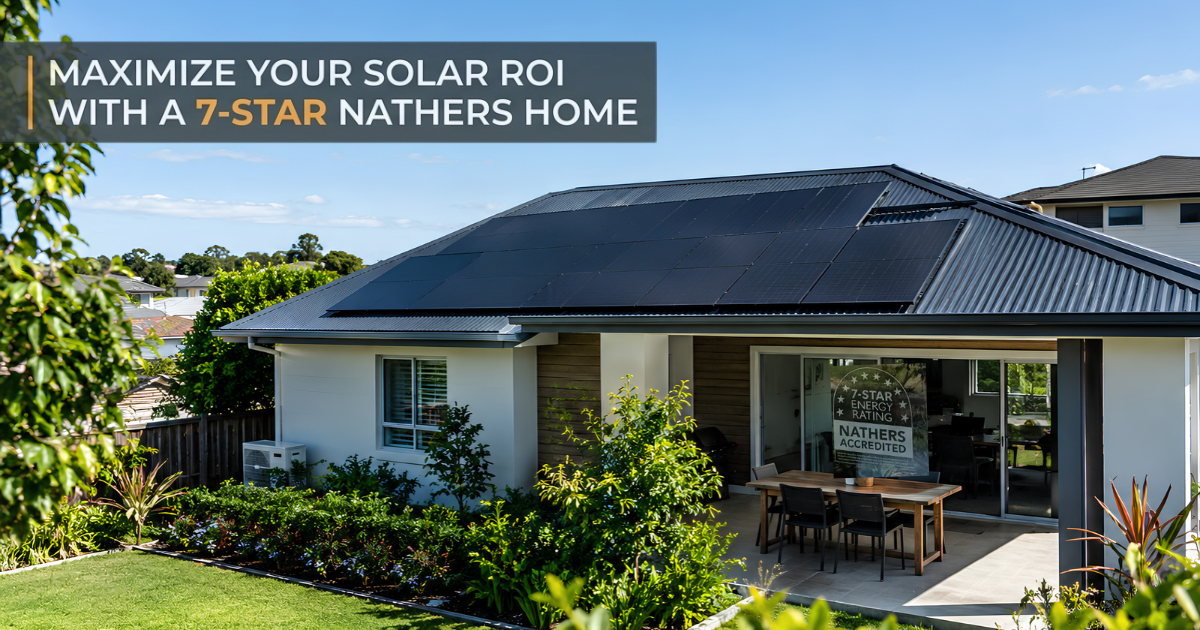
Australia’s rooftop solar boom is changing how households think about energy efficiency, but panels alone cannot solve every high electricity bill. Your home’s design matters, too. According to the ABC, around 70% of Australian homes were built before today’s minimum energy efficiency standards, and older homes average below three stars.
Understanding the relationship between Nathan’s Solar rating Australia and solar return on investment (ROI) can help homeowners decide where to spend their money first. A well-insulated home with effective shading and an appropriately sized solar system can reduce energy costs without oversized equipment. Explore home solar systems from Energy Matters to see how renewable energy can fit into a broader home efficiency strategy.
Ready to see a right-sized system for your home? Compare free solar quotes from SAA-accredited installers through Energy Matters today.
Quick answer
- NatHERS and solar work together. A home’s Nationwide House Energy Rating Scheme (NatHERS) rating measures thermal performance, which influences heating and cooling needs and how much electricity a solar system can offset.
- A 7-star home can improve the value of solar. Better insulation, suitable glazing, shading and ventilation can reduce energy demand, potentially allowing a smaller solar system or battery to meet household needs.
- The best solar ROI comes from matching the whole home. Before investing in solar panels or a battery, assess your NatHERS energy rating, electricity consumption, roof orientation, solar generation, and appliance use.





What is NatHERS and why should Australian homeowners care?
The key facts
Your NatHERS solar rating in Australia has two parts: a thermal star rating for the building and the solar system that supplies its energy. The Nationwide House Energy Rating Scheme (NatHERS) scores a home from 0 to 10 stars; a higher score means it needs less energy to stay comfortable. Your NatHERS energy rating reflects insulation, windows, shading and orientation, tested against one of 69 climate zones.
A few facts worth knowing:
- Seven stars is the new baseline. In most locations, a 7-star home needs 20-25% less heating and cooling energy than a 6-star home.
- Stars are not a bill forecast. They measure the shell per square metre, so a large 8-star home can still use plenty of power.
- Whole-of-home is new. NCC 2022 added an annual energy budget covering appliances and rooftop solar.
- The gap is huge. UTS research (July 2026) found a 2-star home typically needs four to six times the energy of a 7-star home.
Expert insight: Treat your star rating and solar as one project. Efficiency lowers the kilowatt-hours you need, and solar covers the rest. Doing them in the wrong order is how households end up with oversized systems.
Why this matters right now in Australia
Solar adoption is already substantial. The Clean Energy Council reported that Australian rooftop solar capacity reached 28.3 GW by the end of 2025, with rooftop solar supplying 14.2% of electricity generated nationally in the second half of that year.
For homeowners, the next opportunity is to combine generation with lower energy demand. The Guardian reported in September 2025 that Treasury modelling suggested households could save up to $4,300 annually by combining solar panels, batteries, and electric vehicles, although actual savings depend on household circumstances.
A better NatHERS solar rating strategy in Australia considers both sides of the equation. Generating electricity is valuable, but avoiding unnecessary heating and cooling can reduce the amount you need to buy or produce in the first place.
How NatHERS and solar work together: the current state in Australia
To understand the link between building performance and renewable energy, we need to look at how thermal ratings interact with solar power generation.
Technical explanation: How a NatHERS star rating changes solar sizing
Think of your home as a bucket. The star rating tells you how leaky it is, and solar is the tap that refills it. A tighter bucket needs less refilling. A NatHERS star rating solar plan therefore works in three ways:
- Total demand. Lower heating and cooling loads mean fewer kilowatt-hours to offset, so the same panels cover a bigger share of your bill.
- Timing. Heating peaks on winter mornings and evenings, and cooling peaks on summer afternoons and evenings. An efficient shell flattens those peaks, so a battery can often cover them with fewer kilowatt-hours.
- Sizing. Sizing to your old bills can overshoot after an upgrade, sending more power to the grid at low feed-in rates.
- For new builds, the code treats solar as an offset to the Whole of Home energy budget, not as a way to lift the thermal star rating. Queensland once allowed a star credit for solar, but the Whole of Home requirement ended that approach.
Do not confuse this with Green Star, a separate voluntary sustainability rating from the Green Building Council of Australia. A Green Star home solar project can use both, but they measure different things.
Australian examples and data: 7-star home solar versus older homes
The gap bites hardest in older homes. CSIRO puts the average pre-2003 home at around 1.8 stars. In NSW, UTS found older owner-occupied homes average 2.1 stars, while older private rentals average just 1.6.
Here is how the bands tend to play out for solar ROI:
| Star band | Typical home | Heating and cooling demand | What it means for solar ROI |
| 1 to 2 stars | Pre-2003 homes, average about 1.8 stars | Very high (4 to 6 times a 7-star home) | Biggest savings, but fix the shell first |
| 3 to 4 stars | Many established houses (about 70% below 4 stars) | High | Solar still pays well. Add insulation in parallel |
| 5 to 6 stars | Homes built under the former 6-star minimum | Moderate | Right-size and consider a battery |
| 7+ stars | New homes under NCC 2022 | Low (20 to 25% less than 6 stars) | Smaller system can suffice. Battery adds most |
Illustrative guide only. Results vary with climate zone, home size and household usage.
Expert insight: As national home energy rating solar settings reach existing homes, expect installers to ask about insulation and appliances before quoting. That is a good sign.
What does this mean for your electricity bills?
In a low-star home, bright summer sunshine rapidly heats the building interior. Your air conditioner runs continuously at full capacity. Even with a 6.6kW solar array, much of your generated power goes toward running high-draw cooling systems rather than offsetting baseline household appliances.
In contrast, a high-rated home stays cool much longer. You can redirect daytime solar power to run pool pumps, dishwashers, or charge an electric vehicle.
Long-term implications
Over a 10-year period, the financial divergence between poorly rated and highly rated solar homes becomes dramatic:
- Lower system strain: Reduced peak appliance loads mean inverter components operate cooler, extending equipment life.
- Higher battery efficiency: With lower thermal demands, a standard 10kWh home battery can easily power your night-time needs, reducing reliance on the grid at peak times.
- Optimised capital outlay: You avoid buying oversized heating and cooling units, saving thousands on upfront building and renovation costs.
To get a clearer picture of your energy-performance options, review dedicated energy-efficiency guidance to align building-envelope improvements with renewable systems.
Expert insight: A 7-star home solar system can need fewer panels than an older home. Right-size first, then decide whether a battery should move midday power into the evening.
Plan your solar investment
Get independent solar quotes to compare system sizes, equipment, and expected savings before you commit. Get free solar quotes from Energy Matters.
What Australian homeowners can do right now
Actionable steps
- Find your rating. New homes have a NatHERS certificate from the builder. For established homes, book an accredited assessor.
- Fix the shell first. Ceiling insulation, draught sealing, shading and better glazing cut load cheaply. See our energy efficiency guides.
- Electrify smartly. A heat pump hot water system or a solar hot water system can shift a big load into sunny hours.
- Size solar to your post-upgrade usage, not last year’s bills. Choose quality solar panels with strong warranties.
- Add a battery if evenings cost you most. Check that it qualifies for the Cheaper Home Batteries Program.
- Compare quotes. Request solar quotes from SAA-accredited installers and ask about the usage assumptions behind each.
Use Energy Matters’ easy-to-use solar power and solar battery storage system calculator to determine the right size for your solar system with storage. Our solar calculator will generate performance information and potential savings.
We can send this information to 3 pre-vetted, trusted local installers in your area so they can provide obligation-free solar quotes and help you take the first step toward true energy independence!

Questions to ask your installer or retailer
Before accepting a quote, ask:
- Has the installer sized the proposed solar system based on my actual electricity consumption?
- How would insulation or shading improvements change my expected energy demand?
- What proportion of my solar generation is expected to be used onsite?
- Are the estimated savings based on realistic electricity tariffs and feed-in rates?
- Would a battery improve my financial return, or mainly provide backup and energy independence?
- Which rebates or incentives apply to my property, and are they confirmed?
- What monitoring, warranties and maintenance costs should I expect?
Ask for the assumptions behind the financial estimates in writing. A credible proposal should distinguish estimated generation, self-consumption, exports and projected bill savings.
State-by-state considerations
All five states now require seven-star thermal performance for new homes, but start dates and incentives differ.
| State | 7-star start | What to know for solar |
| New South Wales (NSW) | 1 October 2023 (BASIX) | Voluntary rating disclosure began mid-2026. Battery support mainly comes from the Peak Demand Reduction Scheme VPP incentive, up to about $1,500. |
| Victoria (VIC) | 1 May 2024 | Solar Victoria’s panel rebate is up to $1,400 (eligibility applies). The state battery rebate has closed. |
| Queensland (QLD) | 1 May 2024 | The government replaced the old Solar Star Credit with a Whole-of-Home rebate. Battery Booster has closed, but landlords can claim $2,500 to $3,500 for rental solar. |
| South Australia | 1 October 2024 | The federal battery discount applies. Eligible Housing Trust tenants can access a no-cost battery program. |
| Western Australia | 1 May 2025 | Residential Battery Scheme stacks with the federal discount: up to $1,300 (Synergy) or $3,800 (Horizon Power), VPP required. |
Expert insight: State schemes close and reopen fast, and older guides often list rebates that no longer exist. Confirm the current offer before signing.
Expert predictions for 2027 and beyond
Three developments are likely to make whole-home energy performance more important over the coming years.
1. Greater attention to existing homes
NatHERS is expanding beyond new-home assessments through the broader Home Energy Rating initiative. Better information about existing properties could help homeowners compare upgrade options, understand energy performance and make more informed purchasing decisions.
2. More integrated solar and electrification planning
As households adopt batteries, heat pumps, induction cooking and electric vehicles, their electricity consumption patterns will change. Solar design will increasingly need to consider when electricity is consumed, not just how much is used over a year.
Energy Matters recommends treating these technologies as a connected system. For example, a solar hot water system or an efficient heat pump may help shift energy demand and reduce reliance on conventional energy sources.
3. Smarter household energy management
Smart inverters, energy monitoring, battery controls and time-of-use tariffs can help households use electricity when it is cheapest or when solar generation is plentiful. The financial outcome depends on the equipment, tariff structure, export limits, and household behaviour.
For drivers planning to electrify transport, home EV chargers are another consideration. Charging an EV during solar production can increase self-consumption, provided the vehicle is home at suitable times.
These developments are opportunities, not guarantees. Future policies, electricity prices and technology costs will influence actual returns.

Frequently asked questions
1. Does a higher NatHERS rating improve solar ROI?
It can. A higher thermal star rating generally indicates lower heating and cooling energy requirements, which can reduce electricity demand. However, solar ROI also depends on system cost, roof orientation, self-consumption, electricity tariffs and household behaviour. A better-rated home does not automatically achieve a shorter solar payback period.
2. Is a seven-star home better for solar panels?
A seven-star home can be an excellent match for solar because its design is intended to improve thermal comfort and reduce heating and cooling demand. The right solar system still depends on appliance use, roof space, shading and household consumption. Solar panels generate electricity, while the home's thermal performance determines part of the demand they need to meet.
3. Does NatHERS include solar panels and batteries?
Yes, the NatHERS Whole of Home assessment can account for on-site solar generation and battery storage, alongside major appliances and household energy use. The thermal star rating focuses on the building's heating and cooling requirements. The Whole of Home rating provides a broader view of expected energy performance.
4. Can I improve my NatHERS rating after my home is built?
You may be able to improve thermal performance through insulation, glazing, shading and other building upgrades. However, the impact depends on the home's design and climate, and whether an appropriate reassessment pathway is available. For existing homes, check the current Home Energy Rating guidance before assuming an upgrade will result in a formal new star rating.
5. Should I improve energy efficiency before installing solar?
It is worth assessing efficiency first, particularly if your home has poor insulation or high heating and cooling costs. Reducing demand may allow you to install a smaller solar system or battery. However, solar can still be worthwhile before you complete all upgrades, so compare the costs and benefits of each option using your actual electricity consumption.

Key takeaways
- Check your home's performance: Understand your NatHERS thermal star rating and, where available, Whole of Home score.
- Reduce avoidable demand: Prioritise insulation, shading, ventilation and efficient appliances where improvements are cost-effective.
- Size solar around real usage: Use electricity bills, daytime consumption and future electrification plans to guide system design.
- Assess batteries separately: Compare usable storage, tariffs, incentives and expected savings before committing.
- Compare trusted solar quotes: Ask installers to explain their assumptions, warranties, estimated savings and applicable rebates.
Make your home's energy rating work harder
A home's NatHERS rating can help explain why some households need more heating and cooling electricity than others, and why solar savings vary even between similar properties. The best results come from combining an efficient building design with appropriately sized solar, smart energy use and a realistic financial assessment.
Energy Matters helps Australian homeowners explore their renewable energy options. Get a free solar and battery quote from accredited installers and compare solutions tailored to your home's energy needs.
Sources and references
- Home Energy Rating: Understanding your new homes certificate, NatHERS Whole of Home calculations method
- Clean Energy Council: Rooftop solar and storage report
- ABC News: How to improve the energy efficiency in older Australian homes
- The Guardian Australia: Australian households could save through solar, batteries and electrification
- Solar Victoria: Solar panel rebate
- NSW Government: Virtual Power Plant incentive
- WA Government: Residential Battery Scheme