






A flow battery developed by Lockheed Martin could revolutionise industry by breaking its reliance on large renewable energy power plants.
Because utilities rely on generating electricity during peak hours, it’s hard to meet increased consumer demand in the evening. This is when households use lights, heating, electronic devices and kitchen appliances.
The longer-lasting ‘flow battery’ uses energy storage to help companies decentralise and become more site specific, according to Lockheed Martin Corp Senior Vice President Leo Mackay.
The company hopes to launch the flow battery within a year. It should then make renewable energy more marketable and help restructure the utility sector.
Why the Lockheed flow battery is different
So far, large-scale development of solar energy storage has been elusive. Because the breakthrough battery will make renewable storage more affordable, the industry could grow more quickly.
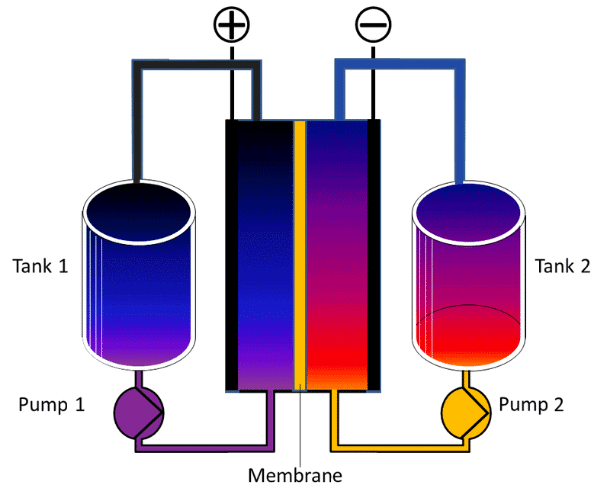
The flow battery also has several unique attributes set to revolutionise the utility sector.
- It uses chemicals dissolved in water while lithium ion batteries are solid.
- It lasts six to 10 hours while lithium ion batteries last two to four hours.
- It avoids the rapid degradation issues of lithium ion batteries.
- It uses inexpensive, non-toxic materials, unlike other flow batteries on the market.
In technical terms, the new battery uses proprietary electrolyte chemistry combining low-cost earth metals with other affordable chemicals.
Meanwhile, the current generation of flow batteries relies on costly, highly toxic materials like vanadium and zinc bromide.
This subsquently provides a clean, long-lasting solution to the challenges faced by utilities. Major industries will be able to harness wind and solar energy then access them whenever they choose.
Lockheed Martin enters large-scale battery storage race
Lockheed Martin Corp is now competing with Tesla, Fluence and LG Chem Ltd in the utility-scale market for solar power and solar battery storage.
Tesla has already proved the effectiveness of its ‘big battery’ in South Australia. Meanwhile, Tesla and Fluence are each constructing large-scale storage batteries in regional Victoria.
Researchers from Harvard University also developed their own cheap, non-toxic flow battery in 2017. They claimed the highest storage retention rates ever reported.
Lithium ion batteries cannot survive 1,000 complete charge/discharge cycles. Using energy storage, the Harvard prototype could subsequently withstand more than a decade of equivalent cycles.