


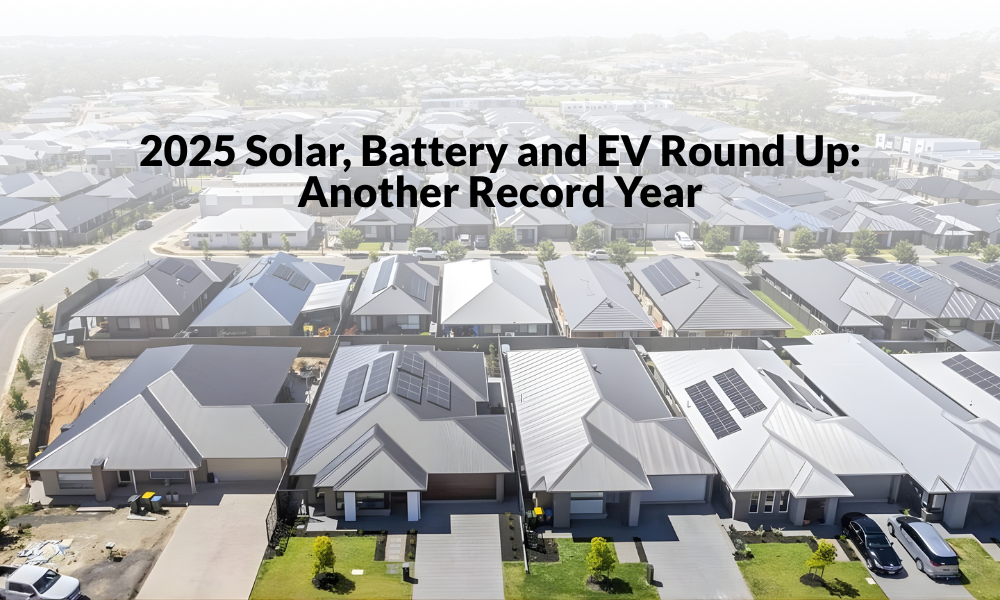
Australia’s clean energy story in 2025 had one clear theme: households kept leading the charge. Rooftop solar remained strong, batteries proliferated, and electrification extended beyond the switchboard. That mix matters because every new panel, battery, EV, and heat pump chips away at fossil fuel demand.
The numbers also show a market maturing. Solar installations eased from 2024 highs, but system sizes grew, and batteries shifted from “nice-to-have” to “no-brainer”.
The national snapshot for 2025
By late 2025, Australia had more than 4.26 million small-scale solar PV systems installed under the national scheme. Combined, they total about 27.8 GW of rated output. That is an extraordinary amount of generation sitting quietly on Aussie roofs.¹
For 2025 installations alone, the Clean Energy Regulator recorded 221,713 new small-scale solar PV systems.¹ That count continues to rise due to the certificate creation window. This figure is from the postcode installation dataset, current to 30 November 2025. That dataset counts STC applications that have been formally lodged and validated.
Batteries delivered the real fireworks. From 1 July 2025, home batteries became eligible under the Small-scale Renewable Energy Scheme thanks to the Cheaper Home Batteries Program. By 30 November 2025, 125,447 solar battery systems had approved applications.¹
The Clean Energy Council also reported 85,000 battery sales in the first half of 2025. That was a 191% increase on the same period a year earlier. Cumulative battery sales exceeded 271,000 units by mid-2025.²
Rooftop solar in 2025: slightly softer, but still massive
Rooftop solar did not slow down because Australians fell out of love with it. It softened because attention, installer capacity, and marketing shifted hard towards batteries.
The Clean Energy Regulator’s market analysis reported about 229,000 small-scale solar systems installed in 2025 up to 14 November. That delivered about 2.3 GW of capacity, and it ran below 2024 levels.³ The 229,000 systems figure comes from the market and quarterly reporting, which uses provisional installation estimates up to 14 November 2025. It includes systems installed but not yet fully processed through the STC creation pipeline.
At the same time, the Clean Energy Council reported that New South Wales held the largest total installed rooftop solar capacity. It sat at about 7.5 GW, which is more than a quarter of the national rooftop capacity. Queensland remained the state with the most installations, at about 1.1 million systems.⁴
So yes, 2025 saw a mid-year wobble for new PV volume. The bigger story is that rooftop solar remains a national energy asset, and it keeps growing.
Home batteries in 2025: the main character energy
If 2025 had a headline act, it was storage.
The Clean Energy Regulator’s data shows 125,447 approved battery installations in 2025, noting that battery data only applies from 1 July.¹ That means the true 2025 installation count, including pending applications, likely sits higher. The regulator also reported more than 124,000 batteries installed by 14 November, when including pending and approved applications.³
The Clean Energy Council observed a sharp spike in battery attachments as July approached.² That matches what the market felt: everyone wanted in, before queues got silly.
This surge matters for net zero. Batteries lift self-consumption, reduce peak demand, and help soak up midday solar. They also make electrification easier, because homes can run more loads when solar output drops.
Grid and industry in 2025: renewables and big batteries set new marks
On the grid, renewables kept breaking records.
In Q1 2025, renewables supplied 43.0% of the National Electricity Market supply mix. That was up from 39.0% in Q1 2024. Total emissions fell, and emissions intensity hit new Q1 lows.⁵
In Q3 2025, the renewable share reached 42.7%, a new high for a September quarter.⁶ That kind of consistency shows the transition is no longer a “good weather” story.
Big batteries also scaled quickly. AEMO reported grid-scale battery discharge surged in Q2 2025. It attributed this to 3,116 MW and 6,415 MWh of new battery capacity since the end of Q2 2024.⁷
That is industry momentum, not just household enthusiasm.
EV uptake in 2025: transport electrification keeps rolling
EV adoption is no longer niche, but it is not uniform either.
The Electric Vehicle Council reported more than 72,000 EVs sold in the first half of 2025. That represented a 12.1% share of new car sales. It also reported a national fleet exceeding 410,000 EVs, plus a growing public fast-charging network.⁸
EV growth links directly to solar and batteries. Daytime charging and smart tariffs help flatten demand peaks. Managed well, EVs turn into grid support, not grid stress.
Heat pumps and solar hot water in 2025: Electrification’s quiet achievers
Hot water is a sleeper issue in home emissions. It is also one of the easiest wins.
The Clean Energy Regulator’s postcode data recorded 88,023 solar water heater and air source heat pump installations in 2025. Victoria dominated, with 48,410 installations.¹ That aligns with strong state policy support and gas replacement programs.
The regulator’s quarterly reporting also flagged softer heat pump volumes in 2025. It reported 24,000 air source heat pumps installed in Q3 2025, and year-to-date installations running below 2024.³
Even with that dip, the installed base remains enormous. The Clean Energy Regulator lists 768,472 air source heat pumps and 1,142,748 solar water heaters installed to date.¹
State and territory breakdown: 2025 installs at a glance
The table below uses Clean Energy Regulator postcode data, current as of 30 November 2025.¹ Battery figures only cover approved applications from 1 July 2025.¹
| State or territory | Solar PV installs in 2025 | Battery installs in 2025* | Solar hot water and heat pumps installs in 2025 |
| ACT | 3,519 | 2,374 | 1,760 |
| NSW | 61,878 | 43,788 | 11,169 |
| NT | 849 | 357 | 427 |
| QLD | 58,932 | 24,095 | 11,614 |
| SA | 19,144 | 16,488 | 3,461 |
| TAS | 4,414 | 1,467 | 1,196 |
| VIC | 47,239 | 21,953 | 48,410 |
| WA | 25,738 | 14,925 | 9,986 |
| Australia total | 221,713 | 125,447 | 88,023 |
* Battery installs reflect approved applications, and only apply from 1 July 2025.¹
What this means for Australia’s net-zero trajectory
This is what progress looks like in the real world. It is not one silver bullet. It is millions of smaller decisions stacking up.
The electricity sector remains the big lever. Australia’s emissions projections expect electricity emissions to decline by more than 60% between 2025 and 2030. The projection links the drop to renewable targets and policy settings.⁹
2025’s household trends support that trajectory. More rooftop solar lowers grid demand. More batteries reduce peaks and increase clean energy use. More EVs and heat pumps shift fossil demand into an increasingly renewable grid.
It is not mission accomplished. It is a mission well underway, with Australians doing a fair chunk of the heavy lifting.
Sources
- Clean Energy Regulator, Small-scale installation postcode data (data current at 30 November 2025).
- Clean Energy Council, Rooftop Solar and Storage Report January to June 2025 (battery sales and cumulative figures).
- Clean Energy Regulator, Quarterly carbon market report September quarter 2025: Small-scale Renewable Energy Scheme (2025 PV and battery program insights, and heat pump commentary).
- Clean Energy Council, Rooftop Solar and Storage Report January to June 2025 (state rooftop capacity notes).
- AEMO, Quarterly Energy Dynamics Q1 2025 (renewables share and emissions outcomes).
- AEMO, Quarterly Energy Dynamics Q3 2025 (renewables share in Q3).
- AEMO, media release, June quarter brings continued renewable growth amid peak winter demand (new battery capacity since Q2 2024).
- Electric Vehicle Council, homepage summary of State of EVs 2025 (H1 2025 sales share, fleet size, charger network).
- DCCEEW, Australia’s emissions projections 2025 (electricity sector decline projection).