





An amazing image from NASA’s Mars Exploration Rover Opportunity shows a huge amount of dust coating the rover’s solar panels; making them appear to almost blend in with the surrounding landscape – and yet they continue to generate electricity.
If any example could show just how robust solar panels can be, Opportunity would be the poster child (robot).
The rover’s solar cells are hard to discern in the small image above; but even in this larger image, the layer of dust appears to be very thick across all the panels; practically obscuring some cells altogether.
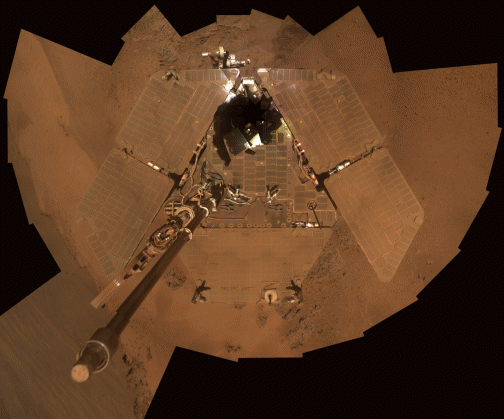
In addition to the threat to electricity generation posed by the dust, Mars is entering its winter when the sun hangs lower in the sky.
Dust and waning sunlight haven’t been the only challenge for Opportunity’s solar panels. The rover has recorded temperatures of up to around 35 degrees C during spring and summer and down to as low as minus 110 degrees C during winter. Temperatures over a single day can differ by more than 100 degrees Celsius.
While mean wind speeds on the planet are only around 4 – 15 km/h, dust storms and dust devils can whip things up to around 110 km/h.
As of a week ago, daily electricity production of Opportunity’s solar array was approximately 274 watt-hours according to NASA, compared to about 900 watt-hours at the start of its mission over 7 years ago; a mission only meant to last several months.
With nary a feather duster or squeegee (or anyone to use either) in sight, Opportunity’s fate now lays in the hands of Mars’ unpredictable winds that could blow the dust off the arrays – or perhaps add even more.
Opportunity is settled in for a harsh Mars winter at the northern end of “Cape York” on the rim of Endeavour Crater. The rover has been angled for favourable solar electricity production to keep Opportunity’s batteries charged and to power the heating systems that will prevent its components from freezing. While stationary for the next few months, it will continue to carry out experiments when possible.
Opportunity’s twin, Spirit, fell silent on March 22, 2010. NASA abandoned recovery efforts on May 25, 2011 after over a thousand commands to the rover were issued without response.
Previous coverage:
Mars Solar Rover Settled In For The Winter
Mars Rover Spirit Still Not Responding
Mars Rover Sets Record
Rover Solar Panels Battle On
Spirit Mired In Mars Muck